


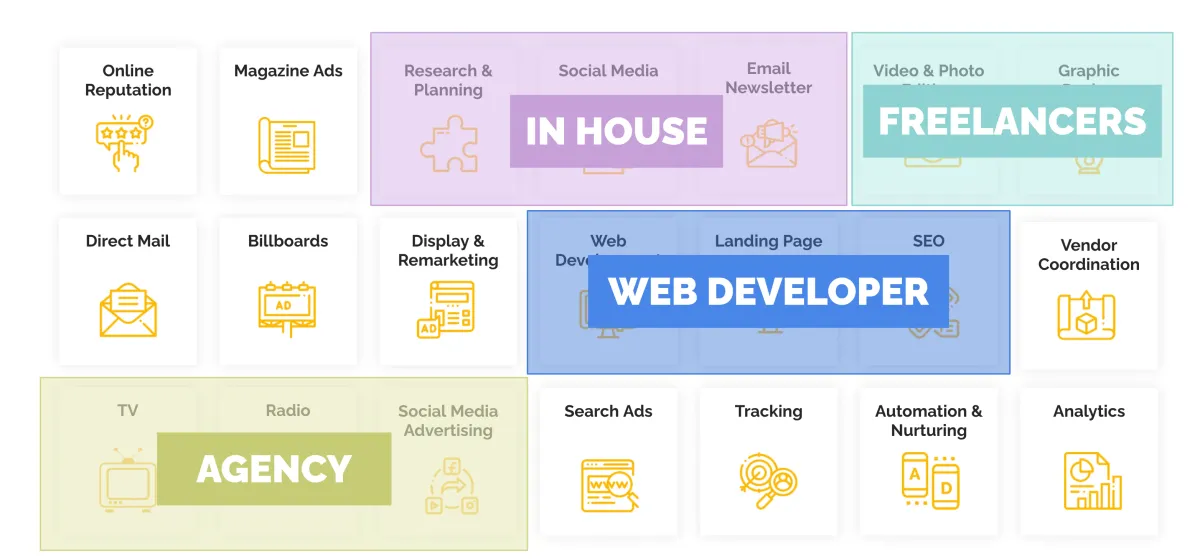
Your marketing department in 2026 probably looks something like this: multiple agencies handling paid media, a handful of freelancers producing creative assets, an in-house team scrambling to keep daily operations running, and a growing pile of SaaS subscriptions nobody fully understands. Each group works in its own silo, and the result is inconsistent messaging, duplicated effort, and missed opportunities.
This fragmentation isn’t just inefficient — it’s becoming unsustainable. According to HubSpot, 88% of marketers say their companies have experienced more change in the past three years than in the previous decade. Between the rise of AI-powered tools, shifting platform algorithms, and entirely new channels, the pace of change shows no sign of slowing down.
The Modern Marketing Challenge
Channel Proliferation
New marketing channels appear faster than most teams can evaluate them. TikTok evolved from a teen dance app into a full-blown commerce platform. Threads and Bluesky carved out their own audiences. Short-form video dominates attention, while AI-driven search is rewriting the rules of discoverability. Each new channel is both an opportunity and a resource drain — and maintaining expertise across all of them is nearly impossible for a single team.
Technical Complexity
The modern marketing stack is no joke. CRM platforms, automation workflows, analytics suites, AI content tools, programmatic ad platforms, CDP systems — each comes with its own learning curve and best practices. Most businesses either overpay for tools they underuse or miss critical opportunities because nobody on the team has the technical depth to unlock them.
The Cost of Traditional Approaches
Companies typically find themselves stuck in one of these situations:
- Overpaying for multiple specialized agencies while still missing emerging channels
- Struggling with costly in-house teams that can’t keep pace with change
- Risking quality with unreliable freelancers who lack platform-specific expertise
- Searching for the elusive “jack of all trades” who claims mastery of everything but excels at nothing
Nearly 80% of marketers feel the industry has changed more in the last three years than in the previous fifty. That’s not an exaggeration — it’s the reality brands are navigating right now.
So how do you cut through the noise and actually stand out? Marketing-as-a-Service (MaaS) offers a way forward. Let’s explore whether it’s the right fit for you.
Enter Marketing-as-a-Service (MaaS): A New Model for Modern Marketing
Marketing-as-a-Service represents a fundamental shift in how businesses access marketing expertise. Instead of stitching together agencies, freelancers, and internal hires, MaaS unifies four traditionally siloed elements — a network of 150+ marketing specialists, customized strategy, enterprise-level analytics, and centralized brand management — into a single, integrated marketing ecosystem.
How Marketing-as-a-Service Works
Unlike traditional models that rely on fragmented teams and disconnected processes, MaaS operates on a unified, subscription-based framework that eliminates common friction points. Here’s how it breaks down:
The Marketing Operating System
At the core of MaaS is a platform that functions as your marketing operating system. This isn’t just project management software — it’s a comprehensive ecosystem where every specialist, regardless of location or discipline, stays synchronized with your brand’s vision and objectives.
When a graphic designer creates a social media post, they’re not just working from a basic brand guide. They’re plugged into your entire marketing ecosystem, with the ability to:
- Access real-time performance data from similar past campaigns
- See exactly how their work fits into the broader strategy
- Maintain perfect alignment with brand standards
- Collaborate seamlessly with other specialists across disciplines
This level of integration enables:
- Turnaround times as fast as 12 hours
- Delivery of 100+ different marketing services
- Consistent quality across every touchpoint
- Data-driven decision making at every level
Team Structure and Expertise
Instead of a single account manager gatekeeping access, you get direct access to an entire network of specialists:
- Design — print, digital, UI/UX, branding
- Content — writers, videographers, animators, photographers
- Technical — developers, SEO specialists, analytics engineers
- Strategy — campaign managers, market researchers, media planners
Engagement Model
The service operates on a flat monthly rate, removing traditional barriers:
- No project-based billing or scope creep
- Fast turnaround on both small updates and large-scale campaigns
- Flexibility to shift priorities as business needs change
- Scale resources up or down based on demand
Quality Control and Performance
Consistent quality is maintained through:
- Automated workflow management
- Built-in review and approval processes
- Real-time performance analytics
- Continuous optimization based on live data
This integrated approach transforms what would typically be a fragmented patchwork of marketing vendors into a seamlessly coordinated, on-demand marketing department. While traditional agencies struggle with siloed teams and disconnected processes, MaaS ensures every deliverable is coordinated, consistent, and data-driven.
How Can MaaS Benefit You?
MaaS addresses a wide range of pain points for CMOs, marketing directors, and managers. Whether the challenge is operational bottleneck, strategic misalignment, or talent gaps, the model is designed to eliminate friction and let your team focus on what matters most.
Strategic Alignment and Market Insights
Marketing strategy will impact every piece of your business, and it should be tied to every piece of your business.
— Brandon Andersen , Chief Digital Officer and Board Member, 919 Marketing
Keeping marketing plans tightly aligned with business objectives — while tracking industry trends and competitive moves — is one of the hardest parts of a CMO’s job. MaaS provides the strategic backbone: data-driven planning, ongoing market research, and competitor analysis that keeps you ahead of the curve.
Technology Integration
Managing a sprawling marketing tech stack doesn’t have to be a puzzle. MaaS simplifies the technology landscape through a suite of purpose-built tools that automate workflows, centralize reporting, and keep every team member on the same page — from creative production to campaign performance.
Global Campaign Management
The most often missing ingredient in a sales message is storytelling. Good storytelling is a vital component of a marketing campaign.
— Gary Halbert , Author
Running campaigns smoothly across markets — especially at scale — introduces serious coordination challenges. MaaS handles content creation, social media management, and email marketing while ensuring brand consistency across every region and channel.
Lead Generation
Generating high-quality leads consistently is one of marketing’s toughest problems. MaaS specialists build and optimize lead generation strategies across multiple campaigns and channels, then track the entire lead journey to continuously improve conversion rates.
Content Production and Distribution
It’s not the best content that wins. It’s the best-promoted content that wins.
— Andy Crestodina , Co-founder and Strategic Director, Orbit Media Studios
High-quality content — blog posts, videos, infographics, photography — takes time and specialized talent. MaaS teams produce it at scale while optimizing distribution to ensure it reaches the right audience through the right channels.
Multichannel Coordination
Orchestrating marketing across a dozen-plus channels is complex, but MaaS streamlines it. Campaigns stay coordinated, messaging stays consistent, and your audience gets a unified brand experience no matter where they encounter you.
Data Management
Marketing leaders are drowning in data but starving for insight. MaaS brings powerful analytics and reporting tools that turn raw data into clear, actionable intelligence — making it easy to see what’s working, what’s not, and where to invest next.
Resource Management
Budget constraints are a reality for every marketing team. MaaS offers a flexible resource model: scale your team up or down as projects demand, without the overhead of hiring, training, or managing additional headcount. You get the expertise you need, precisely when you need it.
Agility and Flexibility
The marketing landscape shifts constantly. MaaS providers stay current with the latest tools, platforms, and trends, then implement strategies quickly — without the lead time of hiring specialists or ramping up internal capabilities. When a new channel or technology emerges, your team is already equipped to move on it.
MaaS vs Agencies
Traditional marketing agencies have long been the default choice for outsourced marketing. But the MaaS model represents a meaningful evolution in how marketing services are delivered:
| Aspect | MaaS | Traditional Agency |
|---|---|---|
| Cost Structure | Predictable monthly subscription, no hidden fees | Variable project-based billing, often with surprise costs |
| Speed & Flexibility | Turnaround as fast as 12 hours, on-demand services | Longer lead times, formal project scoping required |
| Team Access | Direct access to entire specialist network | Limited to account manager and assigned team |
| Scalability | Instantly scale up or down | Fixed team size, new resources require new contracts |
| Technology | Unified platform for all marketing activities | Disconnected tools and systems |
| Transparency | Real-time access to progress, hours, and results | Periodic reports and scheduled updates |
| Contract Terms | Month-to-month flexibility | Long-term contracts typically required |
| Service Range | 100+ integrated services available on-demand | Limited to agency’s core specialties |
Key Differentiators:
- Operational Model — MaaS functions as an integrated extension of your team with direct specialist access. Agencies operate as external vendors with formal communication layers.
- Resource Allocation — MaaS provides flexible access to the full specialist network. Agencies assign fixed teams with limited flexibility.
- Technology Integration — MaaS uses a single unified platform. Agencies rely on multiple disconnected systems.
- Cost Efficiency — MaaS covers all services under one flat rate. Agencies charge separately for each service plus markup.
- Strategic Alignment — MaaS enables continuous collaboration and real-time optimization. Agencies default to periodic meetings and quarterly reviews.
The MaaS model solves many of the persistent pain points of agency relationships: slow turnarounds, lack of transparency, rigid structures, and unpredictable costs.
MaaS vs In-House Teams
Building an in-house marketing team offers direct control and deep brand knowledge, but it comes with significant limitations in today’s fast-moving landscape:
| Aspect | MaaS | In-House Team |
|---|---|---|
| Initial Investment | Low barrier, immediate start | High (recruitment, training, tools, benefits) |
| Expertise Range | 150+ specialists across all disciplines | Limited by hiring budget and team size |
| Scalability | Instantly scale up or down | Slow scaling, requires hiring/firing cycles |
| Technology | All-in-one platform included | Requires purchasing multiple tool licenses |
| Cost Structure | Single monthly subscription | Full employee costs (salary, benefits, tools) |
| Training & Updates | Continuously updated expertise | Ongoing training costs and time investment |
| Availability | Around-the-clock access, no PTO gaps | Limited by working hours and time off |
| Risk | Month-to-month, no long-term lock-in | High (turnover, training, benefits overhead) |
| Response Time | As fast as 12 hours | Dependent on team workload and capacity |
Hidden Costs of In-House Teams:
- Recruitment and onboarding expenses
- Employee benefits and payroll taxes
- Training and professional development
- Marketing technology stack licenses
- Management overhead
- Office space and equipment
- Coverage for vacation, sick time, and turnover
While in-house teams bring the advantage of deep brand knowledge and direct control, they often struggle to maintain the breadth of expertise needed across today’s marketing landscape. MaaS can either replace or complement an internal team — delivering broader expertise without the overhead.
MaaS vs Freelancers
Freelancers offer flexibility and cost advantages for specific projects, but they introduce real challenges around coordination and consistency:
| Aspect | MaaS | Freelancers |
|---|---|---|
| Quality Control | Vetted experts, consistent standards | Variable quality, inconsistent results |
| Project Management | Unified platform, single point of contact | Manual coordination across individuals |
| Availability | Guaranteed coverage, built-in redundancy | Individual availability, potential delays |
| Brand Consistency | Centralized brand management | Requires constant oversight |
| Reliability | Backed by company infrastructure | Dependent on individual commitments |
| Knowledge Management | Documented processes and institutional memory | Knowledge lost with turnover |
| Scalability | Instant access to additional resources | Need to find and vet new freelancers |
| Integration | Seamless cross-discipline collaboration | Siloed work, minimal coordination |
| Cost Structure | Predictable monthly subscription | Variable rates, individual negotiations |
Hidden Costs of Freelance Management:
- Time spent finding, vetting, and onboarding freelancers
- Project coordination overhead across multiple people
- Quality control and revision cycles
- Brand consistency maintenance
- Knowledge transfer when freelancers leave
- Multiple tool subscriptions and access management
- Contract and payment administration
The key advantage of MaaS over freelancers is eliminating the “management tax” — the time and effort required to coordinate multiple independent contractors while maintaining quality and brand consistency. Instead, you get a cohesive team that operates as a unit.
Why MaaS is the Future of Marketing
As we move through 2026, the case for Marketing-as-a-Service keeps getting stronger. The marketing landscape is only becoming more complex — more channels, more tools, more data, more competition for attention. Traditional approaches weren’t designed for this pace of change.
When you compare MaaS to the alternatives, the advantages are clear:
- In-house teams offer control but struggle to scale
- Agencies bring expertise but at premium costs with limited flexibility
- Freelancers are affordable but lack reliability and integration
- MaaS combines the strengths of all three while eliminating their weaknesses
The result is a marketing solution that delivers:
- Deep expertise across every channel and discipline
- Fast, flexible, and agile execution
- Complete transparency and accountability
- Vetted specialists working as a fully integrated team
- Scalability without compromise
- All-in-one platform accessibility
- No long-term contracts required
- Cost-effective pricing that beats hiring a single full-time employee
But the most important advantage is this: MaaS solves the fundamental challenge of modern marketing — the need to stay ahead in a rapidly evolving landscape while maintaining efficiency and controlling costs. As marketing grows more complex and specialized, accessing a full range of expertise through a single, integrated platform isn’t just convenient — it’s a competitive necessity.
The question isn’t whether your business needs sophisticated marketing capabilities. It’s whether you’re ready to access them in a smarter way.
Ready to see what MaaS can do for your brand? Let’s talk.
Share this article