

Most home builders run on referrals plus whatever shows up in the email inbox. When the market is hot that works. When the market is not hot — like most of 2025 and 2026 so far — it stops working, and the only honest answer to “what’s our marketing plan?” is the website you haven’t updated since the last subdivision and the Instagram account a project manager runs when there’s time.
A real plan changes that. It defines who you’re selling to, picks the channels worth your spend, sets the budget and the CPL targets, and gives you a measurement habit tight enough to catch problems within a month instead of at year-end. The 2026 version of that plan looks different from the 2022 version. SEO is now delivering 400-450% ROI — the highest of any builder marketing channel. Meta Ads CPL for construction has climbed to around $45, up roughly 9% year over year. Google Search remains the single highest-intent channel but CPCs for builder keywords routinely run $15 to $80 each. And the buyers on the other end are doing 6 to 18 months of online research before they fill out a contact form.
This guide walks through the 2026 home builder marketing plan framework — what to include, the benchmarks that should set your spend, the channels and the personas that actually map to a builder pipeline, and how to measure it. At the end, you can download our comprehensive free PDF workbook to fill out for your own business.
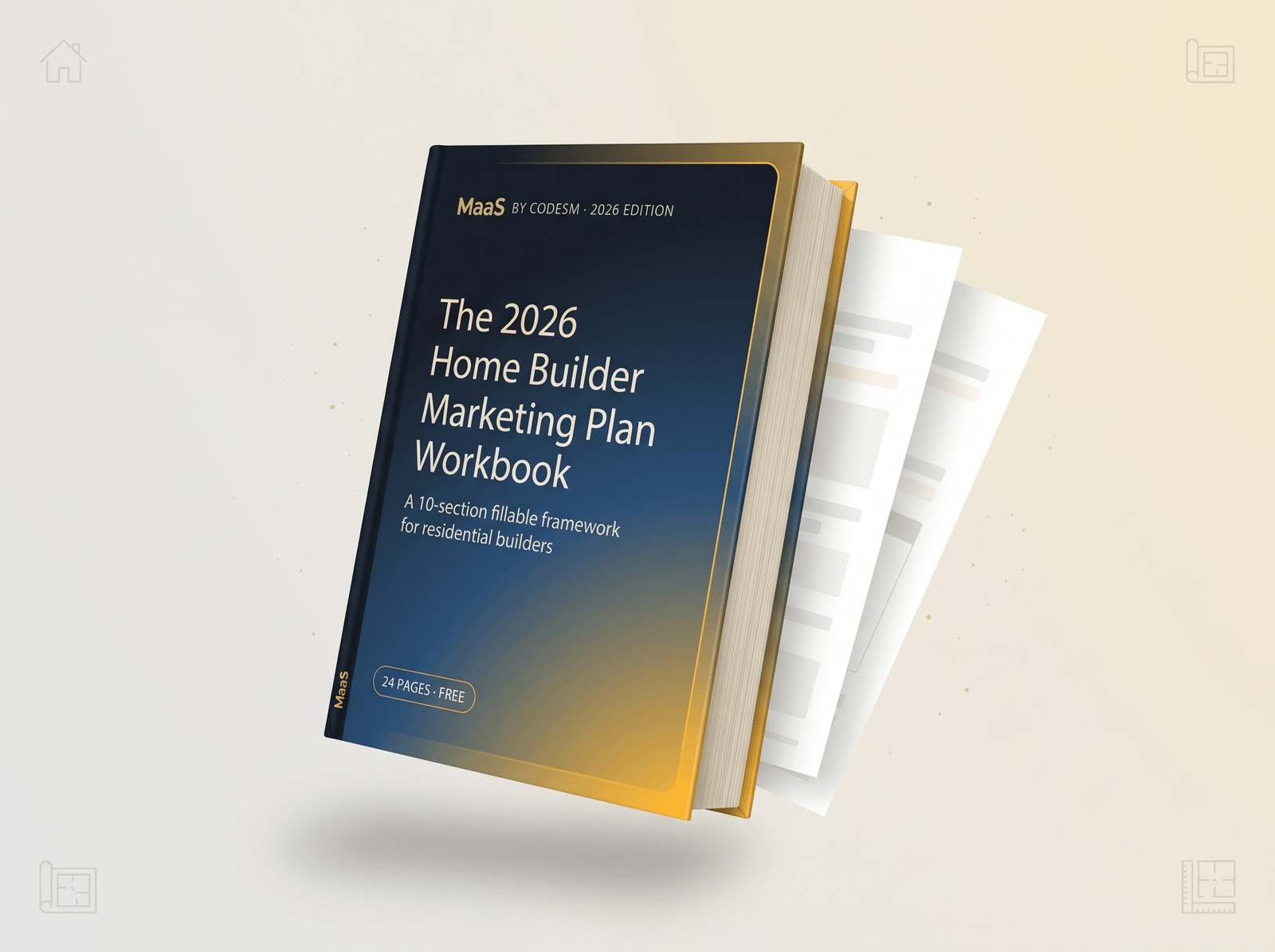
Click to download the free 2026 Home Builder Marketing Plan workbook (PDF, 24 pages)
Why most home builder marketing fails
The most common failure modes for builders are different from restaurants or service businesses. Three patterns dominate:
- Referral dependency. Most builders rely on word-of-mouth for 60-80% of their pipeline. That works when the local market is hot and breaks the moment it isn’t. There is no nurture system in place to convert the people who saw a sign in a yard six months ago.
- No content engine. Builders sit on the single most photogenic, social-friendly asset in any category — finished homes, builds in progress, design work, neighborhood spotlights — and most clinics post once a quarter when a project finishes.
- No measurement. Leads come from somewhere. Most builders cannot tell you which channel drove last quarter’s contracts because there’s no UTM discipline and no source tracking in the CRM.
A marketing plan fixes each of those by forcing the answers in writing, in advance, and then measuring against your own answers. Builders with a documented plan outperform peers by a wide margin — not because the plan is magic, but because it eliminates the 80% of expensive common mistakes.
The 2026 economics of home builder marketing
Before the framework, internalize these numbers:
Budget as a percentage of revenue:
- Established builders: 1.8–3.2% of annual revenue on marketing
- Smaller firms (<5 projects/year): typically $25,000–$45,000 per year
- Growth-stage and luxury custom builders: 3–5% is reasonable, sometimes higher when entering new markets
- 55–70% of total marketing spend should go to digital channels
- 15–25% is traditional (signage, mailers, events, sponsorships)
A builder doing $20M in revenue should be spending $360K–$640K per year — roughly $30K–$53K per month all-in. Most independents underspend that by half.
Channel ROI benchmarks for 2026:
| Channel | ROI / CPL benchmark |
|---|---|
| SEO (local + organic) | 400–450% ROI — the highest-margin long-term channel for builders |
| Google Ads (search) | CPL targets: $50–$300 depending on market; remodeling under $150 |
| Meta Ads | Construction CPL: ~$45 (up 9% YoY), strong for retargeting + remarketing |
| Houzz / Zillow / Realtor / Trulia / New Home Source | Massive organic traffic, but lead quality varies — Houzz leans tire-kicker |
| Email nurture | Highest LTV channel for long-cycle buyers (6–18 month research period) |
| YouTube | Increasingly important for premium custom builders (home tours, build-process video) |
| Direct mail | Still works for spec / production builders in target ZIP codes |
The clear strategic message: SEO is the single highest-leverage channel for residential builders, and the one most builders are most under-invested in. SEO compounds — every page you publish keeps earning leads for years — while Google and Meta Ads stop the moment you stop paying.
Traffic mix for a typical builder in 2026:
- Organic search: 45–55% (the channel SEO builds)
- Direct: 20–25% (brand searches, returning visitors)
- Paid: 12–18% (Google + Meta)
- Referral: 8–12% (Houzz, Zillow, partner sites)
- Social: 5–8% (Instagram, YouTube, increasingly TikTok for younger buyers)
The 10-section home builder marketing plan framework
The workbook PDF has fillable templates for each of these. Here’s what goes in each section.
1. Business snapshot
The one-page foundation: who you are, where you build, what you build, your typical price band, your build cycle length, and one sentence on what makes you different. The builders who can’t articulate the one-sentence differentiator are the ones whose websites all say “quality craftsmanship for over 25 years” — because they couldn’t either.
2. SWOT analysis
Honest internal audit. Strengths (what you do better than competitors — design, speed, transparency, warranty, price). Weaknesses (where you lose — price, timeline, communication, customization). Opportunities (gaps in the local market). Threats (new competition, material costs, interest rate sensitivity, neighborhood saturation).
3. Customer personas
For a residential builder, three personas usually cover the field:
- The Active Searcher — within 0–3 months of a buying decision, comparing 2–4 builders, ready to schedule site visits. Lowest CAC, highest urgency, but highest competition.
- The Researcher — 3–12 months out, gathering inspiration, building a vendor short-list. The persona where content marketing and SEO compound hardest.
- The Dreamer — 12+ months out, scrolling Houzz, saving Pinterest boards, following builders on Instagram. Long nurture target. Often becomes the next year’s pipeline.
For each persona, write: age range, household income, financing readiness, decision criteria, primary research channels (Google, Houzz, Zillow, social), what would move them to the next stage, and what content format would actually reach them.
4. Competitive analysis
Pick five direct competitors in your service area. For each: price band per square foot, dominant build type (spec, semi-custom, custom), Google rating + review volume, Houzz presence + portfolio size, Instagram engagement, dominant marketing message. Then write one sentence on where you can beat them. The goal isn’t to copy — it’s to find the gap.
5. Brand positioning statement
One sentence:
“For [target buyer], [your company] is the [category] that [differentiator] because [reason to believe].”
Example: “For move-up families looking to build their forever home, Highland Homes is the semi-custom builder that delivers turnkey luxury without the 18-month custom-build timeline because we manage the design + build in-house from one team.”
This sentence drives every word of marketing copy for the next year. If you can’t write it, you have a portfolio — not a position.
6. Marketing goals & KPIs
Three to five SMART goals. For builders, the useful KPIs are different from restaurants. Volume metrics matter, but lead quality and conversion-through-the-funnel matter more. Example goals:
- Generate 120 qualified leads (definition documented) by Q4 2026, up from 78 in 2025
- Hold marketing-sourced CPL under $250 average across channels
- Increase site-visit-to-contract conversion from 14% to 22%
- Grow email subscriber list from 1,400 to 4,000
- 1.0% month-over-month growth in organic search traffic
- Maintain 4.6+ average Google rating across all communities
Each goal gets an owner and a weekly check-in. Plans without weekly accountability are decoration.
7. Customer journey map
The buyer journey for a $400K to $5M home is long. Map it:
- Awareness — Instagram Reel of a finished build, Google search “[city] custom home builders”, Houzz portfolio scroll, drive-by sign.
- Consideration — Website visit, gallery browse, model home or showroom visit, Google review skim.
- Research — Multi-week or multi-month phase. They download your floor plan brochure, watch a YouTube walk-through, read 2-3 of your blog posts, scroll three years of Instagram.
- First contact — Form submission, phone call, walk-in. The KPI here is response time (under 30 minutes wins disproportionately).
- Site visit / sales consultation — In person at a model home or office.
- Proposal + design phase — Plans, allowances, pricing.
- Contract — The conversion event.
- Build phase — 6–18 months. Marketing’s job here is to make every touchpoint share-worthy.
- Handoff + warranty — The most under-leveraged moment in the entire builder marketing funnel.
- Advocacy — Reviews, referrals, social shares, repeat business.
Each stage gets a channel and a touchpoint. Most builders are missing stages 3, 8, and 9 entirely — the longest, most expensive gaps in the funnel.
8. Channel strategy
The 2026 channel mix for a residential builder:
| Channel | What it does | Cadence | Investment |
|---|---|---|---|
| Local SEO + Google Business Profile | Top of Google Map Pack for “[city] custom home builders” | Weekly Posts + monthly photos | Free + 1 hr/week |
| Organic SEO (blog + portfolio pages) | Compounding long-cycle research traffic | 2–4 posts/month | $1,500–$5,000/mo |
| Google Ads | High-intent search capture | Always-on | $1,500–$8,000/mo |
| Meta Ads | Awareness + retargeting + lead-gen forms | Always-on | $1,000–$4,000/mo |
| Houzz | Credibility + portfolio destination | Weekly project uploads | $300–$1,200/mo |
| Zillow / Realtor / Trulia / NHS | Spec + inventory homes visibility | Per-property | Per-listing fees |
| Instagram + Reels | Discovery, design inspiration, BTS | 4–6 posts/week | Time |
| YouTube | Home tours, build process, long-form trust | 2 videos/month | Time + production |
| Email nurture | Long-cycle research-phase warm-up | Bi-weekly | $80–$300/mo tool |
| Direct mail | ZIP-targeted prospecting | Quarterly campaigns | $0.50–$1.20/piece |
| Events (parade of homes, open houses) | High-intent in-person | Seasonal | $5K–$50K per event |
Note: Instagram content is now indexed by Google for local search. A captioned Reel showing a finished build in your market with the location and build type can appear in Google results for the same query. We covered this in our Apple Business Connect post — the local search graph is converging.
9. Content strategy & social calendar
The 2026 mix for builders looks like this:
- 50–60% short-form video. Reels, TikToks, Shorts — 15–60 seconds. Home tours, time-lapses, before/after.
- 20–25% carousels. Multi-slide design breakdowns, “the build in 10 photos,” neighborhood spotlights.
- 15–20% long-form. YouTube tours, build process videos, design Q&A.
- 5–10% single image / culture. Team, suppliers, partners, awards.
Cadence: 4–6 social posts per week minimum, plus 2 long-form videos per month for premium builders. The content categories to rotate:
- Finished home tours — interior walk-throughs, hero shots, drone exterior
- Build in progress — time-lapses, framing, milestones
- Design trends — what’s working in 2026 (open kitchens, dual primary suites, indoor-outdoor flow)
- Behind the scenes — supplier visits, team Day-in-the-Life, jobsite mornings
- Process explainers — “how we plan a custom build in 9 steps”
- Neighborhood spotlights — schools, amenities, drive routes
- Client stories — testimonials, the comeback moment when keys are handed over
- Before / after / during — renovations, lot transformations, demolition-to-move-in
10. Budget allocation + measurement
A typical $20K/month digital budget for an established builder looks like:
- SEO retainer + content production: $4,500
- Google Ads: $5,000
- Meta Ads (lead-gen + retargeting): $2,500
- Houzz Pro subscription: $600
- Zillow / Realtor / NHS placement: $1,800
- Email + CRM tool: $400
- Photography + video production: $2,500
- Reputation management + review monitoring: $400
- Contingency / agile reallocation: $2,300
Measurement: every channel needs a tracked outcome. UTM parameters on every paid link, source tracking in the CRM (Procore, Buildertrend, BuilderMT, HubSpot, JobNimbus), call tracking with dynamic numbers, GA4 with conversion events, monthly source-to-contract attribution report. The workbook PDF has a dashboard template.
Common mistakes to avoid
Six patterns explain most builder marketing failures:
- No lead nurture for the 6–18 month research-phase buyer. Send a 12-email educational drip series. Builders that do this convert 2–3× more of their cold leads.
- Underinvesting in SEO. It’s the highest ROI channel for residential builders. Most builders treat it like a one-time website launch.
- Houzz only / Houzz everything. Houzz is one channel and the leads skew price-shopper. Use it for credibility, not for primary lead-gen.
- No response-time discipline. Calls answered in under 5 minutes convert at 7× the rate of calls answered in 30 minutes. Most builders take 4+ hours.
- No source tracking in the CRM. If you can’t attribute closed contracts back to channel, you can’t optimize budget. Add a “lead source” required field.
- No video. YouTube is a discovery engine for premium custom builders, and most builders publish zero. The first builder in a market to take video seriously gets a 12-24 month moat.
Where to start if you’re starting from scratch
Don’t try to do all ten sections in one weekend. Run this order:
- Week 1. Sections 1, 3, 5: business snapshot + personas + positioning. Two hours.
- Week 2. Claim + optimize Google Business Profile + Apple Business Connect. Upload 20 fresh photos. Start asking happy clients for Google reviews. Four hours.
- Week 3. Audit your website for SEO basics — title tags, meta descriptions, location pages, portfolio structure. Identify three priority keyword targets per local market. Six hours.
- Week 4. Stand up email + CRM. Build the 12-email nurture series for research-phase leads. Six hours.
- Month 2. Launch Google Ads on branded + high-intent local terms. Start one Meta retargeting campaign for past site visitors. Begin a weekly content cadence on Instagram and YouTube.
- Month 3. Layer in source tracking and measurement. Build the weekly dashboard. Audit Houzz, Zillow, and Realtor placements.
- Quarter 2. Add SEO retainer with a content roadmap. Plan the next six pieces of cornerstone content. Begin direct-mail and event programming.
- Year 1. Annual review. Adjust the plan based on attribution data.
Download the full template
The workbook PDF is a 24-page fillable companion to this guide. Inside:
- Cover sheet and how-to-use page
- Business snapshot worksheet
- SWOT analysis matrix
- Three buyer persona templates (Active Searcher / Researcher / Dreamer)
- Competitor analysis matrix (5 competitors)
- Brand positioning canvas
- Goals + KPI tracker (with weekly check-in)
- Customer journey map (10 stages)
- Channel strategy matrix
- 30-day content calendar template
- Budget allocation worksheet (template + example)
- 12-month action plan
- Measurement dashboard template
- Closing checklist + how to get help
Download the 2026 Home Builder Marketing Plan workbook (PDF)
If you’d rather have a team run this for you — claim the listings, build the email nurture engine, produce the home tours, run the ads, and report on it weekly — that is exactly what the home builder marketing team at MaaS by CodeSM does for builders every day. Get in touch and we’ll audit where you are and map the plan.
Share this article