
Most restaurants don’t have a marketing plan. They have a Facebook page somebody updates when there’s time, a $300 monthly boost on a “happy hour” post, an Instagram account that occasionally gets a phone photo of a special, and a hope that Friday will be busy. When Friday isn’t busy, nobody can answer the question “why?” because there was no plan to deviate from in the first place.
A real marketing plan changes that. It sets your goals, picks your channels, allocates your budget, and tells you (within a few weeks of execution) what is working and what isn’t. The 2026 version of that plan looks different from the 2022 version. Instagram content is now indexed by Google for local search. Reels and TikTok have become the single largest discovery channel for new restaurants. Email marketing is still returning $36-42 for every $1 spent. Apple Maps Ads launch this summer. And the operators who win in 2026 are the ones running a plan tight enough to redirect spend within a month, not at year-end.
This guide walks through the full 2026 restaurant marketing plan framework: what to include, the budget benchmarks that should set your spend, the channels that actually work right now, and how to measure performance so you can adjust. At the end, you can download our comprehensive free PDF workbook to fill out for your own restaurant.
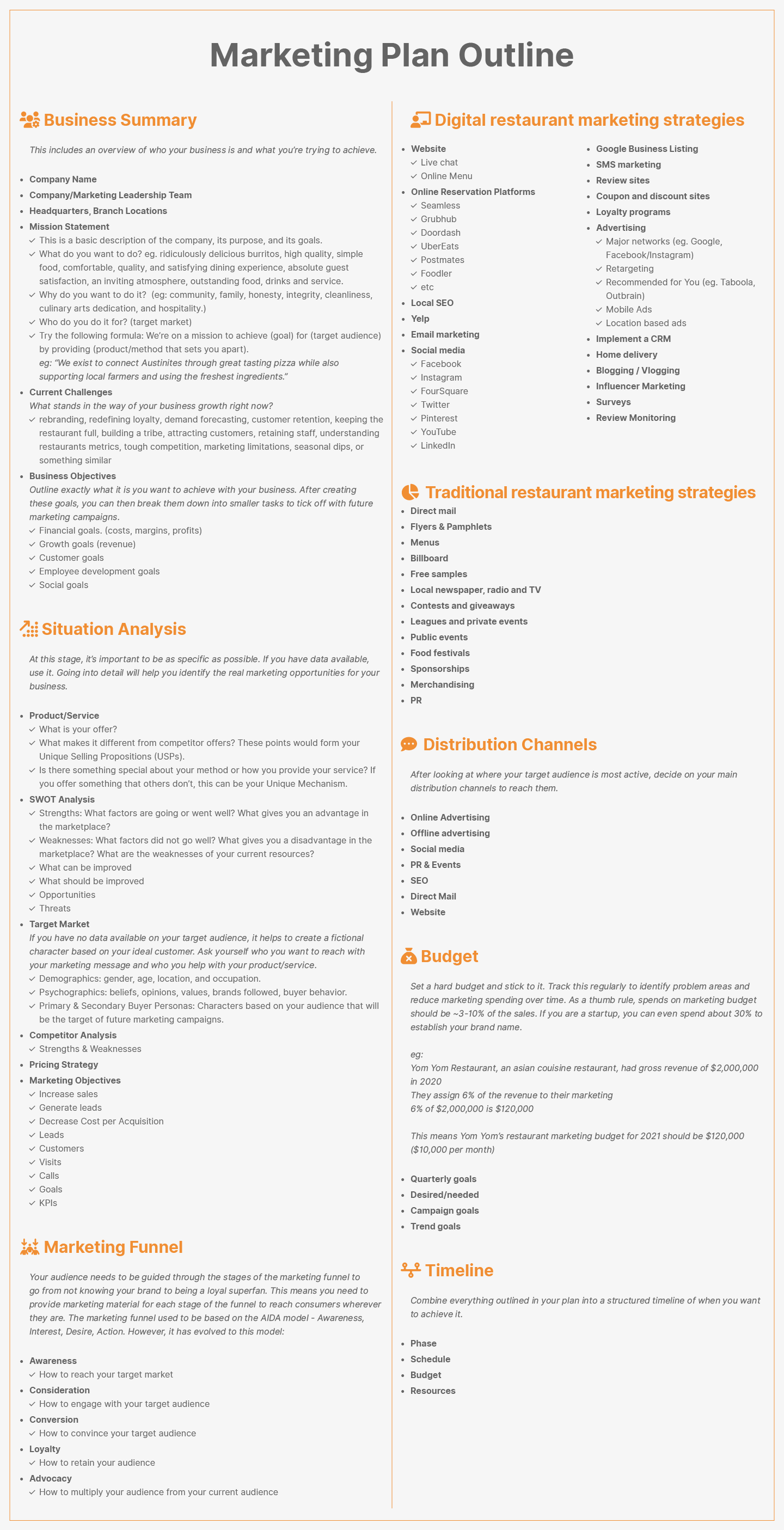
Click to download the free 2026 Restaurant Marketing Plan workbook (PDF, 24 pages)
Why most restaurant marketing fails (and what a plan actually fixes)
The most common failure mode is not too little marketing. It’s marketing without a strategy underneath it. The symptoms:
- Channel hopping. The owner read an article about TikTok in January, switched to Instagram Reels in March, tried Google Ads in May, and is now wondering why nothing is working.
- Budget that floats. Some months it’s $200, some months it’s $2,000, depending on cash flow and mood.
- No defined target customer. “Anyone who eats” is not a target. The menu, the price point, the neighborhood, and the brand voice all imply someone — most operators have just never written down who.
- No measurement. New customers walked in this month — was that the Reel, the Google Business Profile update, the email, the new sign? Nobody knows.
- No retention layer. The marketing budget is 100% acquisition. The first-time guests who walked in last month don’t get followed up with, so they don’t come back.
A marketing plan fixes each of those by forcing you to answer the questions in writing, in advance, and then measure against your own answers. That is the whole job. Restaurants with a written marketing plan outperform restaurants without one by a wide margin — not because the plan is magic, but because the plan eliminates the most expensive 80% of common mistakes.
The 2026 economics of restaurant marketing
Before we get to the framework, internalize these numbers — they should set the expectations you bring to every other decision in this plan.
Budget as a percentage of revenue:
- Established restaurants: 3–6% of revenue on marketing
- Newer restaurants or those scaling fast: 7–10% (some sources recommend up to 12–20% in the first 12 months)
- 60–70% of that marketing budget should go to digital channels in 2026
So a $1.2M annual-revenue restaurant should be spending $36K–$72K per year on marketing, with $22K–$50K of that digital. That is roughly $3K–$6K per month — a number most independents are underspending by half.
Channel ROI benchmarks for 2026 (Owl Claw, Sender):
| Channel | ROI per $1 spent |
|---|---|
| Email marketing | $36–$42 |
| Micro-influencer partnerships (food vertical) | $5–$8 (500–800%) |
| Google Ads (search) | ~$2 |
| Paid social (Meta, TikTok) | ~$1.75 |
| Retention campaigns vs acquisition | 3.3× higher ROI |
The clear message: email and influencer aren’t optional. They are the highest-leverage channels in the restaurant marketing toolkit. Most independents under-invest in both because they look unglamorous next to paid social.
Traffic mix for a typical local restaurant in 2026:
- Organic search: 48% (heavily driven by Google Local Pack + Apple Maps)
- Direct: 25% (brand loyalty, returning customers, word of mouth)
- Social: 18% (Reels, TikTok, IG profile clicks — increasing)
- Paid: 6–9% (Google Ads, Meta Ads)
This mix means local SEO and email together account for more than 70% of where your guests come from. A marketing plan that under-weights either will under-perform regardless of how creative the social content is.
The 10-section restaurant marketing plan framework
A marketing plan that works for an independent restaurant has ten sections. The workbook PDF at the end has fillable templates for each.
1. Business snapshot
The one-page foundation: who you are, what you serve, where you are, when you opened, what makes you different in one sentence. The owners who can’t write the one-sentence differentiator are the ones whose marketing always sounds generic — because it is.
2. SWOT analysis
The honest internal audit. Strengths (what you do better than competitors), Weaknesses (where you lose to them), Opportunities (gaps in the local market you could capture), Threats (new competition, rising food costs, changing neighborhood dynamics). Most operators skip this because it requires admitting weaknesses. That’s exactly why it matters — every weakness is a marketing message you should not be using.
3. Customer personas
Three is the right number. More than three and you’ll dilute messaging. Less than three and you’ll miss meaningful segments. For most independents the three personas are:
- The regular — within 3 miles, comes 2–4 times a month, value-driven, loyalty-receptive.
- The occasion diner — comes for anniversaries, birthdays, date nights. Higher AOV, higher expectations, harder to acquire.
- The discovery guest — found you through Reels or a review, first time in, may or may not return. The persona where social and reviews matter most.
For each persona, write: age range, household income, primary social platform, what they order, what they pay, how they found you, what would bring them back.
4. Competitive analysis
Pick five direct competitors within 2 miles (or 5 miles if you’re in a less dense area). For each: cuisine + price band, dominant social platform, Yelp/Google rating + review volume, what their Instagram looks like, their dominant message. Then write one sentence on where you can beat them. The goal isn’t to copy. The goal is to find the gap.
5. Brand positioning statement
One sentence in this exact format: “For [target customer], [your restaurant] is the [category] that [differentiator] because [reason to believe].”
Example: “For neighborhood couples 35–55 looking for a weeknight date, La Lupa is the wood-fired Mexican spot that serves the best al pastor in the East Side because our taquero trained in Mexico City for fifteen years before opening here.”
This sentence will drive every word of marketing copy you write for the next year. If you can’t write it in one sentence, you don’t have a position yet — you have a menu.
6. Marketing goals & KPIs
Three to five SMART goals (Specific, Measurable, Achievable, Relevant, Time-bound). For example:
- Increase weekday covers (Mon–Thu) by 20% by Q4 2026
- Grow email list from 800 to 2,500 subscribers by year-end
- Reach 1.0% improvement in Google Business Profile direction-tap conversions per month
- Lift average check by $4 through targeted upsell campaigns
- Increase first-30-day return rate from 18% to 28%
Each goal needs an owner and a weekly check-in cadence. Plans without weekly accountability are decoration.
7. Customer journey map
Map how a guest goes from “never heard of you” to “regular.” The 2026 funnel for an independent restaurant typically looks like:
- Awareness — Reel discovery, Google search, friend mention, walk-by.
- Consideration — Profile click, Google Maps tap, Yelp scan, menu PDF open.
- First visit — Walk-in or reservation.
- First impression — Service, food, ambiance, plus a digital touchpoint (a QR code menu, a check-presenter card with the email-list QR).
- Re-engagement — Email or SMS within 7 days of the first visit.
- Return visit — The second visit is the most-predictive moment for lifetime value.
- Loyalty + advocacy — Reviews, social shares, friend invites.
Each stage gets a channel and a message. Most independents are missing stages 4–6 entirely, which is the most expensive gap in restaurant marketing.
8. Channel strategy
The 2026 channel mix for an independent restaurant:
| Channel | What it does | Cadence | Investment |
|---|---|---|---|
| Google Business Profile | Local Pack visibility, direction taps | Weekly Posts + monthly photos | Free + 30 min/week |
| Apple Business Connect | Apple Maps, Siri, CarPlay visibility | Monthly Showcases | Free + 20 min/month |
| Instagram (Reels + carousels) | Discovery + brand | 5–7 posts/week | Time + occasional boost |
| TikTok (food-specific) | Younger audience discovery | 3–5 posts/week | Time |
| Email + SMS | Retention, repeat visits | Weekly email + monthly SMS | $30–$120/mo tool |
| Google Ads | Branded + high-intent local search | Always-on | $500–$2,500/mo |
| Meta Ads | Reach, retargeting, event promos | Always-on retargeting + event bursts | $300–$1,500/mo |
| Influencer | Discovery + social proof | 1–2 collabs per quarter | $200–$1,500 per collab |
| Apple Maps Ads (Summer 2026+) | iOS top-of-result placement | 90-day pilots | $500–$1,500/mo when launched |
Note: Instagram content is now indexed by Google for local search. A Reel captioned “best brunch in Morristown” can show up in Google results for that exact query. We covered this in our Apple Business Connect post — the local search graph is converging, and what you post on social directly affects your search visibility.
9. Content & social calendar
The 2026 Instagram/TikTok mix for restaurants:
- 60–70% short-form video. Reels and TikToks, ideally 15–30 seconds, food-forward.
- 20–30% carousels. Higher engagement than Reels on Instagram. Use them for menu spotlights, behind-the-scenes recipe stories, and seasonal launches.
- ~10% single images or culture. Team, guests, neighborhood.
Cadence: 5–7 posts per week minimum to hit modern engagement benchmarks. The actual content categories to rotate:
- Food hero shots — close-up of the dish, slow pan or pour
- The make — chef plating, sauce drizzle, knife cuts, the ASMR-quality close-up
- The team — chef intro, server day-in-the-life, dishwasher feature
- Guest moments — birthday tables, anniversaries (with permission)
- Behind the scenes — purveyor visits, the produce delivery, the wine selection
- Local + neighborhood — your block, the market down the street, the events near you
- Off-menu reveals — chef specials, seasonal swaps
- Reviews + UGC — share guest content (with permission), screenshot a 5-star Yelp
The workbook PDF includes a 30-day content-calendar template prefilled with this rotation.
10. Budget allocation + measurement
A typical $5,000/month digital budget for an established independent looks like:
- Email + SMS platform: $80
- Google Ads (brand + high-intent local): $1,400
- Meta Ads (retargeting + event bursts): $700
- TikTok / IG paid boost: $400
- Influencer collabs (1 per month): $600
- Local SEO / listings tool (Yext, Birdeye, etc.): $300
- Photography / content production: $700
- Reputation management (review responses, monitoring): $300
- Contingency / agile reallocation: $520
The contingency line is critical. It’s the line that lets you double down on what is working in week 3 of a campaign instead of waiting for next month’s budget.
Measurement: every channel needs a tracked outcome. Direction taps from Google Business Profile, Action Link clicks from Apple Business Connect, email click-through rates, paid social ROAS, reservation source tracking in OpenTable or Resy. Pull these into a single weekly dashboard. The workbook PDF has a dashboard template.
Common mistakes to avoid
After auditing dozens of independent restaurant marketing efforts, the recurring failures cluster around six patterns:
- Treating email as optional. Email is the single highest-ROI channel for restaurants ($36–$42 per $1). If you have under 1,000 subscribers, that is the first thing to fix.
- Ignoring Google Business Profile + Apple Business Connect. Half your future traffic comes from these. Most independents claim them and never optimize them.
- Posting on social without a plan. Random food photos at 11pm three times a week is not a strategy. Pick a cadence and a content rotation.
- Boosting random posts. Don’t boost. Run a structured Meta or TikTok ad campaign with a tracked objective (reservations, list growth, retargeting).
- No retention layer. Spending 100% of the budget on acquisition is the most expensive way to grow a restaurant. Retention generates 3.3× the ROI.
- No measurement. If you can’t tell which channel drove last week’s covers, the plan isn’t operating — it’s decorative.
Where to start if you’re starting from scratch
Don’t try to do all ten sections in one weekend. The order that works:
- Week 1. Business snapshot + brand positioning statement + customer personas (sections 1, 3, 5). Two hours.
- Week 2. Claim and optimize Google Business Profile + Apple Business Connect. Get 10 fresh photos uploaded. Start asking happy guests for Google reviews. Four hours.
- Week 3. Set up email and SMS. Migrate any existing list. Send the first newsletter. Set up a review-request automation triggered 24 hours after the bill drops. Six hours.
- Week 4. Plan the content calendar for the next 30 days. Film three batches of Reels in one session. Schedule them out. Three hours.
- Month 2. Layer in Google Ads (branded search + local-intent terms). Start one Meta retargeting campaign for past visitors. Onboard one micro-influencer.
- Month 3. Layer in measurement. Build the weekly dashboard. Adjust budget allocation based on what is working.
- Quarter 2 and beyond. Goals + KPI tracking + competitive analysis on a quarterly review cadence.
The math: if you spent ten hours in month one on the foundation, eight hours per month on execution after that, and $2,500–$5,000 a month on digital, you would be ahead of 80% of the independent restaurants in your zip code by year-end.
Download the full template
The workbook PDF is a 24-page fillable companion to this guide. Inside:
- Cover sheet and how-to-use page
- Business snapshot worksheet
- SWOT analysis matrix
- Three customer persona templates
- Competitor analysis matrix (5 competitors)
- Brand positioning canvas
- Goals + KPI tracker (with weekly check-in template)
- Customer journey map
- Channel strategy matrix
- 30-day content calendar template
- Budget allocation worksheet (template + example)
- 12-month action plan
- Measurement dashboard template
- Closing checklist + how to get help
Download the 2026 Restaurant Marketing Plan workbook (PDF)
If you’d rather have a team run this for you — claim the listings, build the email engine, produce the content, run the ads, and report on it weekly — that is exactly what the restaurant marketing team at MaaS by CodeSM does for clients every day. Get in touch and we’ll audit where you are and map the plan.
Share this article