


Physical therapy social media in 2026 looks nothing like the playbook from three years ago. The algorithms have changed. The formats have changed. The way patients find a clinic has changed. Direct-access patients now bypass physician referrals entirely after seeing a single Reel that explained their pain better than their last doctor did.
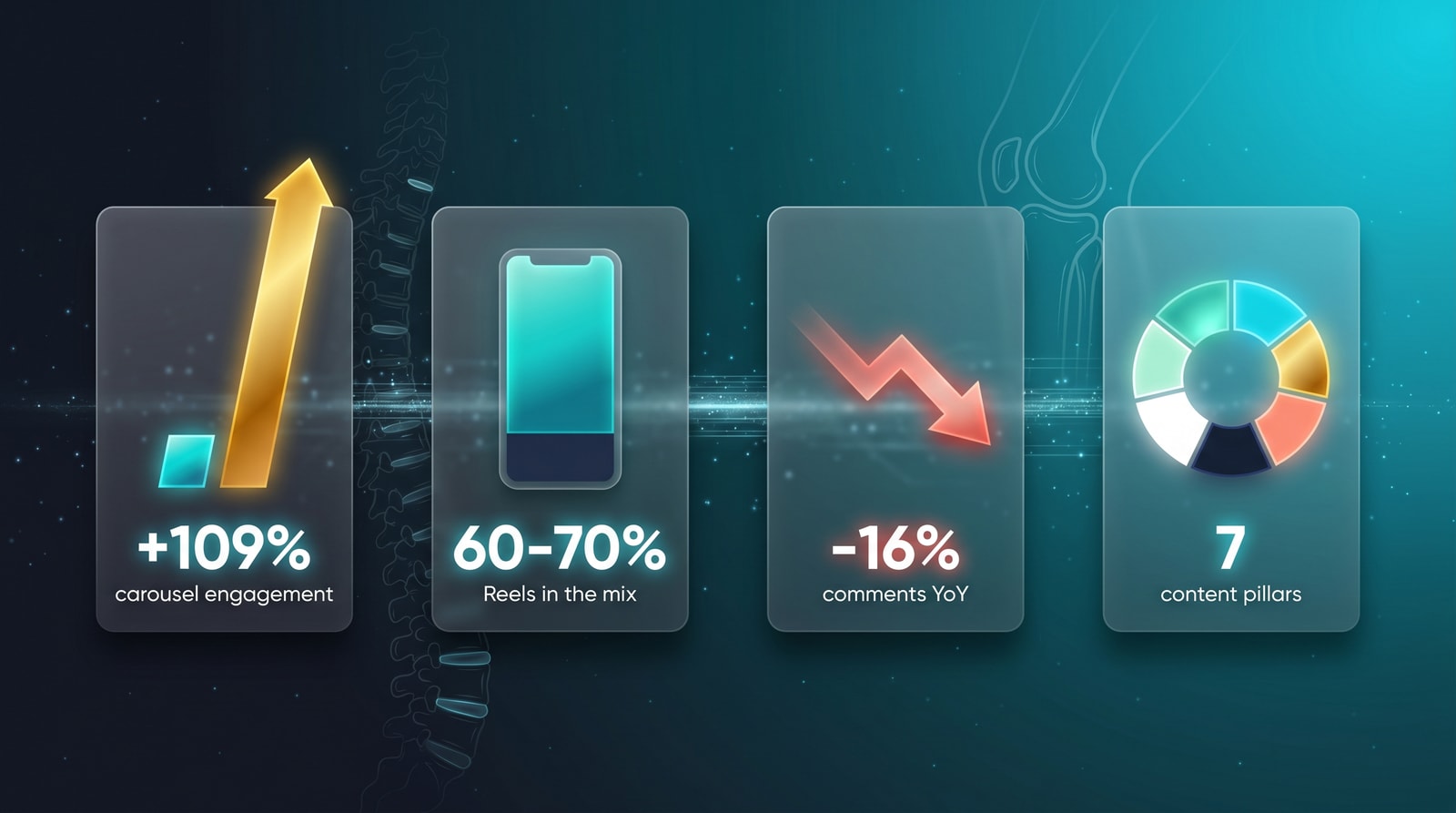
The opportunity is bigger than ever — and the bar is higher. Carousels now drive 109% more engagement than Reels on Instagram, according to Buffer’s analysis of more than 52 million posts. Comments per post are down 16% year over year as audiences shift toward passive engagement (saves and shares are up). And TikTok’s 2026 trend report calls out unpolished, authentic clinical content as the format the algorithm is actively favoring.
This is the practical guide to what to actually post. The 2026 format mix, 30 concrete post ideas organized into seven content pillars (with the format and hook that makes each one work), the captions and hashtags that move the needle for clinical content, and a posting cadence you can actually keep.
The 2026 Instagram & TikTok format mix for PT
Before you pick what to post, pick the right format for each goal. The 2026 mix that works for physical therapy practices:
- 60–70% short-form video (Reels and TikToks). Discovery still runs through watch time and shares. This is where you reach people who don’t already follow you.
- 20–30% carousels. Carousels are how you turn discovery into save-worthy authority. Buffer’s data shows carousels drive 109% more engagement than Reels on Instagram, specifically because they’re built for the new passive-engagement reality: people save them, then come back.
- ~10% single image or culture posts. Team photos, milestone announcements, behind-the-scenes still moments. These don’t build reach, but they humanize the brand.
A successful clinic posting weekly might publish 4 Reels, 2 carousels, and 1 single image. That’s 7 posts a week, which sounds like a lot until you realize most ideas in this guide can be filmed in five minutes between patients.
The seven content pillars for PT social media

Every post should fit into one of these seven buckets. Mix the buckets across your week so the feed doesn’t read like seven exercise videos in a row — the algorithm and your followers both reward variety.
- Misconception breakers — challenge a belief patients hold (Reels)
- At-home exercises & mobility — the bread and butter (Reels + carousels)
- Behind the scenes & humanization — show the people (Reels + single images)
- Patient stories & transformations — proof (Reels)
- Trust & clinical authority — research-backed credibility (carousels)
- Community & local presence — local SEO + relationships (mixed)
- Promotional & conversion — book appointments (carousels, used sparingly)
Now the 30 ideas, grouped by pillar.
Pillar 1: Misconception breakers
These are the highest-share Reels in PT. The hook is not the exercise. The hook is the wrong thing the viewer is probably already doing. Patients save these because the misconception applies to them right now.
1. “You’ve been stretching your hamstrings wrong” — 30-second Reel. Open with the wrong stretch on screen for 3 seconds. Cut to “Here’s why this is making it worse.” Show the fix. End with one save-prompting sentence.
2. “Why your knee hurts when you squat (it’s not the knee)” — 45-second Reel. Diagnostic walkthrough: hip mobility limit → knee compensation → pain. Lead with the symptom, not the joint.
3. “Three myths about back pain you still believe” — 60-second Reel or a 5-slide carousel. Each myth on its own beat. End with what to do instead.
4. “Why this ‘core’ exercise isn’t working for you” — 30-second Reel. Crunches are an easy target. Most patients are doing them. Save-bait.
5. “What your MRI doesn’t tell you about your pain” — 60-second Reel. The educational angle. Bulging disc on an MRI ≠ source of pain. Patients save this and send it to a friend.
Pillar 2: At-home exercises & mobility
These are evergreen, repeatable, and high-save. Carousels outperform Reels here when the user actually needs to remember the moves. Use Reels for the one killer move, carousels for the full routine.
6. “If you only have 5 minutes for [body part]” — 30-second Reel. One demo per move. Text overlay with the move name. End with a “save this” prompt.
7. The desk-worker mobility 4-move carousel — 5 slides. Slide 1 is the hook (“Sit for a living? Do these 4 moves daily”). Slides 2–5 are the moves. Use real anatomy callouts.
8. “Pre-run mobility you can do in 2 minutes” — 30-second Reel. Time it to running season — late January through April for spring marathons, August through October for fall ones.
9. The runner-knee carousel — 7 slides. Slide 1: “Runner’s knee fix in 7 days.” Slides 2–7: progressive mobility + strength routine. Saves over weeks.
10. “5 stretches to do before bed for back pain” — 6-slide carousel. Bedtime + back pain is one of the highest-volume Google searches in healthcare. Match the intent.
Pillar 3: Behind the scenes & humanization
The 2026 TikTok algorithm specifically rewards unpolished, real content. These posts won’t go viral, but they convert browsers into bookers because they make your clinic feel real and trustworthy.
11. “Day in the life of a PT” — 60–90 second Reel with text overlay. Caffeine, charting, treatment, lunch, evals. Cut fast. Match the trend audio of the moment.
12. The “meet the team” Reel — 60-second team intro. One clinician per cut. Name, specialty, one sentence on why they got into PT. Pin to the profile.
13. “What’s in my PT bag” — 60-second TikTok-native format. Tape, tools, snacks. The product-discovery format the platform loves.
14. The clinic walk-through — 30-second Reel filmed on a phone, no narration, soft background music. New patients watch this before booking to know what to expect.
15. “Pre-shift coffee + treatment plan review” — 30-second authenticity post. A clinician sketching a session on a notepad. Quiet vibes. No script. The “real, not staged” feel the algorithm rewards in 2026.
Pillar 4: Patient stories & transformations
The single highest-converting content type for a physical therapy practice. Get the consent paperwork right, then make this a monthly cadence.
16. The before-and-after range of motion Reel — 30 seconds. Film a new patient on day one (with consent). Film the same movement at discharge. Cut together with trending audio. Faces optional — the joint movement is the story.
17. “From [injury] to [milestone]” timeline Reel — 60-second journey. Week 0, week 4, week 8, week 12. Voiceover or text overlay narrates each stage. End at the comeback moment (first run, first dance recital, first deadlift).
18. The raw patient testimonial cut — 60-second Reel, no music, native captions, phone-camera quality. Sincerity beats production value. Pin it to your highlights.
19. The “this is why I do this” Reel — 30-second emotional moment. Patient hits a comeback milestone. PT in the background. No script. Tears optional but high-converting.
Pillar 5: Trust & clinical authority
Carousels dominate this pillar. The format gives you the depth that builds practitioner-level credibility — and the saves that signal quality to the algorithm.
20. The research-backed claim carousel — 7 slides. Slide 1: a strong claim (“Most rotator cuff tears don’t need surgery”). Slides 2–6: the evidence. Slide 7: the takeaway + a soft CTA.
21. “Here’s how we evaluate [condition]” — 5–7 slide carousel. Show your clinical reasoning. The audience sees the thinking, not just the conclusion. Build credibility by being transparent about process.
22. The continuing-education behind-the-scenes Reel — 30 seconds. Team in a course or conference. Books, slides, certificates. Signal that the practice invests in skill. Annual minimum, but powerful.
23. The certification / award announcement — single image or 2-slide carousel. Treat these as rare and evergreen. Doctor of PT degrees, McKenzie certification, dry-needling credentials, vestibular specialist credentials.
Pillar 6: Community & local presence
These posts drive local SEO signals and real-world relationships. They also fill the gap between “personal trainer on the internet” and “the PT you’d actually drive to.”
24. The local race or 5K partnership Reel — 60 seconds. Pre-race, on-site, post-race recovery tent. Runners are an enormous PT audience and the local-race ecosystem is built for partnership.
25. The local sports team / school feature — single image or short Reel. Team photo, athlete spotlight, season recap. Parents become patients.
26. “Best running routes in [your city]” carousel — 6 slides, one route per slide. Drives local-search saves, builds backlinks if a runner blog picks it up, signals to Apple Maps and Google that you’re embedded in the local fitness community. Pairs well with our post on local AI search.
Pillar 7: Promotional & conversion
The minority of your feed. Used sparingly — overdoing this pillar tanks both reach and trust. Aim for one promotional post for every six to eight value posts.
27. The “one new-patient slot this week” pattern-interrupt — single image or 15-second Reel. Real scarcity (not manufactured) is one of the most effective patterns in healthcare social media because it signals demand.
28. The insurance + direct-access carousel — 5 slides. Slide 1: “Did you know you don’t need a referral?” Slides 2–4: the rules in your state. Slide 5: how to book. Direct-access education converts.
29. The new-service announcement — 30-second Reel. Dry needling, blood flow restriction, vestibular therapy, pelvic health. Show one minute of the service in action. Pin to your profile when it’s the focus.
30. The “how to book online” walkthrough — 15-second screen-recording Reel. Boring on purpose. Removes the friction for the patient on the fence. Pin it.
Captions, hooks, and hashtags that actually work for PT
The post idea is half the work. Captions and hashtags are the other half.
Captions:
- Lead with a one-line hook that promises a payoff: “You’ve been doing this wrong” or “Here’s the part nobody tells you.”
- Keep the first line under 80 characters so it shows above the “more” fold on Instagram.
- Use line breaks. Wall-of-text captions die.
- Add a save prompt to value-heavy posts: “Save this for the next time your back acts up.”
- Add a comment prompt to community posts: “Tag your running buddy.”
- Use native auto-captions on every Reel — accessibility plus algorithm boost.
Hooks that consistently work for PT content:
- “You’ve been [X] wrong”
- “Why your [body part] hurts when you [activity]”
- “Three myths about [condition]”
- “If you only have [X] minutes a week, do this”
- “What your [doctor/MRI/coach] didn’t tell you”
- “Here’s what we actually look at when we evaluate [condition]”
Hashtags: Use 5–10 niche-specific hashtags, not 30 broad ones. The 2026 algorithm penalizes hashtag spam. Mix:
- Condition-specific: #LowBackPain, #RotatorCuff, #PlantarFasciitis, #TennisElbow
- Audience-specific: #RunnersOfInstagram, #CrossfitTraining, #PostpartumFitness
- Local: #[YourCity]PT, #[YourCity]Health, #[YourCity]Running
- Specialty: #PelvicHealth, #VestibularTherapy, #SportsPT, #OrthopedicPT
- Profession: #PhysicalTherapy, #DPT, #PhysioLife
Posting cadence for a real PT practice
The honest cadence most clinics can sustain:
- 3 posts per week minimum. Less than that and the algorithm forgets you exist.
- 5–7 posts per week if you want growth. 4 Reels + 2 carousels + 1 single image is the cleanest weekly mix.
- Two Reels filmed in one session. Block one 30-minute window per week. Film two Reels back to back. Schedule them out across the week with Later, Buffer, Metricool, or the native Meta Business Suite.
- One carousel produced from one Reel. Take a 60-second Reel and expand the same idea into a 5-slide carousel for the following week. Double the content, half the work.
- Reply within two hours during business hours, within twelve hours after. Replies are an underrated ranking signal on every platform.
The bottom line
Physical therapy is one of the easiest healthcare verticals to grow on social media in 2026 because the algorithm rewards exactly the content PTs are already trained to deliver — clinical reasoning, common misconceptions, and concrete movements that solve a specific problem. The clinics that win aren’t the ones with the highest production quality. They’re the ones that show up consistently, lead with the patient’s actual symptom or misconception, and treat content as a recurring patient-education exercise rather than a marketing-team afterthought.
Pick five ideas from this list. Film two Reels and one carousel this week. Use the captions and hashtag patterns above. Watch the saves climb. Then come back next week and pick five more.
If you want help building a social media engine for your physical therapy practice — content production, scheduling, ad spend, and analytics, all running together — that’s exactly what the healthcare marketing team at MaaS by CodeSM does for clinics every day. Get in touch and we’ll audit your current channels, benchmark your category, and map the plan.
Share this article