

Ask a CMO how their buyers find vendors in 2026 and you will hear some version of the same story. Someone on the buying team asked ChatGPT for a shortlist. Google answered the question with an AI Overview before anyone clicked a link. The CFO pasted three vendor names into Copilot to sanity-check the recommendation before the final meeting.
AI assistants are no longer just a new place to be found. They have become a place where your brand gets judged. Ask one to compare you with a competitor and it will give an answer, with reasons, built from reviews, forum threads, articles, and directory listings you may never have looked at. As we have been telling clients all year: all of a sudden, the AI has opinions.
That is what AEO, answer engine optimization, is about. And it explains a pattern many marketing teams are seeing in their dashboards. Rankings hold or even improve, yet clicks flatten. SparkToro found that 68% of U.S. Google searches ended without a click in early 2026, up from 60% in 2024, and Ahrefs measured a 58% lower click-through rate for the top-ranking page when an AI Overview appears. That traffic did not disappear. It went somewhere: into answers.
This guide covers what AEO is, how it relates to SEO, how AI now influences both discovery and the final decision, which answer engines matter and how big they are, why enterprise brands feel the shift first, how answer engines decide what to say, the playbook we use with clients, how to measure progress, and a 90-day plan. At the end, we explain what our free AEO audit covers and how to request one.
Key takeaways
- AEO is the work of getting your brand mentioned, cited, recommended, and described accurately in AI answers from ChatGPT, Gemini, Google AI Overviews, Perplexity, Copilot, and Claude.
- AEO sits on top of SEO, it does not replace it. Most AI answers about current businesses are built from pages retrieved through search, so SEO is the price of entry. AEO decides what happens next.
- AI influences the decision, not just the discovery. On branded and head-to-head questions, answer engines form a view of your brand and state it as a verdict.
- What others say about you now outweighs what you say about yourself. Answer engines corroborate. Reviews, third-party lists, press, and community threads do much of the persuading.
- You can trace and influence it. Every AI opinion has sources. Find them, fix what is wrong, strengthen what is missing, and measure the change over time.
What is AEO?
AEO (answer engine optimization) is the work of making sure AI assistants know your brand, describe it accurately, cite your content, and recommend you when a buyer asks a question your business can answer.
An answer engine is any tool that responds to a question with a written answer instead of a list of links. In 2026 that means ChatGPT, Google Gemini, Google AI Overviews and AI Mode, Perplexity, Microsoft Copilot, Claude, and the assistants built into phones, browsers, and work software.
Classic SEO asks one question: where do we rank? AEO asks four:
- Are we mentioned? When a buyer asks “who are the best options for X,” does your name appear in the answer at all?
- Are we cited? Does the answer link to your pages, or to someone else’s page about you?
- Are we recommended? Being mentioned last with a caveat is very different from being named first as the best fit.
- Are we described correctly? Is the pricing current, the service list right, the location right, the reputation fair?
That fourth question is the one most brands never check, and it is often where the damage is.
AEO, GEO, AI SEO, LLM SEO: what the labels mean
The industry has not settled on a name. You will see all of these used for roughly the same work:
| Term | Stands for | What people usually mean by it |
|---|---|---|
| AEO | Answer engine optimization | Being the answer, or part of it, in any AI or voice assistant. The broadest term. |
| GEO | Generative engine optimization | Being cited and recommended in generative AI answers specifically (ChatGPT, Gemini, Perplexity, AI Overviews). Popular with agencies and researchers. |
| AI SEO | AI search engine optimization | SEO adapted for AI search. Often what buyers type when they are looking for an agency. |
| LLM SEO | Large language model SEO | Influencing what language models know and say about you. We covered it in What Is LLM SEO?. |
| AI visibility | (the outcome) | How often and how well AI tools surface your brand. Usually what gets measured and reported. |
The differences matter less than the labels suggest. Whatever your team calls it, the job is the same: shape what AI says about you, and make sure you are part of the answer when it counts. We use AEO throughout this guide.
How AEO relates to SEO
AEO is not a replacement for SEO. It sits on top of it.
Most AI answers that mention current businesses are built by retrieving pages from a search index and summarizing them. Google’s AI Overviews and AI Mode draw on Google’s index. ChatGPT search and Copilot lean on web search results. Perplexity runs its own retrieval over the live web. If your pages are not crawlable, indexable, and trusted by search engines, they are much less likely to be retrieved, and what is never retrieved can never be cited.
So SEO is the price of entry. AEO decides what happens next: whether the model picks you, what it says, and how it compares you with the alternatives. That second step is worth a lot. In Seer Interactive’s 2026 study of 53 brands and 5.47 million queries, brands cited inside an AI Overview earned 120% more organic clicks per impression than brands that were not.
The biggest difference is where the evidence comes from. Google built its rankings largely on what you published on your own site, plus links and authority signals pointing to it. An answer engine behaves more like a careful researcher. It runs searches, reads several sources, and tries to corroborate what it is about to say. The way we put it to clients: SEO was mostly about what you say about yourself. AEO depends on finding other people who are saying it too.
| SEO | AEO | |
|---|---|---|
| What the buyer types | Short keywords (“enterprise CRM”) | Full questions with context (“which CRM works best for a 200-person manufacturer already on Microsoft 365?”) |
| What they get back | A page of links they evaluate themselves | One written answer that has already done the evaluating |
| What winning looks like | A top-three ranking and the click | Being named, cited, recommended first, and described correctly |
| Who you compete with | Pages that rank for the same keyword | Every source the model trusts about your category: competitors, review sites, Reddit threads, news, comparison articles |
| Where the signals come from | Mostly your own site and its backlinks | Your site plus everything said about you elsewhere |
| How it is measured | Rankings, impressions, clicks | Mention rate, share of answers, citations, position in lists, accuracy, sentiment, AI referral traffic |
| How stable it is | Rankings move gradually | Answers can change from one run to the next, so you measure in samples, not snapshots |
Three practical consequences follow.
Your SEO fundamentals still matter, maybe more. Technical health, crawlability, clear page structure, and authority are what get your pages into the pool the AI draws from. Where a brand already ranks well in Google, we often see ChatGPT and Gemini cite it too. Where it does not, it tends to be absent from the answers as well.
Off-site reputation carries far more weight. In classic SEO, a review site or a Reddit thread was a competitor for the click. In AEO it is a source the model reads to decide what to say about you. If the most detailed thing written about your brand is a three-year-old complaint thread, that thread may be shaping the answer.
Content needs to answer, not just rank. A page written to hit a keyword target rarely gets quoted. A page that states the answer plainly in the first two sentences, backs it with specifics and real numbers, and covers the follow-up questions is easy for a model to lift and cite. We now write every page for two readers: the human buyer and the AI assistant they are using.
AI now shapes the decision, not just the discovery
For twenty years, search engines helped buyers find options and the buyer did the judging. Answer engines do both.
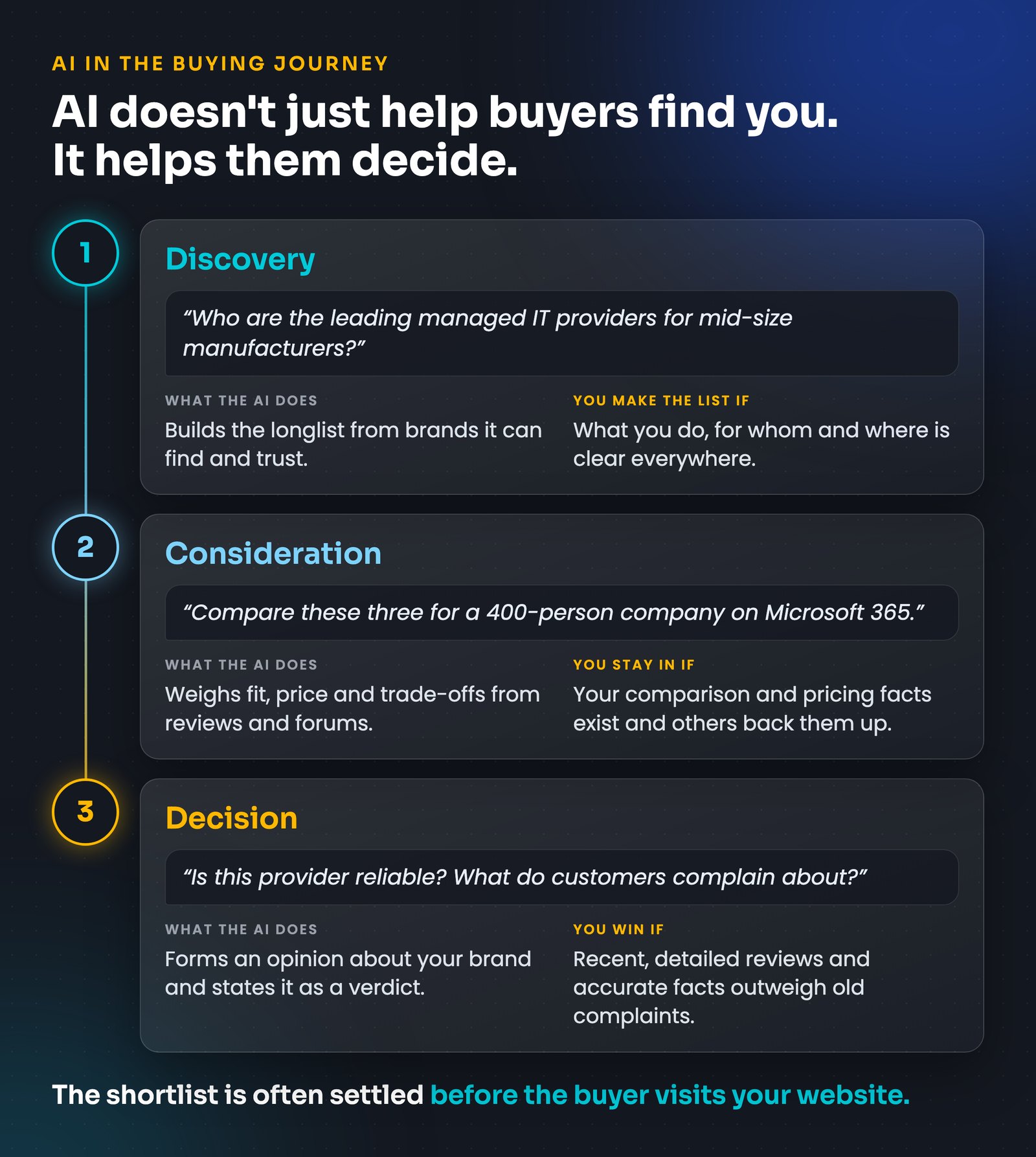
It helps to separate the questions buyers ask into two groups.
Discovery questions are the AI version of keywords: “best managed IT providers for manufacturers,” “who offers commercial roofing in Austin,” “top payroll platforms for multi-state companies.” The question for your brand is simple. Are you on the list?
Branded and head-to-head questions come later, when the buyer already knows your name: “Is [your brand] any good?”, “[your brand] vs [competitor] for a company our size,” “What do customers complain about with [your brand]?” Here the buyer is already in the consideration stage, and this is where AEO differs most from SEO. A search engine would have shown ten links and let the buyer form a view. An answer engine forms the view for them, and it is not shy about it: one provider is “a stronger fit for enterprise teams,” another “has more complaints about onboarding.”
In other words, AI is making judgments about your service without ever having been your customer. And buyers act on those judgments. In a Semrush survey of U.S. adults in July 2026, 57.5% of AI users said information from a chatbot had led them to decide not to buy something.
We see this in real buying situations every month:
- A homeowner holding two quotes asks ChatGPT which company to go with. The answer surfaces one company’s thin Better Business Bureau profile, and that becomes the tiebreaker.
- A prospect meets your team at a conference. Before the follow-up call they search your name, then ask an AI assistant what it thinks of your company and how you compare with the alternative they are also talking to.
- A VP has a great first meeting with your sales rep and mentions you upward. The CEO looks you up. If AI cannot find you, or describes you poorly, the deal gets harder before your team knows anything happened.
Where AI opinions come from
The good news is that AI opinions are not random. They are traceable. When an answer engine describes your brand, it is summarizing sources, and most assistants will show you which ones.
Those sources are rarely just your website. Assistants try to confirm what they say across several places before they commit to it: reviews on multiple platforms, Better Business Bureau profiles, industry directories (Healthgrades for medical practices, home and real estate portals for builders, G2 and Capterra for software), news coverage, “best of” lists, and community discussions on Reddit and Facebook. Old threads matter more than most teams expect. Hardly anyone on Reddit will read a two-year-old discussion about your company, but an AI assistant probably will.
The research backs this up. When Siege Media analyzed about 1,000 bottom-of-funnel buying questions and 57,095 citations, 80% to 95% of the citations pointed to third-party sites, Reddit appeared in 62% of answers, and most brands’ own websites barely registered. For buying questions, AI mostly listens to everyone except you.
In one audit we ran for a regional service business, a single review directory appeared as a source in roughly two-thirds of about 120 AI answers we tracked, and more than 40 different Reddit threads were being cited. Nobody on the marketing team had looked at either. That is the norm, not the exception.
There is a structural reason this keeps growing. Anyone can now publish ten polished websites in an afternoon, and AI-generated content is flooding the web. Answer engines respond by leaning harder on independent validation. Your own site tells the AI what you claim. Everyone else tells it whether to believe you. That is why going external, earning mentions and reviews on sites you do not control, is one of the most important AEO strategies right now.
The answer engines that matter in 2026
A year ago, “AI search” mostly meant ChatGPT. That is no longer true. Your buyers now meet AI answers in at least five places, and each one behaves differently.
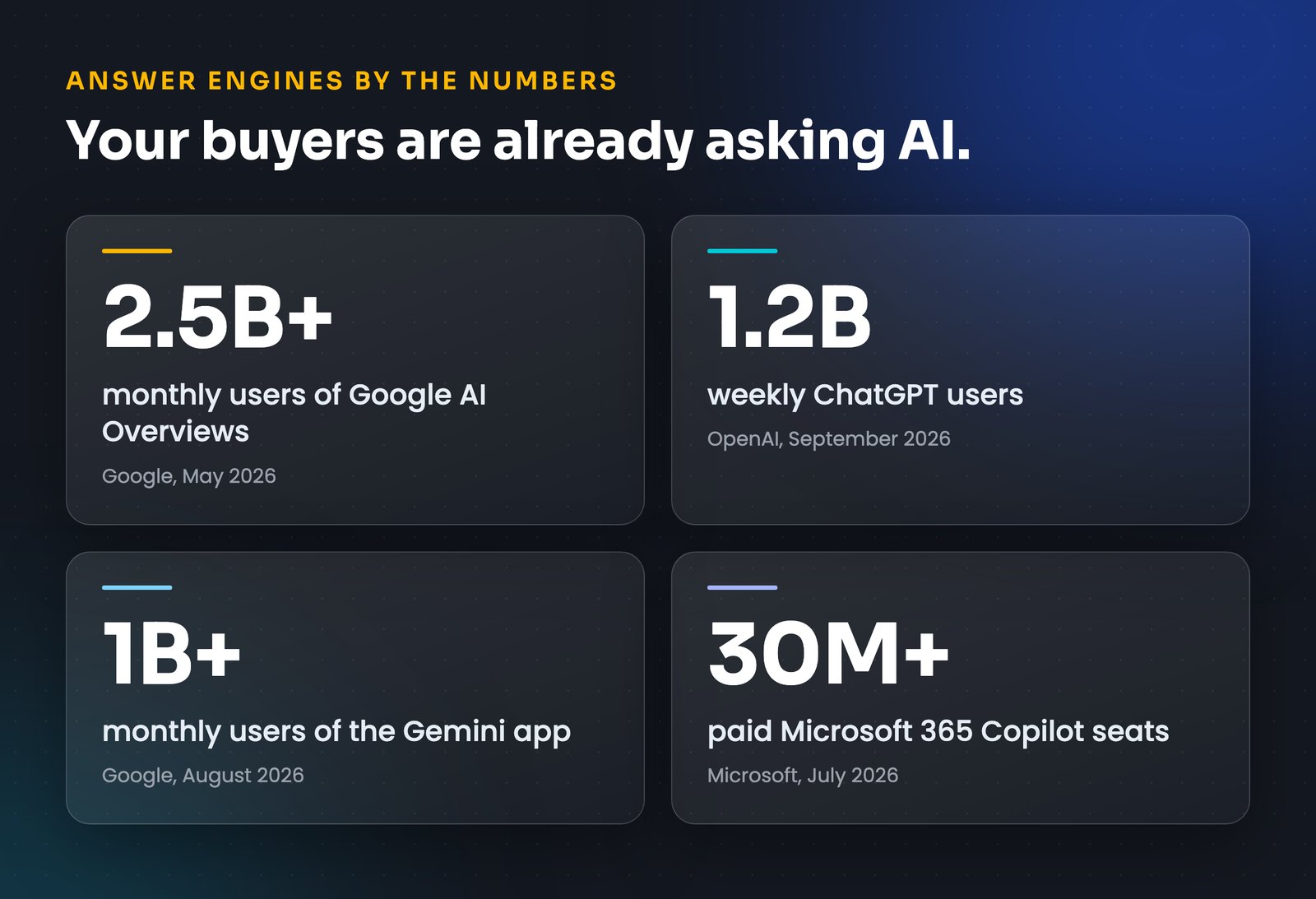
Here is how big they are, according to the companies themselves:
- Google AI Overviews: more than 2.5 billion monthly users as of May 2026.
- Google AI Mode: more than 1 billion monthly users, with queries more than doubling every quarter, available in over 200 countries and territories.
- ChatGPT: 1.2 billion weekly users as of September 2026.
- Gemini app: more than 1 billion monthly users as of August 2026, up from about 400 million in May 2025.
- Microsoft 365 Copilot: more than 30 million paid seats inside companies, as of July 2026.
Weekly and monthly users are not directly comparable, so market-share trackers are a useful second view. Each tracker measures something different, so it matters which one you quote. Similarweb, which measures visits to AI assistant websites (apps excluded), shows ChatGPT still well ahead but Gemini closing fast:
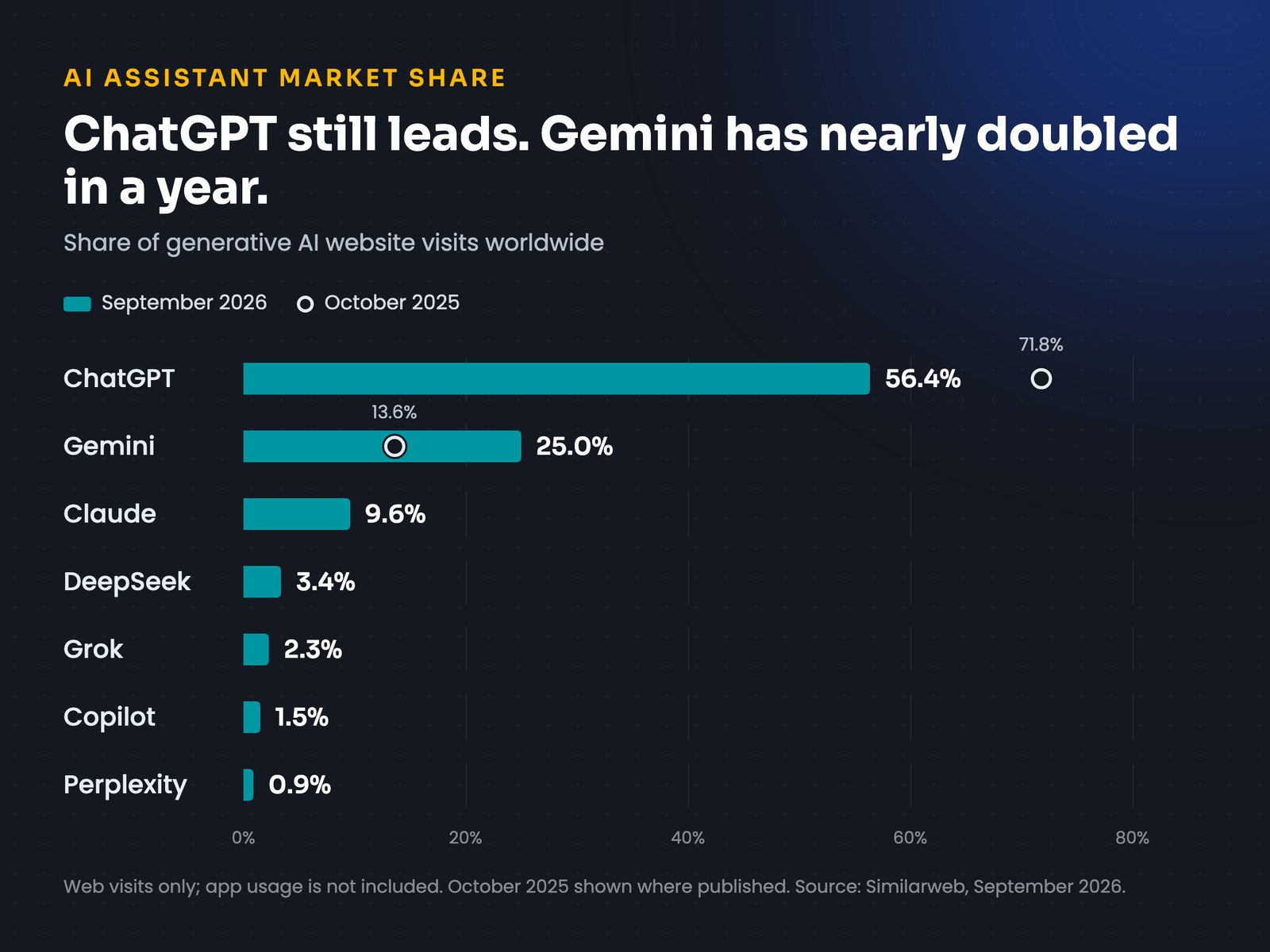
Gemini’s share of AI website visits rose from 13.6% in October 2025 to 25.0% in September 2026, according to Similarweb data reported by OfficeChai, while ChatGPT’s fell from 71.8% to 56.4%. Gemini peaked around May and has slipped slightly since, but the year-on-year direction is clear. StatCounter’s tracker, widely read as a measure of chatbot referrals to websites, still puts ChatGPT at about 80% worldwide. Both can be true: ChatGPT sends the most traffic, and Gemini is winning attention.
What each platform means for your brand:
ChatGPT is the largest standalone assistant and the biggest source of AI referral traffic to websites: roughly 75% to 95% of all AI referrals, depending on the study. It searches the live web for most commercial questions. In Ahrefs’ September 2026 analysis of its most-cited sites, Reddit, Wikipedia, and consumer review publications dominate. For local businesses, we regularly see it lean on Yelp, the Better Business Bureau, and directories.
Google AI Overviews and AI Mode have the largest reach of any AI surface, because they sit on top of Google search itself. BrightEdge found AI Overviews on about 48% of tracked queries in February 2026, and Semrush found them on more than 86% of “brand vs. brand” searches and 96% of “best X for Y” searches in August 2026. Google’s AI surfaces lean on Google’s own data (reviews, Business Profiles, YouTube) alongside Reddit, Facebook, and the wider web. AI Overviews and the Gemini app are not the same thing: Overviews are short answers built for billions of everyday searches, while Gemini is a full assistant competing with ChatGPT.
Gemini is the fastest-growing assistant, and it is everywhere Google is: Android, Chrome, Gmail, Docs, and Google Workspace. In Ahrefs’ data it cites Reddit and YouTube heavily, and review sites such as Trustpilot and the Better Business Bureau appear among its most-cited sources.
Microsoft Copilot has a small share of consumer web traffic but a very large footprint at work. It lives inside Outlook, Teams, Word, and Excel, and it is where engineers, procurement teams, and executives at Microsoft 365 companies increasingly do their research. Its answers draw on Bing search and are largely built on OpenAI models, so they often resemble ChatGPT’s.
Perplexity is small (under 1% of AI website visits in Similarweb’s data), but its users are research-heavy and it shows its sources more transparently than any other assistant, which makes it a useful diagnostic tool.
Claude has grown to roughly a tenth of AI website visits and is popular with knowledge workers and technical teams, which makes it worth tracking for B2B and technology brands.
| Platform | Where your buyers meet it | Prioritize it if |
|---|---|---|
| Google AI Overviews / AI Mode | On top of ordinary Google searches | You get meaningful traffic from Google today (nearly everyone) |
| ChatGPT | Standalone app and website, increasingly inside other apps | You sell to consumers or businesses; it sends the most AI referral traffic |
| Gemini | Android, Chrome, Gmail, Docs, Google Workspace | Your buyers live in Google’s ecosystem; it is growing fastest |
| Microsoft Copilot | Outlook, Teams, Word, Excel, Edge | You sell to enterprises that run on Microsoft 365 |
| Perplexity | Standalone app and website | Your buyers do heavy research before buying; useful for diagnosing sources |
| Claude | Standalone app, developer and workplace tools | You sell to technical or knowledge-worker audiences |
One more reason to look at each platform separately: they do not agree on their sources. An earlier Ahrefs study found that only 14% of the top-cited domains were shared across ChatGPT, Perplexity, and AI Overviews. Strong visibility on one does not guarantee visibility on the others.
Why enterprise brands feel this first
For enterprise and B2B brands, AI is not a side channel. It increasingly decides who makes the shortlist.
Buyers start with AI. In G2’s 2026 survey of 1,076 B2B software buyers, 51% said they start software research with an AI chatbot more often than with Google, up from 29% a year earlier. AI chatbots were the top source shaping shortlists (54%), ahead of review sites (43%) and vendor websites (36%). And 69% said they chose a different vendor than they had originally planned because of what a chatbot told them.
But they check the AI against reviews. The more conservative surveys tell the same story from the other side. TrustRadius found 63% of technology buyers used AI during their purchase journey, and 94% of those fact-checked its answers at least some of the time. Demos, trials, and user reviews remained the sources buyers trusted most. In G2’s July 2026 buyer report, review sites (38%) narrowly edged out chatbots (37%) as the top shortlist source. AI and reviews are not competing channels. The AI reads the reviews.
Buying committees multiply the effect. Forrester reports that a typical business purchase now involves 13 internal stakeholders and 9 outside influencers, and that generative AI has become buyers’ starting point. Each of those people can ask their own assistant about you, and inconsistent facts get amplified across the group.
AI is built into the tools buyers already use. Microsoft reports more than 30 million paid Microsoft 365 Copilot seats. Alphabet says Gemini Enterprise is used by nearly 90% of the Fortune 100, and Gemini in Chrome is available across Google Workspace plans. Your buyer’s research assistant is sitting inside their inbox and their browser.
Big purchases don’t start on Google, but they get checked by AI. Nobody types “buy a $2 million software platform” into a search box. Enterprise deals start with a referral, a conference conversation, or a sales meeting, and then someone checks. That check used to be a Google search and a look at your website. Now it is often a question to an assistant: what does this company do, who uses it, how does it compare, what are the complaints?
Products need their own credibility. For companies with several products, the assistant is usually asked about a specific product, not the parent brand. Each important product needs its own evidence: its own review-platform listings (G2, Capterra, Software Advice for software), its own comparison pages, its own case studies. That makes enterprise AEO partly a product branding job, not just a company SEO job.
The traffic is small, fast-growing, and undercounted. AI assistants still send a small share of website visits: 0.32% of all traffic across 101,574 sites studied by SE Ranking in early 2026, against 42.75% from organic search. But Similarweb measured 770.7 million AI referral visits a month worldwide, up 117% year on year, and Siege Media found AI visitors converted at a median of 1.26 times the rate of organic visitors across 78 sites. The bigger effect never shows up as a visit at all. It happens upstream, when the assistant decides which three vendors the buyer will call.
How answer engines decide what to say
You do not need to understand model architecture to do AEO well, but it helps to know the two ways an assistant “knows” about you.
1. What it learned in training. Large language models are trained on huge snapshots of the web, books, and other text. Anything widely and consistently written about your brand before the training cutoff becomes part of the model’s background knowledge. This is slow to change and hard to correct, which is why consistency across years of content and coverage matters.
2. What it retrieves right now. For most commercial questions, assistants now search the web in real time, pull a handful of pages, and write an answer from them. This is often called retrieval-augmented generation. Google describes AI Mode as using a “query fan-out” technique: one question is split into many related searches, results are gathered for each, and the answer is assembled from all of them. A single prompt like “best payroll provider for a multi-state company” may quietly trigger searches about pricing, compliance, integrations, and reviews.
That second path is the one you can influence quickly. It rewards:
- Pages that match the sub-questions. Pricing pages, comparison pages, integration pages, industry pages, and FAQs give the fan-out something specific to retrieve.
- Consistent facts across sources. When your website, Google Business Profile, LinkedIn, directories, and review sites agree on what you do, where you are, and who you serve, the model can state it with confidence. When they disagree, even on something as small as a phone number, it hedges or picks the wrong version.
- Third-party corroboration. Models lean heavily on sources that are not you. Reviews, industry lists, news coverage, community discussions, and expert videos act as evidence.
- Freshness. For anything time-sensitive, recent pages are favored, and stale information on your own site gets repeated as fact.
Each engine also has its own habits, as the platform rundown above shows, so the same fix rarely moves all of them at once. Check them separately.
The AEO playbook: what actually moves AI visibility
This is the work, in roughly the order we do it with clients. One principle runs through all of it: start from the sources, not the tactics. Until you know which questions matter and which sources the AI relies on for them, you are guessing.
1. Make sure AI can reach you
Check that your robots.txt and firewall rules are not blocking the crawlers that feed answer engines: Googlebot (Google’s AI Overviews and AI Mode), Bingbot (Copilot and other assistants that use Bing’s index), OAI-SearchBot and ChatGPT-User (ChatGPT search and browsing), PerplexityBot, and Claude’s crawlers. Review the Google-Extended setting too, which controls whether your content can be used for Gemini models.
Then make sure key content is readable without heavy JavaScript, loads fast, and is not hidden in tabs, PDFs, or gated forms. Clean, well-structured HTML that converts neatly to plain text is easier for every model to read. A surprising number of enterprise sites block AI crawlers by default through a CDN or bot-protection setting nobody remembers turning on.
2. Get your facts consistent everywhere
Before any content work, clean up the basics. Answer engines think in entities: a company, its products, its people, its locations, and how they relate. Give them one clean picture:
- An About page that states plainly what you do, for whom, where, and since when.
- Organization, Product, LocalBusiness, and Person structured data with
sameAslinks to your official profiles. - Identical name, address, phone, hours, and categories across Google Business Profile, Apple Business Connect, Bing Places, LinkedIn, industry directories, and review sites. Duplicate listings and old phone numbers are some of the most common problems we find.
- One canonical description of each product or service, reused everywhere instead of rewritten per channel.
- Your ChatGPT business profile. Since November 2026, OpenAI lets businesses claim and verify their profile in ChatGPT through Business Hub; see How to Claim Your Business in ChatGPT.
3. Build reviews on more than one platform
Answer engines rarely trust a single source. If all your reviews live on one site, you are giving the model one data point when it is looking for three or four.
- Prioritize the review sites each engine leans on for your category: Google for Google’s AI surfaces, plus Yelp, the Better Business Bureau, and your industry’s directories for ChatGPT and others. For software, that means G2, Capterra, and similar platforms.
- Ask at the moment customers are happiest, not on a fixed schedule. Detailed reviews that mention specific services and outcomes give the model something concrete to quote.
- Do not let a neglected profile rot. A handful of unanswered negative reviews on a site you ignore can quietly become the source an assistant quotes.
4. Publish answer-first content for every stage of the journey
Map the questions buyers ask at each stage and make sure a specific page answers each one:
- Discovery: what is X, how does X work, what does X cost, who offers X.
- Consideration: X vs Y, best X for [industry, size, or use case], alternatives to Y, how to choose X.
- Decision: is [your brand] good for [use case], [your brand] pricing, [your brand] reviews, [your brand] vs [competitor], implementation timeline, security and compliance.
Write the answer in the first one or two sentences, then support it. Use real numbers, named features, clear comparisons, and dates. Answer engines love specifics. Shift effort away from generic educational posts, which assistants now answer on their own, and toward comparison pages and original data an AI can cite.
Do not avoid comparison pages out of nervousness. Across 116 B2B websites, Siege Media found “versus” pages were the strongest content predictor of AI referral traffic, about twice as strong as the next content type. If you do not publish a fair comparison of you versus your main competitor, the model will build one from someone else’s.
5. Go external: earn third-party proof where models read
This is where most of the lift comes from, and where most brands underinvest.
- Lists and roundups. “Best X for Y” articles on independent sites are among the most-cited pages in AI answers. Getting included legitimately matters more than publishing your own.
- Digital PR and earned media. Coverage in trade publications and news sites helps twice: the AI uses it to verify you, and search engines read the link as a sign you are a real, established business.
- Communities. Reddit, Facebook groups, Quora, industry forums, and LinkedIn discussions show up constantly in AI answers. Participate as genuine experts, from real accounts with history, disclosing who you work for. Be helpful, not salesy. You do not even need to drop a link; the AI is smart enough to connect the mention to your brand.
- Video. YouTube explainers, demos, and expert interviews are cited frequently, especially in Google’s AI surfaces.
6. Publish original data and proof
Models favor sources with something no one else has: original research, benchmarks, named case studies with real numbers, and expert commentary with a named author. A page that says “we helped a client grow” gets ignored. A page that says what changed, by how much, over what period, and how, gets cited.
7. Correct what AI gets wrong
When an assistant states outdated pricing, a discontinued service, the wrong headquarters, or an unfair characterization, trace where it came from. Usually it is an old page on your own site, an outdated directory listing, or a third-party article. Fix or update the source, publish a clear and current version of the facts on your site, and recheck over the following weeks. Most assistants also offer feedback controls on individual answers. Use them, but do not rely on them.
8. Build credibility at the product level, not just the brand level
For companies with several products or service lines, this is the step most often missed. AI assistants answer questions about specific products, and they look for evidence about that product: its own listing on review platforms, its own comparison pages, its own case studies, its own mentions in industry coverage. A strong company brand does not automatically carry an individual product into the answer. Treat each important product as something that needs its own visibility.
How to measure AEO
There is still no settled science for AEO, and the platforms change their rules every few months. That is exactly why measurement matters more than opinions. A single screenshot of a single answer proves very little.
A measurement program that holds up:
- Build a prompt universe. Start with 30 to 50 questions written the way your buyers actually ask them, split into discovery, branded, and head-to-head prompts. Grow it toward a few hundred over time, the same way a keyword list grows.
- Run every prompt across the engines your buyers use, more than once. Answers vary from run to run. In a SparkToro study of nearly 3,000 runs, there was less than a 1-in-100 chance of getting the same list of brands twice. What does stay stable is how often a brand appears across many runs, so that is what to track.
- Track the right metrics. Mention rate by topic and by engine, share of answers against named competitors, position in lists, sentiment and accuracy on branded prompts, and which sources were cited.
- Group the cited sources. Sort them by type (review sites, directories, publishers and editorial, forums and communities, associations and government, your own site). This becomes your to-do list: the places you need to be present, correct, or stronger.
- Date everything and re-run on a schedule. Your first run is a baseline. Re-run quarterly, or at least every six months, and compare against it.
- Treat percentages as directional. A visibility score is useful for spotting trends and gaps, not a precise market share. Do not overplay it in a board deck.
- Connect AI to pipeline where you can. Create an AI assistants channel group in GA4 for referrals from chatgpt.com, perplexity.ai, gemini.google.com, copilot.microsoft.com, and claude.ai. Add “AI assistant (ChatGPT, Gemini, etc.)” as an option on your “How did you hear about us?” field. Capture it in your CRM.
One warning about analytics: AI-referred visits are badly undercounted. Many arrive without referrer data and land in “direct” traffic. If your direct traffic is rising and converting unusually well, some of it is likely coming from AI assistants that are not passing their name along.
A 90-day AEO plan
Days 1 to 30: Baseline. Define the prompt universe. Run it across the major engines and record visibility, sentiment, accuracy, competitors, and cited sources. Audit your listings and directories for inconsistent facts. Check crawler access. Log every inaccuracy AI states about you.
Days 31 to 60: Fix the foundations and publish. Fix listing inconsistencies and duplicates. Open crawler access and clean up structured data and your About page. Correct inaccuracies at the source. Publish or upgrade the comparison, pricing, industry, and decision-stage pages the prompt set showed you are missing, with real numbers. Start a review program across the platforms that matter for your category.
Days 61 to 90: Go external and measure. Pitch the lists and publications that keep appearing in your cited sources. Start genuine, disclosed participation in the communities where your category is discussed. Publish one piece of original data or a detailed case study. Re-run the full prompt set, compare against the baseline, and set a quarterly cadence.
Retrieval-based answers can shift within weeks once the underlying sources change. What a model learned in training moves slower. Plan on a quarter to see measurable movement, and a year to change how a category talks about you.
Common AEO myths
“AEO replaces SEO.” It does not. The same indexes that power search results feed most AI answers. Weak SEO means fewer of your pages are retrieved in the first place.
“An llms.txt file will fix it.” An llms.txt file is cheap and harmless, but the major AI search providers have not said they rely on it, and Google has said it does not use it. It is not a strategy.
“FAQ schema is AEO.” Structured data helps machines understand your pages. It does not make anyone recommend you. Google also stopped showing FAQ rich results for most sites, which we covered in Google Killed FAQ Rich Snippets.
“You can’t influence what AI says.” You can, through the sources it reads. It is slower and less direct than buying a keyword, and it rewards brands that are genuinely good and well documented.
“We can pay to be the answer.” Ads now exist inside some AI assistants, including ChatGPT Ads, but they appear separately from the organic answer and are clearly labeled. They do not change what the model says about you.
“It’s only for big brands.” Local businesses are often the easiest wins. Assistants answer “near me” and “best in [city]” questions from Google reviews, Yelp, the Better Business Bureau, and industry directories, and most local competitors have never looked at any of it.
Our free AEO audit
If you want to know what AI is telling your buyers right now, start with our free AEO audit.
We take the questions your buyers actually ask, both discovery questions about your category and branded, head-to-head questions about you and your competitors, and run them through ChatGPT, Gemini, and Google AI Overviews, adding Perplexity or Copilot where your buyers use them. Each question runs more than once, so you see a pattern rather than one lucky or unlucky answer.
You get:
- Your visibility. How often you appear, by topic and by platform, compared with the competitors you name.
- AI’s opinion of you. How assistants describe your brand on branded and comparison questions, and where they get facts wrong.
- The sources behind the answers. Which review sites, directories, publications, and forum threads AI relies on for your category and your brand, and where you are missing or misrepresented.
- A consistency check. Where your name, contact details, and descriptions do not match across listings.
- A short, prioritized fix list. The changes most likely to move the answers, in order.
It is delivered as a dated baseline, so you can measure progress against it later, whether or not you work with us. To request yours, contact us and tell us the brand, the market, and the two or three competitors you care about most.
Frequently asked questions about AEO
What does AEO stand for? Answer engine optimization: the practice of getting your brand mentioned, cited, recommended, and accurately described in answers from AI assistants such as ChatGPT, Gemini, Google AI Overviews, Perplexity, Copilot, and Claude.
Is AEO the same as GEO? In practice, yes. GEO (generative engine optimization) usually refers specifically to generative AI answers, while AEO is the broader term that also covers voice assistants and featured answers. The work is the same.
Does AEO replace SEO? No. Most AI answers are built from pages retrieved through search indexes, so strong SEO is what gets you into the pool of sources. AEO adds the work of earning citations, shaping how AI describes you, and building the third-party proof models use to corroborate.
Which AI platform should we focus on first? Start with Google AI Overviews and ChatGPT, because they reach the most people. Add Gemini, which is growing quickly and is built into Google’s products, and Copilot if you sell to enterprises that run on Microsoft 365. Perplexity is smaller but research-heavy and useful for diagnosing which sources are being cited.
How long does AEO take to show results? Answers that rely on live retrieval can change within weeks once the underlying sources change. What models learned in training changes more slowly. Plan on about a quarter for measurable movement in visibility and accuracy.
Can you pay to appear in ChatGPT or Gemini answers? Not in the organic answer. Some assistants now sell ads, but they are labeled and shown separately from the answer itself. What the AI says about you is earned through the sources it trusts.
How do you measure AEO? With a fixed set of buyer prompts run across the major assistants on a schedule, tracking mention rate, share of answers against competitors, position, sentiment, accuracy, and cited sources, plus AI referral traffic and self-reported attribution in your CRM.
Do we need an llms.txt file? It does not hurt, but there is little evidence the major assistants rely on it today. Crawler access, consistent facts, answer-first content, reviews, and third-party coverage matter far more.
The bottom line
Search is not going away, but it is no longer the whole story. Your buyers are asking AI assistants who to consider, how the options compare, and whether you can be trusted, and those assistants are answering with confidence, using sources you may have never looked at.
The brands that win this shift will not be the ones with the most AI-generated content. They will be the ones that are easiest for an AI to understand, easiest to verify, and most often recommended by people who are not them.
At MaaS by CodeSM, AEO is part of how we run SEO, content, reputation, and reporting for our clients: we track what AI says about them, trace where it comes from, and work on the sources that change the answer. If you want to see where your brand stands today, contact us to request your free AEO audit.
Share this article