


Most salons, spas and barbershops don’t have a marketing plan. They have a booking app, an Instagram account the owner posts to between clients, a first-visit discount that has been running for three years, and a slow Tuesday nobody can explain. Med spas usually have more budget and the same pattern: a boosted post for a neurotoxin special, a filler ad that Meta rejected, and consult requests that never turn into appointments.
The market around them keeps getting more crowded. According to the Bureau of Labor Statistics, 48% of hairdressers, hairstylists and cosmetologists and 80% of barbers are self-employed, which means suite renters and independents, each with their own Instagram and booking link, competing for the same clients as your salon. On the medical side, the American Med Spa Association says the med spa industry has passed $17 billion and is growing by more than $1 billion a year. And clients are pickier before they ever book: in BrightLocal’s 2026 survey, 68% of consumers said they will only use a business rated four stars or higher, and 74% look for reviews written in the last three months.
This guide is written for owners and managers of salons, spas, barbershops and med spas. It covers why most beauty marketing fails, the 2027 cost benchmarks, the advertising rules (especially for med spas), the 10 sections of a working plan, and where to start. At the end you can download a free fillable PDF workbook.
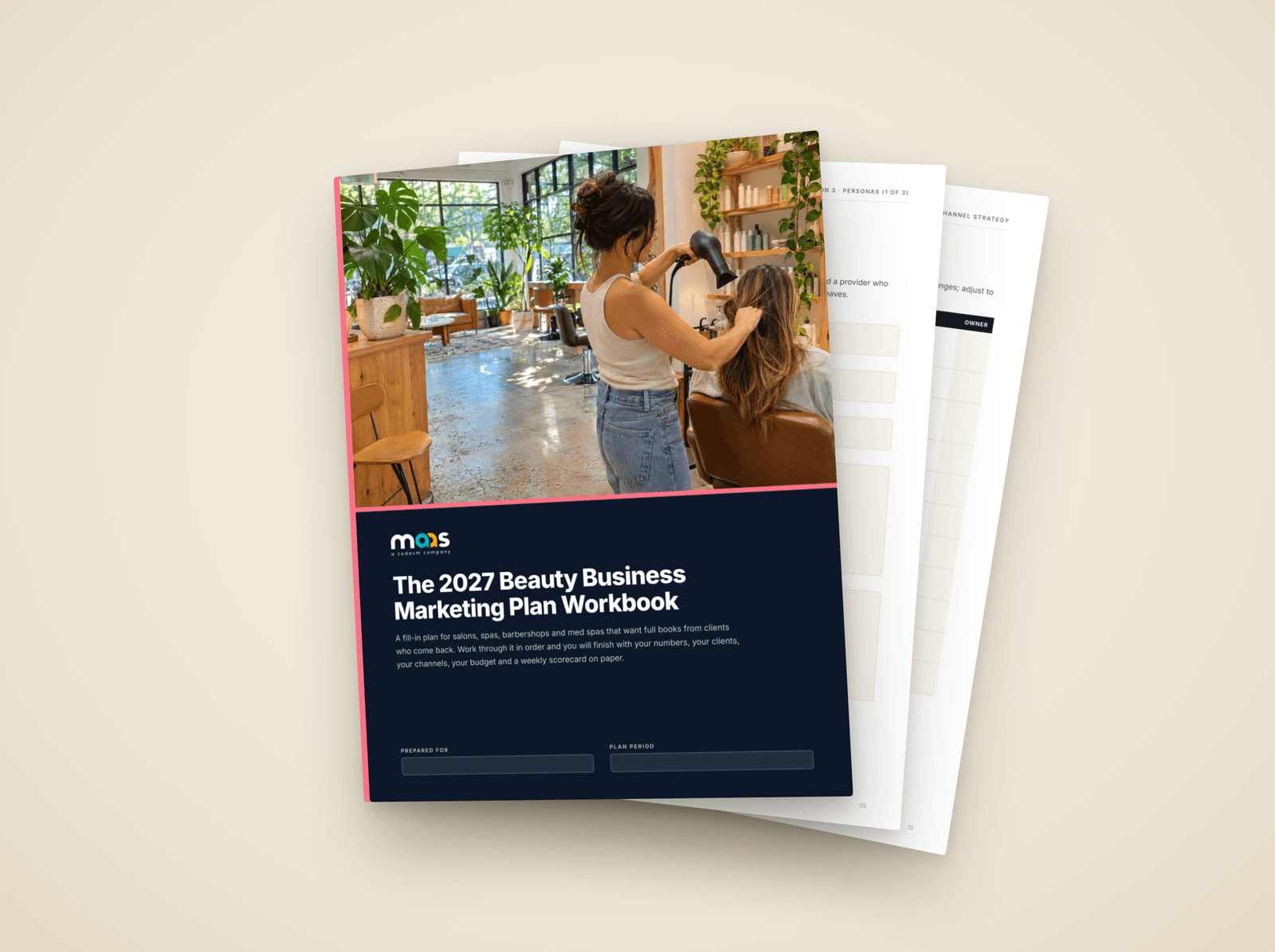
Click to download the free 2027 Beauty Marketing Plan workbook (PDF)
Why most beauty marketing fails
Beauty businesses rarely fail at marketing because the work isn’t good. They fail because the marketing is aimed at the wrong part of the business:
- All acquisition, no retention. A color client on a seven-week cycle visits about seven times a year. Yet most budgets go to first visits, while rebooking at checkout is left to whoever is at the front desk.
- Discounts as the main offer. A deep first-visit discount fills one appointment with someone shopping on price, and trains clients to wait for the next deal.
- Instagram with no path to a booking. A beautiful feed, a link in bio that goes to the homepage, no “Book” button on the Google profile, DMs answered hours later.
- No-shows treated as bad luck. Without deposits, a card-on-file policy and reminders, every empty slot is inventory you can never resell.
- The provider owns the audience. Clients follow their stylist, barber or injector. When that person leaves, the book leaves too, unless the business owns the client list, the reviews and the brand.
- Med spa ads written like salon ads. Brand-name drug terms, side-by-side photos and loose results claims get ads rejected and create compliance risk.
- No source tracking. The “how did you hear about us” field in the booking software is empty, so nobody knows which channel produced last month’s new clients.
A plan fixes these by putting the answers in writing: who you want, what you’ll offer, which channels you’ll pay for, and which numbers you’ll check every week.
The 2027 economics of beauty marketing
These are the numbers to plan with.
Paid search converts well in beauty. In LocaliQ’s 2026 search advertising benchmarks, beauty and personal care averaged a $4.62 cost per click, a 6.75% click-through rate, a 10.35% conversion rate and a $39.25 cost per lead, against $66.69 per lead across all industries. Searches like “brow lamination near me” or “balayage [city]” are close to a booking, which is why the conversion rate is high.
Meta is cheaper per click but not per lead. LocaliQ’s 2026 Facebook benchmarks put beauty traffic campaigns at $0.50 per click, but beauty lead campaigns at $50.91 per lead, almost double the $27.39 all-industry average. Use Meta to show your work, retarget visitors and launch services, and send people to booking rather than lead forms.
Reviews decide the shortlist. BrightLocal’s 2026 survey found that 97% of consumers read reviews for local businesses, 31% will only use a business rated 4.5 stars or higher (up from 17% a year earlier), 47% won’t use a business with fewer than 20 reviews, and 89% expect owners to respond.
Your clients are on Instagram. Pew Research’s 2026 data shows 56% of U.S. women and 79% of adults aged 18 to 29 use Instagram. For most beauty businesses it is the portfolio clients check before they book, whether they found you there or on Google.
Lifetime value sets what you can pay for a client. An illustrative example: a $90 average ticket, a visit every six weeks (about eight a year) and retail at 15% of service revenue is roughly $830 a year, or about $2,500 over three years. Paying $40 to $80 for a client who rebooks is a good trade. Paying $40 for one who never returns is not. Run this math with your own numbers before setting cost-per-client targets.
Budget as a share of revenue. A common planning range is 3% to 6% of revenue for an established salon or spa, and 8% to 10% while opening, adding a location or launching a service line. Med spas usually need the upper end. Adjust to your market.
| Channel | What it is good for | Benchmark or typical cost |
|---|---|---|
| Google Business Profile + reviews | Map Pack visibility for “[service] near me”, trust | Free; about 1 hour a week to post and reply |
| Google Search Ads | High-intent bookings | $4.62 CPC, $39.25 CPL (LocaliQ 2026) |
| Meta ads (Instagram, Facebook) | Showing work, retargeting, launches | $0.50 traffic CPC, $50.91 lead-form CPL (LocaliQ 2026) |
| Instagram + TikTok organic | Discovery, portfolio, education | Time plus photo and video production |
| Booking marketplaces | In-app discovery by new clients | Varies by platform (subscription or new-client fees); check terms yearly |
| Email + SMS | Rebooking, filling gaps, win-back | Often included in booking software; planning range $50 to $300 a month |
| Referral program | The highest-trust new clients | Cost of the reward, usually a service credit |
| Memberships and packages | Retention and predictable revenue | The discount or credit built into the price |
Rules to know before you market
Beauty looks lightly regulated. It isn’t, and most regulators treat a med spa as a medical practice. This is a practical summary, not legal advice: check specifics with your attorney, medical director and state boards.
For every salon, spa and barbershop:
- Reviews. The FTC’s rule on fake reviews and testimonials, in force since October 2024, bans fake or AI-written reviews, rewards conditioned on a positive review, undisclosed reviews from staff, and suppressing negative reviews, with civil penalties for knowing violations. Ask every client for an honest review; never tie a reward to the star rating.
- Creators and comped services. Under the FTC’s Endorsement Guides, a creator who received a free service has to disclose that connection clearly in the post.
- Text messages. Automated marketing texts need prior express written consent under the TCPA, and opt-outs have to be honored within a reasonable time of no more than 10 business days under FCC rules (as revised in September 2026). Some states add their own texting laws.
- Memberships. For recurring charges sold online, the federal Restore Online Shoppers’ Confidence Act requires clear terms, express consent and a simple way to cancel. Many states have automatic renewal laws on top.
- Client photos. Get written permission before posting any client’s face or results.
Additional rules for med spas:
- Supervision and scope. State law decides who can own a med spa, who must serve as medical director, and who can inject or run lasers. Ads should never imply credentials your team doesn’t hold.
- FDA product limits. Dermal fillers are approved for specific uses. The FDA recommends against fillers for body contouring and says needle-free devices are not approved for filler injection. Don’t advertise uses the product isn’t approved for.
- Compounded GLP-1 weight loss. The FDA notes that compounded drugs are not FDA approved and flags claims that a compounded drug is the same as an approved one. Don’t call a compounded product a generic version of a brand.
- Results claims. The FTC’s health products guidance expects competent and reliable scientific evidence behind health claims. “Painless”, “permanent” and “lose 20 pounds” all need proof.
- Patient privacy. If your practice is a HIPAA covered entity, using a patient’s photo or story in marketing generally requires their written authorization. Get written consent either way.
- Meta ad policy. Meta’s health and wellness policy requires cosmetic procedure ads to target people 18 and older, bans ads that try to create negative self-perception, and says anti-aging injectable ads can show close-ups but not side-by-side comparisons.
- Google ad policy. Google restricts prescription drug terms in ads, landing pages and keywords. Neurotoxin brand names can trigger disapprovals, so plan your wording and check the policy before launch.
The 10-section beauty marketing plan framework
The workbook has a fillable page for each of these sections. Here is what goes in each one.
1. Business snapshot
One page with the numbers that run the business: service menu and prices, average ticket, chairs or rooms, utilization (booked hours as a share of available hours), rebooking rate at checkout, new clients per month, the share who return within 90 days, retail as a share of service revenue, no-show rate, team model (commission, booth rent or hourly) and booking software. Add one sentence on what makes you different. If you can’t pull these numbers in 20 minutes, setting up those reports is your first marketing task.
2. SWOT analysis
Strengths: specialties, credentials, a signature service, location, a loyal core of regulars. Weaknesses: provider turnover, thin reviews, no online booking or deposits, a confusing menu. Opportunities: underserved services nearby (textured hair, men’s grooming, lash and brow, medical weight loss), Spanish-speaking clients, bridal groups, memberships. Threats: suite renters, marketplace apps that own discovery, discount chains, providers leaving with their books, ad policy changes.
3. Client personas
Three personas cover most beauty businesses:
- The Maintenance Regular. Books every four to eight weeks for color, cuts, fades, nails, brows or facials. Values consistency, an easy rebook and a provider who remembers them. The highest lifetime value, and the biggest risk if their provider leaves. You reach them with rebooking at checkout, reminders and memberships.
- The Occasion Booker. A wedding, prom, quinceañera, graduation or holiday party. Books once, against a deadline, often for a group, after finding you on Instagram, TikTok or Google and reading reviews. A high ticket and low loyalty unless you convert them. You reach them with event pages, portfolio posts, group packages and a post-event offer to come back.
- The Results Researcher. Considering a neurotoxin, filler, laser, body treatment or medical weight loss. Researches for weeks: injector credentials, before-and-after galleries, reviews, price per unit or syringe, safety. Needs education and a consultation before they commit. You reach them with treatment pages, educational video, an easy consult booking and a nurture sequence.
For each one, fill in: age range, travel distance, service interval, budget per visit, where they discover businesses, what stops them booking, and the offer that moves them.
4. Competitive analysis
Pick five competitors clients compare you with, including at least one independent or suite renter and the strongest profile on your booking marketplace. For each, note: price of your core service, Google rating and review count, online booking and deposit policy, Instagram activity, specialties and credentials, and offers or memberships. Then write one sentence on where you can win. The goal is to find the gap they leave open, not to match their prices.
5. Brand positioning statement
One sentence:
“For [ideal client], [your business] is the [category] that [differentiator] because [reason to believe].”
Example (fictional): “For working professionals in North Dallas who want color that still looks good at week eight, Copper and Comb is the color-specialist salon that matches every client with one stylist and one formula card, because every colorist trains in our system and rebooks you before you leave.”
A med spa version might read: “For first-time injectable clients in Scottsdale who are nervous about looking overdone, Lumen Aesthetics is the nurse-injector-led med spa that starts conservative and books a two-week check-in with every treatment.” If you can’t write this sentence, every ad will default to price.
6. Goals and KPIs
Three to five SMART goals, each with an owner and a weekly check-in. Beauty goals should weigh retention as heavily as new clients. Examples:
- Raise rebooking at checkout from 48% to 65% by June 30, 2027.
- Cut no-shows and late cancellations from 9% to under 3% within 90 days of introducing deposits.
- Grow Google reviews from 120 to 300 at a 4.8 average or better by December 31, 2027.
- Bring 60% of first-time clients back within 90 days.
- Lift retail to 15% of service revenue by the end of Q3 2027.
- For a med spa: sell 150 memberships by Q3 2027 with monthly cancellations under 4%.
7. Client journey map
Map each stage, what the client is doing and where you meet them:
- Discover. A Reel, a TikTok, a Google search for “[service] near me”, a friend’s recommendation.
- Evaluate. Reviews, portfolio, price menu, provider profiles and credentials.
- Book. Online booking with a deposit, a call or a consult request. Every extra step loses people.
- Prepare. Confirmation, reminders, intake or consent forms.
- Visit. The service, the consult, the front-desk experience.
- Checkout. Rebook the next visit, recommend home care, ask for a review.
- Aftercare. Care instructions and a check-in after medical treatments.
- Return. A reminder timed to the service interval.
- Loyalty. Membership, packages, referral rewards.
- Win-back. A personal note when a regular goes 90 days past their usual interval.
Most beauty businesses leave stages 6, 8 and 10 to chance. Those are the cheapest clients you will ever win.
8. Channel strategy
The 2027 channel mix for a beauty business. Investments are planning ranges for a single location; scale to your market.
| Channel | Role | Cadence | Typical investment |
|---|---|---|---|
| Google Business Profile | Map Pack visibility, reviews, Book button | Weekly posts and photos, reply to reviews within days | Free + 1 hr/week |
| Website service pages + local SEO | Rank for each service and treatment | 1 to 2 new pages or posts a month | $500 to $2,500/mo |
| Google Search Ads | Capture “[service] near me” demand | Always on, weighted to your slow days | $500 to $3,000/mo salons; $1,500 to $6,000/mo med spas |
| Instagram + TikTok organic | Portfolio, discovery, education | 4 to 6 posts a week, daily Stories | Time + content |
| Meta ads | Retargeting, launches, filling slow weeks | Always-on retargeting + monthly campaigns | $300 to $2,000/mo |
| Booking marketplaces | In-app discovery | Keep profile, photos and prices current | Platform fees |
| SMS + email | Rebook reminders, openings, memberships | Automated flows + 2 to 4 campaigns a month | $50 to $300/mo |
| Referral program | Trusted new clients | Always on, asked at checkout | Service credits |
| Creator collaborations | Local reach with proof | 1 to 2 a month | Comped services |
| Events | Bridal trials, injector days, gift card pushes | Seasonal | $250 to $2,500 per event |
Your Instagram bio, Google profile, ads and texts should all open the booking page, not the homepage.
9. Content strategy and calendar
A workable mix for 2027: 50% to 60% short-form video (transformations, technique, quick education), 20% to 25% carousels (service menus, FAQs, result sets where allowed), daily Stories for openings and behind the scenes, and one or two emails a month. Aim for four to six feed posts a week. Rotate these categories:
- Transformations, with written consent and within ad rules for medical treatments
- Process and technique: how a lived-in blonde, a skin fade or a lash lift is done
- Meet the provider: training, specialties, credentials
- Education and myth-busting: what a peel does and doesn’t do
- Aftercare: how to make the result last until the next visit
- Seasonal: prom, wedding season, holiday glam, summer skin
- Client stories, with permission
- Openings and offers: “two spots open Thursday” beats another generic promo
In bilingual markets, plan Spanish-language content on purpose. Of the 67.8 million U.S. residents who speak a language other than English at home, 62% speak Spanish, according to the Census Bureau. Start with key service pages, booking confirmations, aftercare instructions and review replies.
10. Budget allocation and measurement
An example $5,000 monthly budget for a single-location med spa or a larger salon:
- Google Search Ads: $1,250 (25%)
- Meta ads: $1,000 (20%)
- Photo and video production: $1,000 (20%)
- Retention (SMS, email, CRM, membership promotion): $750 (15%)
- Reputation and local SEO: $500 (10%)
- Referral rewards and creator partnerships: $250 (5%)
- Testing reserve: $250 (5%)
A smaller salon can run the same split at $1,500 to $2,500 a month. Measurement: make referral source a required booking field, tag every bio and ad link with UTMs, use a tracking number on paid ads, and review this dashboard weekly: new clients by source, cost per new client, rebooking rate at checkout, 90-day return rate of new clients, utilization, no-show rate, average ticket, retail share, review count and rating, and (for med spas) memberships sold and canceled. The workbook includes a dashboard template.
Common mistakes to avoid
- Discounting the first visit so deeply you attract the wrong client. Offer value a regular would want (a free add-on, a consult credit) instead of half off.
- Sending social traffic to your homepage. Every link should open booking for the service in the post.
- Running without a deposit policy. Publish it, apply it consistently and send reminders 48 and 24 hours ahead.
- Letting the client list live in providers’ phones. Every client, note and photo belongs in the business’s booking system.
- Launching med spa ads before checking platform rules. Write to Meta’s and Google’s policies first, then to the offer.
- Reporting followers instead of booked revenue. New clients, rebooks and revenue by source are the scoreboard.
- Ignoring Spanish-speaking clients in bilingual markets. A Spanish confirmation and aftercare text cost little and show you want their business.
Where to start if you’re starting from scratch
Don’t try to finish all ten sections in one weekend. Run this order:
- Week 1. Sections 1, 3 and 5: snapshot, personas and positioning. Pull rebooking, no-show, retail and new-client numbers from your booking software.
- Week 2. Complete your Google Business Profile, add 20 recent photos, and use one booking link in your Instagram bio, Google profile and website header.
- Week 3. Introduce deposits or card-on-file, publish the cancellation policy, and set up reminders.
- Week 4. Build the review habit: an ask at checkout plus an automated text after each visit.
- Month 2. Start posting four times a week and launch one Google Search campaign on your two most profitable services.
- Month 3. Automate retention: rebook reminders by service interval, a 90-day win-back message, and a membership or package.
- Quarter 2. Add a referral program, monthly creator collaborations, Spanish-language basics where relevant, and Meta retargeting.
- Year 1. Compare cost per new client and 90-day return rate by channel, then move budget toward the sources that produce regulars.
FAQ
How do you advertise a salon?
Start with what’s free and high-intent: a complete Google Business Profile with recent photos, steady reviews and a booking link. Add consistent Instagram and TikTok content that shows your work, then a Google Search campaign for your most profitable services. Use Meta ads mainly for retargeting and launches.
How much should a salon or med spa spend on marketing?
A common planning range is 3% to 6% of revenue for an established salon or spa and 8% to 10% while opening, expanding or launching a service. Med spas often need the upper end. Set the final number from your goals and your client lifetime value.
What are the best marketing strategies for a med spa?
Treatment pages that rank in local search, educational video from your injectors, a fast consult booking flow, a nurture sequence for researchers, and memberships for retention. Build every ad to platform and regulatory rules first.
Can med spas use before-and-after photos in ads?
On Meta, cosmetic procedure ads must target adults 18 and older and avoid negative self-perception, and anti-aging injectable ads can show close-ups but not side-by-side comparisons. On your own site and profiles, results galleries are common, but get written patient consent and keep claims accurate.
What are the 5 P’s of a marketing plan?
Product, price, place, promotion and people. For a beauty business: your service menu, pricing and memberships, location and booking experience, channels and content, and the team that delivers the experience clients come back for.
Download the full template
The workbook is a fillable PDF companion to this guide. Inside:
- How to use the workbook
- Business snapshot
- SWOT analysis
- Three persona templates (Maintenance Regular, Occasion Booker, Results Researcher)
- Competitive analysis matrix (5 competitors)
- Brand positioning canvas with a worked example
- Goals and KPI tracker with a monthly check-in
- Customer journey map (10 stages)
- Channel strategy matrix
- Content framework and 30-day content calendar
- Budget allocation worksheet with an example split
- Tech stack checklist and weekly measurement dashboard
- 12-month action plan
- Common mistakes checklist and quick-start plan
Download the 2027 Beauty Marketing Plan workbook (PDF)
If you’d rather have a team run this for you, from content and ads to reviews, rebooking automations and weekly reporting, that is what the beauty and med spa marketing team at MaaS by CodeSM does for salons, spas and aesthetics practices such as Dr. Ruby. Get in touch and we’ll review where you are and map the plan with you. For more, see our med spa email templates and how to get more reviews.
Share this article