


Enrollment for the 2027-28 school year will be won in a tighter market. There are fewer young children: the U.S. recorded 3,606,400 births in 2025, down 1% from 2024, and a general fertility rate of 53.1 births per 1,000 women aged 15 to 44. There are more choices: 19 states now offer a school choice program open to all students, and a new federal tax credit scholarship starts in 2027 in states that opt in. And families are worried about cost. In a February 2026 survey of 495 independent school enrollment leaders, 55% named perceived affordability as a top concern and 41% reported more financial aid applications than the year before.
Most private schools, charter schools and learning centers still run enrollment without a written marketing plan. The admissions director doubles as the marketer, the fall open house is the campaign, and the website is built for current families, with the lunch menu easier to find than tuition and aid. Re-enrollment is treated as paperwork, even though every family that leaves is a seat you have to fill twice.
This guide is for private and independent K-12 schools, charter schools and learning centers focused on enrollment. It covers why school marketing stalls, the funnel math and benchmarks that should set your targets, the privacy and consent rules that apply to schools, and the 10-section plan framework, built around your admissions calendar. At the end you can download the free 2027 School Marketing Plan workbook, a fillable PDF that walks you through each section.
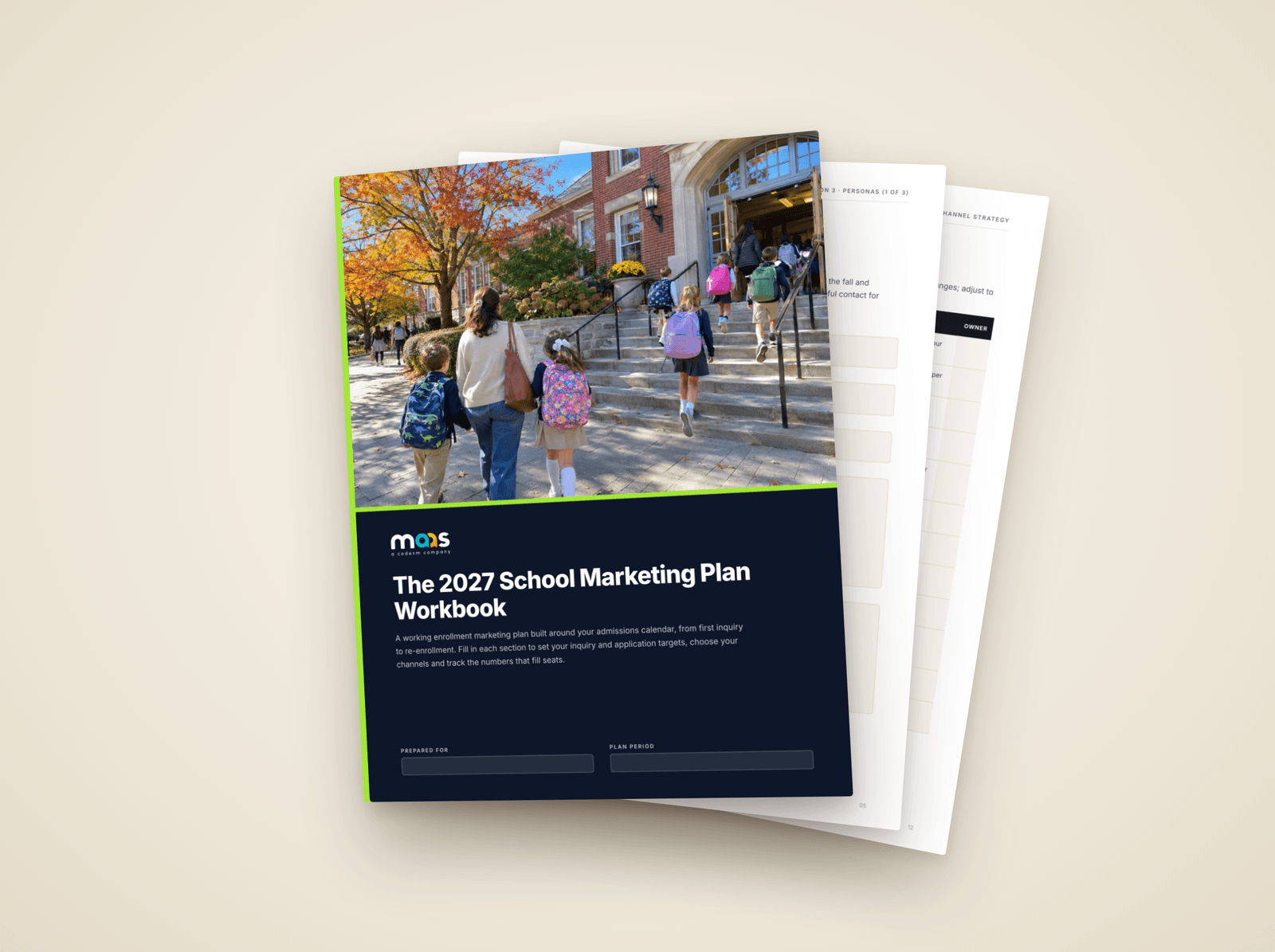
Click to download the free 2027 School Marketing Plan workbook (PDF)
Why most school marketing fails
Schools rarely fail because families do not want what they offer. They fail in the gaps between steps:
- Marketing stops at the open house. One fall event gets all the energy, with no follow-up for families who inquired in October and will decide in February.
- Slow, generic inquiry follow-up. The reply comes days later, and it is the same brochure for a family planning for kindergarten in 2028 and one that needs a seat in two weeks.
- A website built for current families. Calendars and login links sit up front; tuition, aid and visit booking are buried.
- Tuition without the aid story. Families see a sticker price and leave. At NAIS member schools, a median 26.4% of students receive financial aid with a median grant of $22,308 (NAIS Facts at a Glance 2025-26). Lead with net cost, not the sticker price.
- Retention treated as administration. The median NAIS school loses 8.2% of its students each year (NAIS), and nobody in marketing owns that number.
- Word of mouth left to chance. Current parents are often a school’s most trusted voice, but there is no ambassador program, no review request and no referral tracking.
A plan closes those gaps by assigning each stage of the enrollment funnel an owner, a message and a number to watch.
The 2027 economics of school marketing
The enrollment funnel in numbers. NAIS publishes median admissions figures from its 1,358 member schools. In 2025-26, the median school recorded 389 inquiries, 177 completed applications, 112 acceptances and 77 newly enrolled students. The median rates: 45.5% of inquiries became completed applications, 65.8% of applications were accepted, and 72.3% of accepted students enrolled. Each figure is a separate median, so they do not chain perfectly, but the rule of thumb holds: roughly five inquiries per new student. Charter and smaller private schools should build the same ratios from their own data.
Work backward from the seats you need. For 80 new students at those median rates:
| Funnel stage | Conversion assumption | Volume needed |
|---|---|---|
| New students enrolled | Target | 80 |
| Acceptances | 72.3% yield | 111 |
| Completed applications | 65.8% acceptance rate | 169 |
| Inquiries | 45.5% inquiry to application | 371 |
Add a row for visits between inquiry and application, using your own rate. It is usually the step a plan can move fastest.
Retention is the cheapest enrollment. At NAIS member schools, median attrition was 8.2% in 2025-26. A 350-student school at that rate loses about 29 students a year before admissions recruits anyone. Each percentage point of attrition you remove is about 3.5 students you do not have to replace. At an illustrative net tuition of $20,000, that is roughly $70,000 a year per point.
Affordability is now the core message. Median day tuition at NAIS member schools was $32,920 for grade 6 in 2025-26 (NAIS), and many parochial and smaller private schools charge far less. Whatever your price, families need to see net cost: aid, sibling discounts, payment plans, state ESA or voucher programs, and from 2027 the federal tax credit scholarship. Under that program, donors can claim a credit of up to $1,700 a year and scholarships can go to families earning up to 300% of area median income, in states that opt in (NCSL).
Paid media benchmarks. In WordStream’s 2026 Google Ads benchmarks, the Education and Instruction category averaged a $4.81 cost per click, a 13.14% conversion rate and a $77.48 cost per lead. On Meta, Education and Instruction lead campaigns averaged a $26.31 cost per lead with a 15.87% conversion rate (WordStream 2026 Facebook benchmarks). That category includes tutoring, test prep and training programs, so use it as a rough guide and judge your campaigns on cost per tour and cost per enrolled student, not cost per form fill.
Setting the budget. There is no reliable public benchmark for school marketing spend, so work from the value of a student. At an illustrative $20,000 net tuition for six years, a new student is worth $120,000. A common planning range for tuition-based schools is $1,500 to $3,000 in marketing per newly enrolled student; adjust to your tuition and market. Charter schools will spend far less and lean on community channels.
Channel benchmarks for 2027:
| Channel | What it is good for | Benchmark or typical cost |
|---|---|---|
| Google Business Profile | Map results for “private schools near me” and reviews | Free, plus staff time |
| Google Ads | High-intent searches inside your enrollment radius | $4.81 CPC, $77.48 CPL for Education and Instruction (WordStream 2026) |
| Meta (Facebook and Instagram) | Reaching local parents, promoting visits, retargeting | $26.31 CPL on lead campaigns (WordStream 2026) |
| School directories (Niche, GreatSchools, Private School Review) | Third-party validation and reviews | Free profiles; paid upgrades vary |
| Email and text nurture | Moving families from inquiry to visit to application | Tool cost; consent rules apply |
| Open houses, tours and shadow days | The highest-intent conversion step | Staff time plus a planning range of $500 to $3,000 per event |
| Direct mail | Neighborhoods in your radius with young families | Planning range $0.50 to $1.50 per piece |
Rules to know before you market
- FERPA. FERPA applies to schools that receive funds under any U.S. Department of Education program (34 CFR 99.1), which covers public schools, including charter schools that receive those funds. A private school that takes no such funds is generally outside FERPA, but state law and parent expectations still apply, so use the same standard.
- Student photos and video. The Department of Education says an image is an education record when it is directly related to a student and maintained by the school, and that schools often designate photos from public events as directory information or get parent consent before publishing them (ED FAQ). In practice: an annual media release with a separate yes or no for paid ads, a “do not publish” list checked before every post, and no names next to faces in ads.
- COPPA. It covers websites and apps directed to children under 13. An admissions site aimed at parents usually is not, but student portals, camp sign-ups and games can be. The amended COPPA Rule took effect June 23, 2025, with a compliance date of April 22, 2026 (Federal Register), and a school can consent for parents only in the educational context (FTC COPPA FAQ). Keep ad pixels off child-directed pages.
- Charter school admissions. Under the federal definition, a charter school does not charge tuition, is nonsectarian, and admits students by lottery when applications exceed seats (20 U.S.C. 7221i). Marketing cannot imply selective admissions, and inquiry forms should not ask for anything that could screen students before the lottery. Check your state law and authorizer rules too.
- Private school nondiscrimination statements. Tax-exempt private schools must include a statement of their racially nondiscriminatory policy in brochures and catalogs dealing with admissions, programs and scholarships, and a reference to it in other written advertising (IRS Schedule E instructions).
- Email and texts. Admissions marketing emails must follow CAN-SPAM, including a working unsubscribe honored within 10 business days (FTC). Autodialed marketing texts need prior express written consent (47 CFR 64.1200), so add a clear text-consent checkbox to inquiry forms.
- Website accessibility. Public entities, including public schools, fall under the DOJ’s ADA Title II web rule (WCAG 2.1 AA). An April 2026 interim final rule moved the deadlines to April 26, 2027 for governments serving 50,000 or more people and April 26, 2028 for smaller ones (Duane Morris). Charter schools should confirm their deadline with counsel; private schools should build to the same standard anyway.
This is a practical summary, not legal advice. Check specifics with your counsel, authorizer or state association.
The 10-section school marketing plan framework
The workbook has a fillable page for each section, built around your admissions calendar.
1. Business snapshot
Grades served, enrollment and capacity by grade (where are the empty seats?), tuition and typical net tuition, aid budget, state choice programs families can use, mission in one plain sentence, enrollment radius in drive time, retention rate, and who owns admissions and marketing.
Then map your admissions calendar. Many independent schools run inquiries and open houses from September to January, application deadlines in January or February, decisions and aid letters in March, enrollment contracts and deposits in spring, and rolling admissions through summer. Charter schools follow application windows and lottery dates set by state law or the authorizer. Write down your own dates; every campaign in the plan hangs off them.
2. SWOT analysis
Strengths might be small classes, a distinctive program (Montessori, classical, STEM, faith-based, language immersion), outcomes, or a warm community. Weaknesses are often aging facilities, limited aid, a dated website, or a thin review profile. Opportunities include new ESA or scholarship programs, a growing neighborhood, district changes that push families to look around, and grades with open seats. Threats include new charters or microschools, rising tuition sensitivity, declining births in your area, and families relocating.
3. Parent personas
Three personas cover most enrollment:
- The Early Planner. Parents of a child entering preschool, kindergarten, grade 6 or grade 9 a year or more from now. Visits several schools in the fall, compares philosophy, class size, outcomes and commute, and needs nurture for months.
- The Switcher. A family whose child is enrolled elsewhere and something is not working: academics, bullying, class size, a learning difference, or a move. Inquires mid-year or in spring and summer, wants a fast tour and a straight answer about openings, and decides quickly.
- The First-Time Private School Family. A family that never considered private school (or a charter) until a choice program or scholarship made it possible. Anxious about cost and unfamiliar with the process, they need plain explanations of tuition, aid, applications and what the visit involves, sometimes in another language.
For each, write the child’s grade and entry year, current school, what triggered the search, top three priorities, cost and aid questions, where they research, and who influences the decision.
4. Competitive analysis
Pick five: two or three private or charter schools families compare you with, the best-rated district school nearby, and a homeschool, microschool or online option if it shows up in your conversations. For each, record net cost after typical aid, grades and class size, Google and Niche ratings and review counts, signature programs, visit format, and the inquiry experience (submit an inquiry and time the reply). Ask ChatGPT and Google’s AI Mode for the “best private schools in [your city]” and note who gets named. Then write one sentence on where you win.
5. Positioning statement
One sentence:
“For [families], [school] is the [type of school] that [differentiator] because [reason to believe].”
Example (fictional): “For north Austin families who want a rigorous but warm K-8 education, Riverbend Academy is the independent school where every child is known by name, because classes are capped at 16 and every student has the same faculty advisor from kindergarten through eighth grade.”
A specific family, a specific promise, and proof a parent can repeat at the soccer field.
6. Goals and KPIs
Three to five SMART goals, dated to your enrollment cycle. Examples:
- Grow completed applications for fall 2028 entry from 150 to 175 by February 15, 2028.
- Reply to 100% of inquiries within one business day, with a median under two hours during school hours.
- Lift tour-to-application conversion from 50% to 60% by the end of the 2027-28 cycle.
- Reduce attrition from 9% to 7% by the 2028 re-enrollment deadline.
- Reach 75 Google reviews with an average of 4.7 or higher by June 2028.
Give each goal one owner and a weekly check-in during admissions season.
7. Customer journey map
The enrollment funnel, in 10 stages:
- Trigger. An entry grade nears, a problem at the current school, a move, a new scholarship.
- Research. Google and Maps, Niche, friends, social media, AI assistants.
- Inquiry. Form, call, text or event sign-up. The KPI is response time.
- Nurture. Emails, texts and calls that answer questions and invite a visit.
- Visit. Tour, open house or shadow day.
- Application. Follow up on every unfinished one.
- Assessment or lottery. Interviews, testing, or lottery entry for charters.
- Decision and aid. Acceptance or lottery result, plus a conversation about net cost.
- Enrollment and summer. Contract, deposit and onboarding, when families can still drift away.
- Re-enrollment and advocacy. Year two, reviews, referrals and ambassador roles.
Most schools are strong at stage 5 and weak at stages 4, 9 and 10.
8. Channel strategy
Investments are planning ranges; scale to your enrollment goals and market.
| Channel | Role | Cadence | Typical investment |
|---|---|---|---|
| Google Business Profile | Map visibility, reviews, event posts | Weekly posts and photos | Free, 1 hour/week |
| Website admissions pages | Tuition and aid, visit booking, programs, FAQs | Monthly updates; refresh before fall | $500–$2,000/mo |
| SEO and parent-question content | Rank for local and program searches | 2–4 pages/month | $1,000–$3,000/mo |
| Google Ads | High-intent local searches | Always-on, heavier in fall and spring | $1,000–$4,000/mo |
| Meta ads | Open house promotion, retargeting, awareness | Bursts around events, always-on retargeting | $500–$2,500/mo |
| Instagram and Facebook organic | Show daily life and build trust | 3–5 posts/week | Staff time plus content |
| Email and text nurture | Inquiry to visit to application | Triggered sequences plus monthly email | $100–$500/mo tools |
| Open houses, tours and shadow days | Convert interest into applications | Monthly in season, tours weekly | $500–$3,000 per event |
| Parent ambassador program | Word of mouth, reviews, peer calls | Ongoing, with a fall kickoff | Time plus small gifts |
| Directories (Niche, GreatSchools, Private School Review) | Third-party validation | Quarterly profile updates | Free to paid tiers |
| Community and feeder partnerships | Preschools, churches, youth sports, relocation agents | Quarterly | Time plus sponsorships |
Make word of mouth a program. Recruit 10 to 20 ambassador families across grades and backgrounds. Give them a visit invitation with a tracked link, talking points on aid, and one prospective family to call after each open house. Ask for Google reviews at happy moments, such as the end of the first semester, and add “Who referred you?” to the inquiry form.
Treat retention as marketing. Each fall, flag at-risk families (low engagement, academic struggles, late payments) and talk with them before contracts go out. Send a “year ahead” preview before re-enrollment, and survey new families at 6 weeks and 6 months.
9. Content strategy and calendar
A workable cadence: three to five social posts a week (mostly short video), one or two website articles a month answering parent questions, a monthly email to prospective families, and a weekly newsletter to current families. Rotate eight categories:
- A day in the life. Real classroom moments, with consent.
- Teacher spotlights. Who will know their child.
- Student work and outcomes. Projects, performances, where graduates go.
- Admissions explainers. How to apply, what a visit involves, key dates.
- Tuition, aid and scholarships. Net cost and choice programs in plain language.
- Parent stories. Short stories shared with permission.
- Events and traditions. The moments that make the community.
- Parent FAQs. One question, one short video.
10. Budget allocation and measurement
An illustrative $6,000 monthly program for an independent K-8 school of about 350 students:
- Google Ads: $1,500 (25%)
- Meta ads (visit promotion and retargeting): $1,200 (20%)
- Photo and video production: $1,200 (20%)
- SEO and website content: $900 (15%)
- Events and ambassador program: $600 (10%)
- Enrollment CRM and texting tools: $300 (5%)
- Contingency for open seats or a late push: $300 (5%)
Measurement. A required “How did you hear about us?” field, UTMs on every ad and ambassador link, call tracking on paid campaigns, and every family’s stage tracked in your enrollment CRM. The weekly dashboard in season: inquiries by source and entry grade, median response time, visits booked and attended, visit-to-application rate, applications started versus completed, cost per visit by paid channel, new Google reviews, and re-enrollment contracts returned.
Common mistakes to avoid
- Promoting the open house and nothing else. Families need several touches after the event before they apply.
- Burying tuition and aid. Put net cost, aid, payment plans and choice programs one click from the homepage.
- Treating every inquiry the same. Route switchers to a fast call and a tour this week; put early planners into a monthly nurture.
- Publishing student photos without a consent system. One complaint can undo a year of trust.
- Going quiet in summer. Accepted families still need contact, events and reasons to stay committed.
- Leaving re-enrollment to the business office. Retention is the cheapest enrollment you will get, so give it a plan and an owner.
Where to start if you’re starting from scratch
Don’t try to do all ten sections at once. Run this order:
- Week 1. Sections 1, 3 and 5, plus your admissions calendar.
- Week 2. Fix inquiry handling: one form, an instant auto-reply, a named owner, a one-business-day reply standard, a source field and a text-consent checkbox.
- Week 3. Put tuition and aid, visit booking and program pages within one click of the homepage. Update your Google Business Profile and Niche profile.
- Week 4. Build two nurture tracks (early planners and switchers) and audit your media release process.
- Month 2. Launch Google Ads on high-intent local terms and Meta ads for your next visit event. Recruit ambassador families and start review requests.
- Month 3. Build the weekly dashboard, start a re-enrollment risk list, and survey new families.
- Quarter 2. Publish parent-question content and a plain-language aid and scholarship guide. Start two feeder partnerships.
- Year 1. Review the full cycle, inquiries to enrolled students by source, plus attrition, and move budget to what worked.
FAQ
How do I create a marketing plan for my school? Start with the new students you need by grade, then work backward through your funnel to the inquiries and visits required. Add personas, positioning, an admissions calendar, channels, content, budget and a weekly dashboard. The 10 sections above follow that order.
How do you advertise a private school? Combine a strong Google Business Profile and website, Google Ads on local high-intent searches, Meta ads to promote visits, current-parent referrals and community partnerships. Lead with what a day looks like and what it costs after aid.
How can a school increase enrollment? Reduce attrition first, then improve conversion between inquiry, visit and application. Faster inquiry replies, better tour follow-up and a clear aid story often add more students than extra ad spend.
What are examples of weaknesses of a school for a SWOT analysis? Limited aid, aging facilities, a dated website, slow inquiry follow-up, few reviews, low awareness outside current families, and high attrition in certain grades.
What is the biggest issue facing private schools right now? Affordability and perceived value. In the February 2026 E3n and Mission & Data survey, 55% of enrollment leaders named perceived affordability a top concern, followed by more financial aid requests (44%) and perceived value (43%).
Download the full template
The workbook is a fillable PDF companion to this guide. Inside:
- How to use the workbook
- Business snapshot
- SWOT analysis
- Three persona templates (Early Planner, Switcher, First-Time Private School Family)
- Competitive analysis matrix (5 competitors)
- Brand positioning canvas with a worked example
- Goals and KPI tracker with a monthly check-in
- Customer journey map (10 stages)
- Channel strategy matrix
- Content framework and 30-day content calendar
- Budget allocation worksheet with an example split
- Tech stack checklist and weekly measurement dashboard
- 12-month action plan
- Common mistakes checklist and quick-start plan
Download the 2027 School Marketing Plan workbook (PDF)
If you would rather have a team run this for you, from inquiry nurture and open house campaigns to parent-facing content, ads and weekly enrollment reporting, that is what the education marketing team at MaaS by CodeSM does, including a managed marketing partnership with Sylvan Learning in the Rio Grande Valley. Get in touch and we will review where you are and map the plan. For two quick wins, see our guides on getting more reviews and growing an email list.
Share this article