


Most agents don’t have a marketing plan. They have a brokerage website they never update, a “Just Listed” post when there’s a listing, a portal subscription or referral agreement they’re not sure pays off, and a phone full of past clients they haven’t called since closing day. When the market is hot, that’s enough. In 2026 it isn’t.
Buyers and sellers still want agents. In NAR’s 2026 Profile of Home Buyers and Sellers, 90% of buyers and a record 92% of sellers used one. But there are fewer transactions to share, and the rules changed. Since August 2024, agents working with buyers need a written agreement before touring, and compensation offers can’t appear on Realtor MLSs. The typical Realtor closed nine transaction sides in 2025, and 28% of the typical agent’s business came from repeat clients and another 22% from referrals by past clients. Half the business comes from people who already know you, yet most marketing budgets go to strangers.
This guide covers why most real estate marketing fails, the 2027 economics by channel, the rules that changed (and the ones that didn’t), the 10 sections of a working plan for agents, teams and small brokerages, and where to start. At the end you can download a free fillable PDF workbook to build your own.
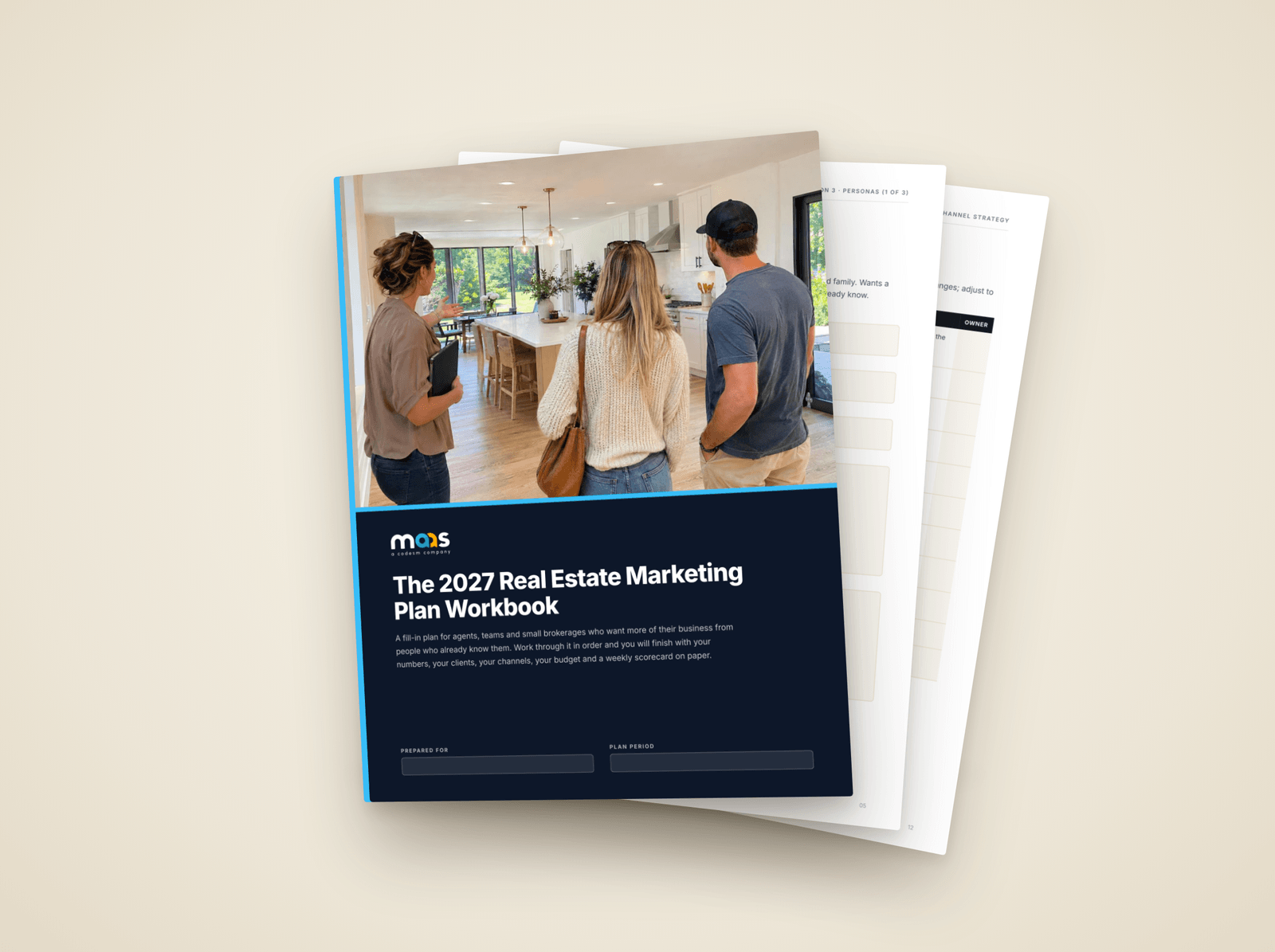
Click to download the free 2027 Real Estate Marketing Plan workbook (PDF)
Why most real estate marketing fails
The patterns are consistent across markets and price points:
- Renting leads instead of building a database. Portal leads and pay-at-closing referral programs can fill a calendar, but the relationship belongs to the platform. When the subscription ends or the fee rises, the pipeline goes with it.
- No system for the sphere. NAR’s 2026 Generational Trends report found that 43% of buyers found their agent through a friend, neighbor or relative and 15% used an agent they had worked with before. For sellers it was 37% and 29%. Sellers now stay in their homes a median of 12 years, long enough to forget an agent who never stayed in touch.
- Slow response. The same NAR report found 74% of buyers interviewed only one agent. The first agent to have a real conversation usually gets the business.
- “Just Listed” as the whole content strategy. Listing posts show inventory, not expertise. Buyers and sellers choose the agent who seems to know the neighborhood best.
- Buyer value no longer explained. With written buyer agreements, the buyer consultation is now a sales conversation about what you do and what it costs. Agents who haven’t written that pitch down lose buyers at the agreement.
- No tracking to closed sides. Most agents can tell you how many leads they got. Few can tell you which source produced last year’s commission income.
- Fair housing blind spots. Ad copy, photos and audience targeting all fall under fair housing rules, and the platforms enforce their own versions.
The 2027 economics of real estate marketing
Plan with these numbers before you set a budget.
Google Search is expensive per lead. In LocaliQ’s 2026 search advertising benchmarks, real estate averaged a $3.22 cost per click, a 7.61% click-through rate, a 3.70% conversion rate and a $102.51 cost per lead. Cheap clicks, low conversion: real estate searchers browse a lot before they raise a hand.
Meta leads are cheap and need fast follow-up. LocaliQ’s 2026 Facebook benchmarks put real estate lead campaigns at $13.74 per lead with a 9.95% conversion rate, and traffic campaigns at $0.55 per click. Those leads are earlier in the journey. Without a response and nurture system, the low cost per lead is an illusion.
Speed matters more than the channel. In research published in Harvard Business Review, companies that contacted an online lead within an hour were nearly seven times as likely to qualify it as those that waited even an hour longer.
Portal referral fees come out of your commission. Zillow’s pay-at-closing program (formerly Flex, now marketed as Zillow Preferred) charges a percentage of your commission that varies by market, price and timing. Model it per closed side, not per lead.
Buyers start online, then rely on agents. NAR’s 2026 Generational Trends report found that 46% of buyers began by looking online for properties and 20% by contacting an agent; 52% found the home they bought on the internet and 27% through their agent; the typical search lasted 10 weeks. Among buyers who used the internet, 81% rated photos very useful, 77% detailed property information and 57% floor plans.
Sellers judge your marketing. The same report lists what sellers’ agents used: the MLS (85%), yard signs (67%), open houses (59%), Realtor.com (50%), the agent’s own website (49%) and social networking sites (23%). Your listing presentation should show more than the minimum.
Budget. The typical Realtor’s median business expenses were $9,530 in 2025, which covers far more than marketing. A common planning range for marketing alone is 10% to 15% of expected gross commission income, more for a growth year or a new market. Adjust to your goals.
| Channel | What it is good for | Benchmark or typical cost |
|---|---|---|
| Sphere and past-client nurture | Repeat and referral business, the largest source | CRM plus mail, events and gifts; planning range $200 to $800 a month |
| Google Business Profile + reviews | Searches for agents by name and area | Free; about 1 hour a week |
| Website + hyperlocal SEO | Neighborhood and home-value searches | $500 to $3,000 a month (planning range) |
| Google Search Ads | High-intent seller and buyer searches | $3.22 CPC, $102.51 CPL (LocaliQ 2026) |
| Meta ads (housing category) | Listing exposure, seller leads, retargeting | $0.55 traffic CPC, $13.74 lead-form CPL (LocaliQ 2026) |
| Portals (Zillow, Realtor.com) | Buyer lead volume | Subscription or a share of commission at closing |
| Video (YouTube, Reels, TikTok) | Neighborhood expertise, listing tours | Time plus production |
| Open houses and events | Meeting buyers and future sellers in person | Staff time, signage, small ad spend |
| Direct mail | Farming a neighborhood | Planning range $0.60 to $1.50 a piece |
Rules to know before you market
These are the rules that most often affect agent marketing. It’s a practical summary, not legal advice: check your state commission’s rules, your MLS and your broker.
- The NAR settlement practice changes. In effect since August 17, 2024: an agent working with a buyer needs a written agreement before touring a home, in person or live virtual, that states the amount or rate of compensation in objectively ascertainable terms and says fees are negotiable, and offers of compensation can’t be made on Realtor MLSs, though they can still be arranged off the MLS (NAR FAQ). In August 2026 the Eighth Circuit upheld approval of the settlement, so plan on these rules staying. In marketing, describe your compensation accurately and never imply that representation is free unless it is.
- Pre-marketing and private listings. Clear Cooperation still requires filing with the MLS within one business day of public marketing. NAR’s Multiple Listing Options for Sellers adds office-exclusive and delayed-marketing options with a signed seller disclosure. Portals have their own rules too, and Zillow’s private-listing standards were still in litigation in 2026. Check your MLS before any “coming soon” campaign.
- Fair Housing Act advertising. 24 CFR 100.75 bars ads that show a preference based on race, color, religion, sex, disability, familial status or national origin, through words, photos or symbols, or through the choice of media and locations. HUD withdrew its 2024 digital advertising guidance effective September 2025, but the statute and regulation still apply, and many states and cities add protected classes. Describe the property and amenities, not who should live there.
- Platform targeting limits. Meta requires housing ads to run in its special category, with no age or gender targeting and a 15-mile minimum radius. Google bars housing ads in the U.S. and Canada from targeting by age, gender, parental status, marital status or ZIP code.
- Calls and texts. Marketing texts and autodialed calls need prior express written consent under the TCPA, cold calls must be scrubbed against the Do Not Call registry, and opt-outs must be honored within no more than 10 business days (FCC rules as revised in 2026). Some states go further: Texas extended its telemarketing law to texts in 2025, and a later settlement exempted consent-based texts from its registration rules.
- State license law. State commissions set advertising disclosure rules, such as how your brokerage name must appear in ads and on social profiles.
The 10-section real estate marketing plan framework
The workbook has a fillable page for each section. Here is what goes in each one.
1. Business snapshot
One page: your brokerage and license, the neighborhoods and price bands you serve, your buyer and seller mix, closed sides and gross commission income for the last 12 months, average commission per side, database size, and the share of last year’s business from each source (sphere, past clients, portals, ads, open houses, other agents). Add one sentence on what makes you different. “Full-service and client-focused” doesn’t count.
2. SWOT analysis
Strengths: neighborhood knowledge, a past-client base, a niche (downsizing, relocation, new construction, investors, a language), listing results. Weaknesses: thin reviews, no video, a database scattered across phone, email and old transaction files, slow follow-up. Opportunities: long-tenured owners in your farm, first-time buyers who need education, Spanish-speaking buyers and sellers, builder and relocation partnerships. Threats: discount and flat-fee brokerages, portal dependence, inventory shortages, rate swings, rule changes.
3. Client personas
Three personas cover most agents’ business:
- The Equity-Rich Move-Down Seller. In their 60s or older, in the home for 12 years or more, selling to downsize or to be closer to friends and family (the most common reason for selling in NAR’s 2026 Profile, at 22%). Wants a trusted guide, a plan for the next home and minimal disruption. Often chooses an agent they already know.
- The Late-Start First-Time Buyer. First-time buyers were 22% of purchases and had a median age of 40 in the same report. Has been saving for years, worries about rates and payment, and needs the buyer agreement explained plainly. Researches online for weeks before reaching out.
- The Move-Up or Relocating Family. Buying and selling at once, often against a job or school deadline, comparing neighborhoods they don’t know well. Needs sequencing advice, area expertise and fast communication. Worth two sides if you win the trust.
For each one, fill in: life stage, price band, timeline, financing readiness, where they research, what triggers the move, and the content that would earn a first conversation.
4. Competitive analysis
Pick the five agents or teams who take the most listings in your farm. For each, note: listings and closed sides in the last 12 months (from the MLS), average days on market and list-to-sale ratio, Google and portal review counts, website and neighborhood content, video presence, and brokerage brand. Then write one sentence on where you can win: a neighborhood nobody covers well, a buyer type nobody speaks to, or a listing package nobody matches.
5. Brand positioning statement
One sentence:
“For [target client], [you or your team] is the [category] that [differentiator] because [reason to believe].”
Example (fictional): “For empty-nesters in northwest San Antonio who have been in their homes 15 years or more, the Delgado Group is the downsizing specialist that plans the sale and the next move together, because we partner with a senior move manager and a stager and run every listing on a written 30-day launch plan.”
That sentence drives your bio, your listing presentation, your ads and your content. If you can’t write it, you will compete on commission.
6. Goals and KPIs
Set three to five SMART goals, each with an owner and a weekly check. Real estate goals should track the pipeline, not just leads. Examples:
- Grow the database from 400 to 900 contacts with permission to email by December 31, 2027.
- Touch every past client personally at least twice in 2027, plus a monthly email.
- Close 24 sides in 2027, with at least half from the sphere and past clients.
- Keep median response time to new online leads under five minutes.
- Hold 12 listing appointments a quarter and convert at least half.
- Add 40 new Google reviews by year end.
7. Client journey map
The real estate journey can run for years. Map it:
- Dormant. Not thinking about moving. Your monthly email, social content and annual home-value check keep you familiar.
- Trigger. A new job, a new baby, an empty nest, a retirement, a loss. Life events start most moves.
- Research. Online listing searches, home-value estimates, neighborhood videos, reviews.
- First contact. A call, a text, a form, an open house. Response time decides this stage.
- Consultation. The listing presentation or buyer consultation, including the written buyer agreement.
- Prep or search. Pricing, staging, photos and launch for sellers; tours and offers for buyers.
- Under contract. Inspections, appraisal, communication. Silence here costs referrals.
- Closing. Keys, a thank-you, a review request.
- Post-close. A move-in check, a home anniversary note, an annual equity review.
- Referral and repeat. The next move, theirs or a friend’s.
Most agents are strong at stages 4 through 8 and missing 1, 2, 9 and 10, which is where half the business comes from.
8. Channel strategy
The 2027 channel mix for an agent or small team. Investments are planning ranges; scale to your market.
| Channel | Role | Cadence | Typical investment |
|---|---|---|---|
| CRM + sphere nurture | Repeat and referral business | Monthly email, quarterly personal touch, annual review | $50 to $300/mo tool + mail and events |
| Google Business Profile | Name and area searches, reviews | Weekly posts, reply to every review | Free + 1 hr/week |
| Website + hyperlocal SEO | Neighborhood guides, home-value pages | 2 to 4 pages or posts a month | $500 to $3,000/mo |
| Google Search Ads | Seller and buyer intent | Always on for seller terms; buyer terms tested | $750 to $3,000/mo |
| Meta ads (housing category) | Listing exposure, seller campaigns, retargeting | Per listing + always-on retargeting | $300 to $2,000/mo |
| Video (YouTube, Reels, TikTok) | Expertise and listing tours | 2 to 4 videos a week | Time + production |
| Portals | Buyer volume | Ongoing, reviewed quarterly | Subscription or referral fee |
| Listing marketing package | Win listings, sell homes | Every listing | Photo, video, floor plan, staging help |
| Open houses + events | In-person buyers and future sellers | Weekly open houses, 2 client events a year | $100 to $2,500 per event |
| Direct mail | Farm awareness | Monthly or quarterly | $0.60 to $1.50 a piece |
| Spanish-language marketing | Bilingual markets | Matches the English cadence | Translation or a bilingual agent’s time |
Two habits make the table work: route every new lead to a person within minutes (call, then text with consent), and tag every contact with a source in the CRM so you can trace closed sides back to it.
9. Content strategy and calendar
Hyperlocal beats generic. A workable 2027 mix: 50% to 60% short-form video, 20% carousels and photo posts, and the rest long-form (YouTube tours, market reports, blog guides). NAR’s 2026 Generational Trends report found that 52% of buyers used an online video site in their search. Aim for four to six posts a week and one monthly email. Rotate these categories:
- Neighborhood guides: parks, commutes, restaurants, new development
- Market updates: monthly prices, days on market and inventory by area, in plain language
- Listing tours: walkthroughs with floor plans and the details buyers ask about
- What it costs: “What $450,000 buys in three neighborhoods”
- Process explainers: the buyer agreement, pricing a listing, inspections, closing costs
- Client stories: with permission, told in your words
- Local business spotlights: content your sphere shares
- Home value and equity: what homes like theirs sold for, with an invitation to ask
Keep fair housing in mind in every caption: describe homes, amenities and distances, not the kind of people a neighborhood suits.
10. Budget allocation and measurement
An example $4,000 monthly budget for a productive solo agent or small team:
- Sphere and past-client nurture (CRM, mail, events, gifts): $1,000 (25%)
- Listing marketing (photography, video, floor plans, staging help): $800 (20%)
- Paid search and Meta lead generation: $800 (20%)
- Hyperlocal content and video: $600 (15%)
- Website, SEO and Google Business Profile: $400 (10%)
- Portal or referral program test: $200 (5%)
- Reserve for new listings and launches: $200 (5%)
Measurement: a required lead-source field in the CRM, UTM tags on every ad and profile link, a tracking number on ads and signs, and a monthly report of closed sides and commission income by source. Review this dashboard weekly: new contacts added, sphere touches completed, median lead response time, appointments set, buyer agreements signed, listing appointments and listings taken, pending and closed sides, and cost per closed side by source. The workbook includes a dashboard template.
Common mistakes to avoid
- Buying leads with no follow-up system. If nobody calls within minutes and nurtures for months, portal and Meta leads mostly go to waste.
- Treating the sphere like a mailing list. A monthly email helps, but personal calls, notes and annual home reviews are what produce referrals.
- Posting only listings. Without neighborhood and process content, an agent with no listings this month has nothing to say.
- Targeting or wording that creates fair housing risk. Use the platforms’ housing categories and describe properties, not people.
- Winging the buyer consultation. Write your value statement and compensation explanation down and rehearse them.
- Measuring leads instead of closed sides. Judge every channel by commission income and cost per closed side.
Where to start if you’re starting from scratch
Don’t try to finish all ten sections in one weekend. Run this order:
- Week 1. Sections 1, 3 and 5: snapshot, personas and positioning. Pull last year’s closings and label each by source.
- Week 2. Consolidate your database into one CRM. Tag past clients, sphere and leads, and give each group a touch plan.
- Week 3. Complete your Google Business Profile, ask your last 20 clients for reviews, and add a home-value page and a buyer agreement explainer to your website.
- Week 4. Set up lead routing and response: instant alerts, a call-first rule, and a consent-based text follow-up.
- Month 2. Build your listing presentation marketing package and start a weekly neighborhood video series.
- Month 3. Test Google Search on seller terms and Meta in the housing category, with tracking in place.
- Quarter 2. Launch a monthly market report email, hold a client appreciation event, and add Spanish-language content if your market calls for it.
- Year 1. Compare cost per closed side and commission income by source, then move budget toward the sources that close.
FAQ
Can you give an example of a real estate marketing plan?
A solo agent’s plan might read: serve two neighborhoods and the $350,000 to $600,000 band; grow the database to 900 contacts; touch past clients twice a year plus a monthly email; post four neighborhood videos a week; run seller-focused Google Search and Meta housing campaigns; close 24 sides with half from the sphere. The workbook walks through each piece.
How much should a real estate agent spend on marketing?
A common planning range is 10% to 15% of expected gross commission income, more in a growth year or a new market. For context, the typical Realtor’s total business expenses, marketing included, were a median of $9,530 in 2025, according to NAR’s 2026 Member Profile.
What is the 3-3-3 rule in real estate?
It isn’t an industry standard. Coaches use the phrase for different daily prospecting quotas, such as a set number of calls, notes and follow-ups each day. The useful idea is a small, fixed daily habit of contacting your sphere, which fits the nurture plan above.
Is it better to buy Zillow leads or build your own pipeline?
Portals can add buyer volume, but you pay either a subscription or a share of your commission, and you compete for the client’s attention. Your own database, reviews and local content cost less per closed side over time. Most agents should treat portals as a tested supplement, not the foundation.
How did the NAR settlement change real estate marketing?
Buyer agents now need a written agreement before touring, and compensation offers can’t be made on Realtor MLSs. Marketing has to explain your value and fees up front, on your website, in your buyer consultation and in your content.
Download the full template
The workbook is a fillable PDF companion to this guide. Inside:
- How to use the workbook
- Business snapshot
- SWOT analysis
- Three persona templates (Equity-Rich Move-Down Seller, Late-Start First-Time Buyer, Move-Up or Relocating Family)
- Competitive analysis matrix (5 competitors)
- Brand positioning canvas with a worked example
- Goals and KPI tracker with a monthly check-in
- Customer journey map (10 stages)
- Channel strategy matrix
- Content framework and 30-day content calendar
- Budget allocation worksheet with an example split
- Tech stack checklist and weekly measurement dashboard
- 12-month action plan
- Common mistakes checklist and quick-start plan
Download the 2027 Real Estate Marketing Plan workbook (PDF)
If you’d rather have a team run this for you, from listing launches and seller campaigns to neighborhood video, CRM nurture and weekly reporting, that is what the real estate marketing team at MaaS by CodeSM does for agents, teams and brokerages such as Big Realty and Red Door Real Estate. Get in touch and we’ll review where you are and map the plan with you. For more, see our real estate email templates and social media tips for agents.
Share this article