


Most B2B tech companies under $50M in revenue still market the way they were founded. The founder sells, a product marketer writes launch posts, someone turns on LinkedIn ads when the pipeline looks thin, and the website explains features to people who have not yet decided they have a problem. That worked when buyers called sales early. They no longer do. In 6sense’s 2026 Buyer Experience Report, buyers made first contact with a seller about 59% of the way through a 10.3-month journey, had already ranked their shortlist in 91.4% of cases, and bought from their pre-contact favorite 82% of the time.
The research has moved, too. In G2’s March 2026 survey of 1,076 software buyers, 51% said they now start research with an AI chatbot more often than with Google, up from 29% a year earlier, and they named review-site citations as the signal that most increases their trust in an AI answer. Budgets are not growing to cover the extra ground: marketing averaged 7.8% of company revenue in Gartner’s 2026 CMO Spend Survey, up only slightly from 7.7% in 2025. The job for 2027 is not more activity. It is a plan that puts a small team where the shortlist gets built, and measures pipeline instead of clicks.
This guide is for small and mid-sized B2B software and tech companies with a sales-led or hybrid product-led motion. It covers why tech marketing stalls, the pipeline and CAC payback math that should set your budget, the rules on email, privacy, reviews and AI claims, and the 10-section plan framework with worked examples. At the end you can download the free 2027 SaaS and Tech Company Marketing Plan workbook, a fillable PDF that walks you through every section.
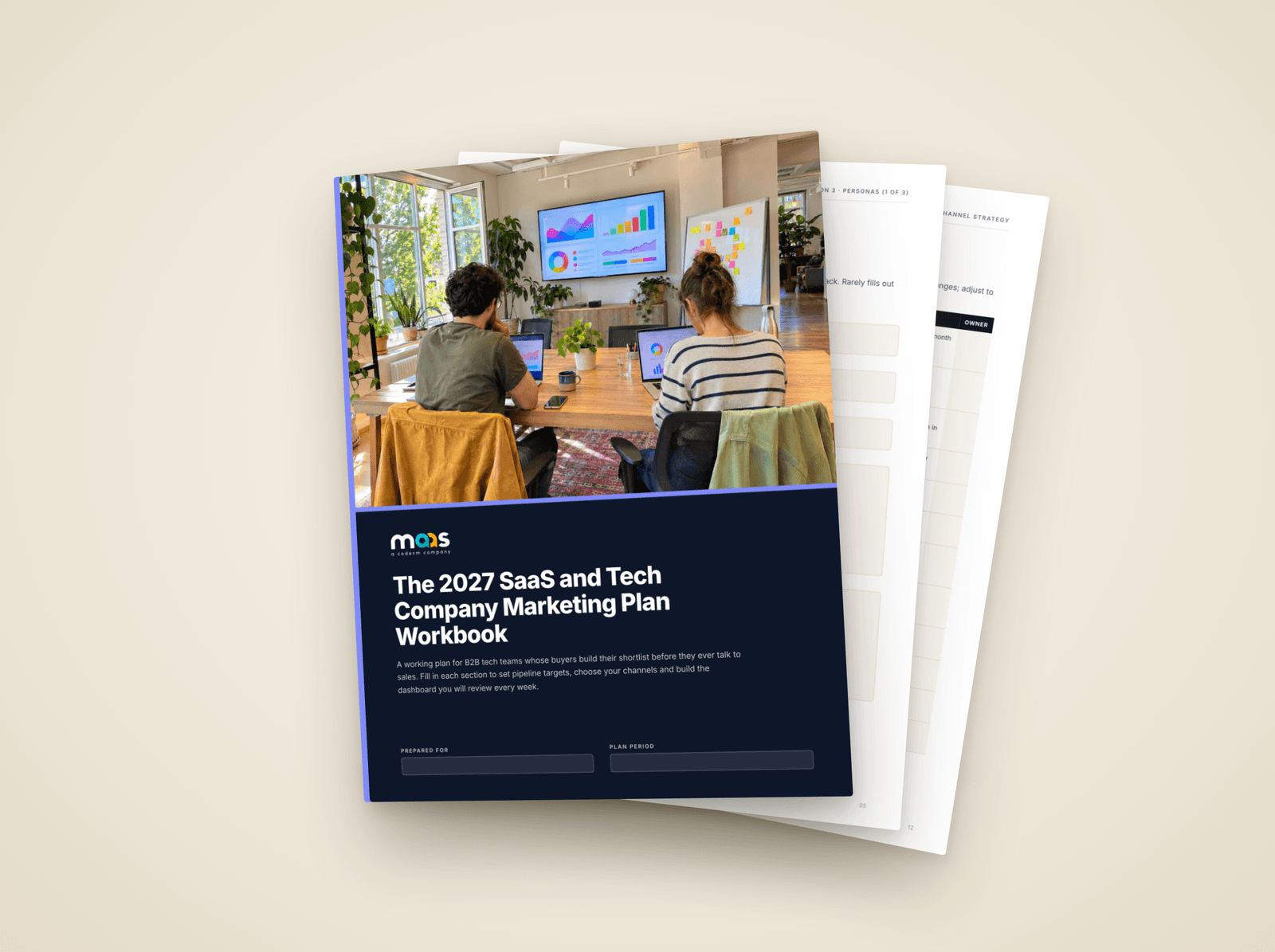
Click to download the free 2027 SaaS and Tech Company Marketing Plan workbook (PDF)
Why most tech company marketing fails
Tech companies rarely lack tools. They usually have more software than strategy. Six patterns show up again and again:
- Marketing counts leads, sales counts revenue, and nobody owns the gap. When marketing is measured on MQLs and sales on closed-won, the MQL definition turns into a negotiation. In Belkins’ 2026 conversion survey, roughly 44% of companies with 1 to 10 employees did not track MQL-to-SQL conversion at all.
- Feature-first messaging. The homepage lists what the product does. The buyer is searching for the problem they have, in their own words, and for proof that a company like theirs fixed it.
- All demand capture, no demand creation. Search ads and demo forms only reach people already shopping. The 95:5 rule from John Dawes of the Ehrenberg-Bass Institute holds that only about 5% of your target buyers are in market at any given time. Harvest only that 5% and you fight the same competitors for the same small pool every quarter.
- Invisible where the shortlist is built. Review sites, comparison pages, integration marketplaces and AI answers do much of the persuading now. Most small vendors have a thin G2 profile, no comparison pages, and have never checked what ChatGPT says about them.
- Launches treated as a single day. A feature ships, a blog post goes out, and the launch is over by Friday. Nobody updates the comparison pages, the sales deck, the review profile or the help docs that AI tools read.
- No attribution across a long journey. Dreamdata’s 2026 LinkedIn Ads benchmarks put the average time from first ad impression to revenue at 281 days. A 30-day last-click report will tell you the channels that started your deals did nothing.
A written plan fixes these by forcing the answers in advance and measuring against them.
The 2027 economics of tech marketing
Budget as a share of revenue. Gartner’s 7.8% average skews toward large companies, and tech has been cutting: in Gartner’s 2025 survey, IT and business services providers brought marketing down to 5.8% of revenue from 9% the year before. Use percent-of-revenue as a sanity check, not the method. The better method is to work backward from the new revenue you need.
Pipeline math. Take the new ARR you need from new customers, divide by your average contract value (ACV), then walk back up the funnel with your own conversion rates. Funnel definitions vary so much that published stage benchmarks are only directional. Belkins’ 2026 survey, which leans toward smaller companies, found a median win rate of 21% to 30% and a median MQL-to-SQL rate of 11% to 20%. For SQL-to-opportunity, a common planning range is 40% to 60%. Replace every assumption with your own data after one quarter.
Here is the math for $1.5M of new ARR at a $30,000 ACV:
| Funnel stage | Conversion assumption | Volume needed per year |
|---|---|---|
| Closed-won deals | $1.5M ÷ $30,000 ACV | 50 |
| Opportunities | 25% win rate | 200 |
| Sales-qualified leads (SQLs) | 50% SQL to opportunity | 400 |
| Marketing-qualified leads (MQLs) | 15% MQL to SQL | 2,667 |
That is about 220 MQLs a month. Raise MQL-to-SQL from 15% to 25% and you need 1,600, a 40% cut in the volume you have to buy. This is why fixing lead definitions and speed to lead usually beats adding a channel.
CAC payback. The 2026 Aleph and Benchmarkit SaaS benchmarks, based on full-year 2025 data, put median CAC payback for B2B SaaS at 16 months. The top quartile recovers acquisition cost in 6 months or less; the bottom quartile takes 24 months or more. Companies under $5,000 ACV had an 11-month median, and those at $50,000 to $100,000 had a 22-month median. The formula:
CAC payback (months) = sales and marketing cost to acquire new customers in a period ÷ (new MRR from those customers × gross margin)
Example: $300,000 of sales and marketing spend in a quarter brings in $25,000 of new MRR at 80% gross margin. $300,000 ÷ ($25,000 × 0.8) = 15 months.
Channel benchmarks for 2027:
| Channel | What it is good for | Benchmark or typical cost |
|---|---|---|
| Google Search (brand, competitor, category terms) | Capturing buyers already shopping | Business Services average CPC $5.87, CPL $93.69 (WordStream 2026); competitive software terms often cost more |
| LinkedIn Ads | Reaching buying committees by role, company size and industry | Average CPC €5.98 and 121% ROAS across Dreamdata customers (Dreamdata 2026) |
| Meta Ads | Low-cost retargeting, SMB buyers | Average CPC €1.60 across Dreamdata customers (Dreamdata 2026) |
| Review sites (G2, Capterra, TrustRadius) | Validating the shortlist, feeding AI answers | Free profiles; buyers rank review-site citations as the top trust signal in AI answers (G2 2026) |
| SEO, comparison and alternatives pages | Compounding research-phase traffic | Planning range $3,000 to $10,000 a month for a steady program |
| AI search visibility (AEO) | Being named in ChatGPT, Gemini, Perplexity and AI Overviews | 51% of software buyers start research in a chatbot more often than Google (G2 2026) |
| Partner and integration marketing | Borrowed trust, co-selling | 11.7% average win-rate lift when partners are involved in deals (Crossbeam network data) |
| Email nurture | Staying present across a 10-month cycle | Tool cost; must follow CAN-SPAM |
| Webinars and events | Education, accelerating active deals | Planning range $500 to $5,000 per webinar; trade shows far more |
One shift to plan around: across Dreamdata’s customers, LinkedIn now takes 41% of B2B paid media budgets, while non-branded search CPCs rose 29% and click-through rates fell 26%, a drop Dreamdata ties to AI Overviews (Dreamdata 2026). Keep search for brand and competitor terms.
Rules to know before you market
- CAN-SPAM covers B2B email. The FTC says plainly that “the law makes no exception for business-to-business email.” Each violating email can cost up to $53,088, and opt-outs must be honored within 10 business days (FTC CAN-SPAM guide). Every email needs an accurate sender, an honest subject line, a physical address and a working unsubscribe.
- UK and EU rules differ. In the UK, PECR does not require consent to email corporate subscribers, but sole traders and some partnerships need consent or the soft opt-in, and UK GDPR still applies to named contacts (ICO). EU countries apply their own ePrivacy rules to B2B email, so check each market first. For EEA and UK visitors, use a consent platform and Google Consent Mode; Google’s EU user consent policy governs ads measurement and personalization.
- US state privacy laws. A growing list of states has comprehensive privacy laws (the IAPP tracker keeps count). California’s covers business contacts: its B2B exemption expired on December 31, 2022. Honor opt-outs and keep your privacy policy current.
- Reviews. The FTC’s rule on consumer reviews and testimonials, in force since October 21, 2024, bans fake reviews, buying reviews conditioned on sentiment, undisclosed insider reviews and review suppression (FTC final rule). Treat it as the standard for G2 and Capterra campaigns: incentives for honest reviews only, never for positive ones, and follow each site’s own rules.
- AI claims. Launching Operation AI Comply in September 2024, the FTC said “there is no AI exemption from the laws on the books” (FTC). “AI-powered,” accuracy, time-saved and ROI claims need evidence you could show a regulator.
- Texts and calls. Autodialed or prerecorded telemarketing calls and texts to mobile numbers require prior express written consent under the TCPA rules (47 CFR 64.1200).
This is a practical summary, not legal advice. Check specifics with counsel, especially before entering a new country.
The 10-section tech marketing plan framework
The workbook has a fillable page for each section. Here is what goes in each one.
1. Business snapshot
The numbers everything else depends on: what you sell in one plain sentence, ARR and growth rate, ACV and pricing model, sales motion (sales-led, product-led or hybrid), ideal customer profile, average sales cycle, win rate, net revenue retention and your top three integrations. Add the trigger event that makes a company start looking. If you cannot name it, ask your last 10 customers what was happening the month they started searching.
2. SWOT analysis
Strengths might be time to value, a niche you serve better than horizontal platforms, or integrations. Weaknesses are often a thin review count, no SOC 2 report, no self-serve trial, or pricing nobody can find. Opportunities include competitor price increases, a legacy tool being sunset and new compliance requirements. Threats include a platform bundling your feature for free, AI-native entrants, and AI assistants recommending a competitor when buyers ask for alternatives.
3. Buyer personas
In B2B, personas are roles in a buying group, not demographics. Three cover most deals:
- The Budget Owner. A VP or director of operations, finance or the affected department. Owns the problem and the money, weighs cost, risk and payback, and has the final say. Reads peer reviews, comparisons and the business case your champion builds.
- The Champion. The manager who will use the product every day. Usually finds you first, through search, an AI assistant or a peer, and needs material to sell you internally: a short demo video, a comparison page, an ROI calculator, a peer customer story.
- The Technical Gatekeeper. The IT, security or engineering lead who joins late and can veto. Wants security documentation, SSO, API docs and a SOC 2 report, and does not want to be sold to.
For each, write the title, the trigger that starts their search, where they research, their top objections and the content that answers them.
4. Competitive analysis
Pick five: three direct competitors, one horizontal platform that bundles your feature, and “do nothing” (the spreadsheet or in-house tool you most often lose to). For each, record G2 rating and review count, pricing model and entry price, primary segment, top integrations, homepage claim, and how AI assistants describe them. Ask ChatGPT, Gemini and Perplexity “best [category] for [your ICP]” and “[competitor] alternatives,” and note who gets named and why. Then write one sentence on where you win.
5. Positioning statement
One sentence:
“For [target buyer], [company] is the [category] that [differentiator] because [reason to believe].”
Example (fictional): “For operations leaders at 50- to 500-person field service companies, Routewise is the scheduling platform that cuts dispatch time without replacing the ERP they already run, because it syncs both ways with NetSuite, Acumatica and QuickBooks and goes live in under two weeks.”
A specific buyer, the main objection answered, and a proof point sales can repeat. If you cannot write yours, you have a feature list, not a position.
6. Goals and KPIs
Three to five SMART goals tied to pipeline, not activity. Examples:
- Create $4.8M in marketing-sourced pipeline by December 31, 2027, up from $3.1M in 2026.
- Raise MQL-to-SQL conversion from 14% to 22% by Q3 by rewriting the MQL definition with sales.
- Bring blended CAC payback from 19 months to 15 months by Q4.
- Grow G2 reviews from 38 to 120, at least 10 a month.
- Be named in AI answers for 40% of 50 tracked buyer prompts by Q4, up from 12%.
Each goal gets one owner and a weekly check-in, and pipeline goals are shared by marketing and sales.
7. Customer journey map
A typical sales-led or hybrid journey has 10 stages:
- Trigger. A new hire, a failed audit, a tool being sunset, a growth spurt.
- Problem research. Google, AI chatbots, LinkedIn, peers, communities.
- Solution research. Category pages, “best X for Y” answers, comparison posts.
- Shortlist. Review sites, alternatives pages, peer referrals.
- First contact. Demo request, free trial or chat. The KPI is speed to lead.
- Evaluation. Demo, trial, proof of concept.
- Business case and security review. ROI model, security questionnaire, procurement.
- Close. Contract and kickoff.
- Onboarding. Time to first value.
- Expansion and advocacy. Upsell, reviews, case studies, referrals.
Most small tech companies have content for stages 5 and 6 only. Stages 2 to 4 and stage 7 are where deals are won or lost while you are not in the room.
8. Channel strategy
Investments below are planning ranges; scale them to your ACV and market.
| Channel | Role | Cadence | Typical investment |
|---|---|---|---|
| Website and conversion paths | Home base: pricing, demo, trial | Monthly conversion test | $2,000–$6,000/mo |
| SEO, comparison, alternatives and integration pages | Capture research-phase buyers | 4–8 pages/month | $3,000–$10,000/mo |
| AI search visibility | Get named and cited in AI answers | Monthly prompt tracking | With SEO, plus $300–$1,000/mo tools |
| Review sites | Validate the shortlist | Always-on review requests | Free profile; paid tiers vary |
| Google Ads | Brand, competitor and high-intent terms | Always-on | $3,000–$15,000/mo |
| LinkedIn Ads | Reach buying committees, retarget | Always-on | $3,000–$15,000/mo |
| LinkedIn organic (company, founder, experts) | Create demand among buyers not yet shopping | 3–5 posts/week across people | Time |
| Email nurture and newsletter | Stay present across the cycle | Biweekly plus triggered sequences | $100–$800/mo tool |
| Webinars | Educate, accelerate active deals | Monthly or quarterly | $500–$5,000 per event |
| Partner and integration marketing | Co-marketing, marketplace listings, co-selling | One campaign per top partner per quarter | Time plus partner funds |
| Product launches | Turn releases into pipeline | Quarterly, tiered | Time plus paid promotion |
Tier your launches. Tier 1 (a new product or major capability) gets a full campaign: landing page, press, webinar, paid promotion, sales enablement, and updated comparison pages and review profile. Tier 2 (a meaningful feature) gets a blog post, email, in-app message and sales note. Tier 3 goes in the changelog. Set the tier when the feature enters the roadmap.
Treat AI visibility as a channel. Track a fixed set of buyer prompts monthly, note who gets named and which sources get cited, and fix the gaps: missing comparison pages, outdated pricing, thin review profiles. Our guide to answer engine optimization covers the full playbook.
9. Content strategy and calendar
A workable cadence for a small team: one cornerstone piece a month, four to eight bottom-of-funnel pages a month, three to five LinkedIn posts a week across your company page and two or three people, and a biweekly newsletter. Rotate eight categories:
- Problem explainers. The problem in the buyer’s words, before your product appears.
- Comparison and alternatives pages. Be fair about where a competitor fits better; it makes the rest believable.
- Integration pages. One per integration: what syncs and how long setup takes.
- Customer stories. Approved outcomes from companies your ICP sees as peers.
- Original data. Aggregated, anonymized benchmarks that press and AI tools cite.
- Launches and changelog. Tiered as above.
- Expert point of view. Founder and practitioner posts on how the work is changing.
- Demos and how-to video. Short walk-throughs your champion can forward.
10. Budget allocation and measurement
An illustrative $30,000 monthly program for a company between $5M and $10M ARR:
- LinkedIn Ads: $7,500 (25%)
- Google Ads: $6,000 (20%)
- SEO, comparison pages and AI visibility: $6,000 (20%)
- Content production (video, design, customer stories): $3,600 (12%)
- Martech (CRM, automation, AI visibility tracking): $2,400 (8%)
- Review program and partner co-marketing: $1,500 (5%)
- Webinars and events: $1,500 (5%)
- Testing reserve: $1,500 (5%)
Measurement. UTMs on every paid link, original-source fields in the CRM, a required “How did you hear about us?” field on demo forms (it catches AI chatbots, podcasts and peers that analytics miss), offline conversion imports into Google and LinkedIn, and account-level reporting. The weekly dashboard: MQLs and SQLs by source, MQL-to-SQL rate, pipeline created by source, median speed to lead, demo show rate, rolling 90-day win rate, CAC payback, AI share of answers, and G2 review count and rating.
Common mistakes to avoid
- Calling every form fill an MQL. A student’s ebook download is not a lead. Write the definition with sales and score on fit and intent.
- Gating everything. Gate benchmarks, templates and ROI tools. Leave explainers and comparisons open so buyers and AI tools can read them.
- Running LinkedIn like Meta. Broad audiences, one image ad, and campaigns judged after two weeks on a journey that takes months. Target the buying committee and judge on pipeline.
- Ignoring review sites until a deal is lost. Build review requests into onboarding milestones and renewals.
- Hiding how pricing works. Buyers and AI tools fill the gap with guesses. If you cannot publish prices, publish the model and a starting point.
- Measuring launches by launch-day traffic. Measure pipeline influenced over the next 90 days.
Where to start if you’re starting from scratch
Don’t try to finish all ten sections in one week. Run this order:
- Week 1. Sections 1, 3 and 5. Interview five recent customers about their trigger and shortlist.
- Week 2. Agree MQL and SQL definitions with sales. Add source fields and the “How did you hear about us?” field.
- Week 3. Run 20 buyer prompts through ChatGPT, Gemini, Perplexity and Google AI Mode and record who gets named. Update G2 and Capterra profiles and start review requests.
- Week 4. Publish or fix the pricing page, three comparison or alternatives pages and your top integration pages.
- Month 2. Launch Google Ads on brand, competitor and high-intent terms. Start LinkedIn retargeting plus one ICP campaign. Build a nurture for trial users and demo no-shows.
- Month 3. Build the weekly dashboard, run your first CAC payback calculation, and tier the next two launches.
- Quarter 2. Co-marketing with your top two integration partners, one original data report, and a quarterly webinar series.
- Year 1. Re-run the funnel math with real conversion rates and move budget to the sources that produced pipeline.
FAQ
How do you make a marketing plan for a SaaS or tech company? Start with the new ARR target and work backward through your funnel to the qualified leads you need. Then define buying-group personas, positioning, channels, content, budget and a weekly dashboard. The 10 sections above, and the workbook, follow that order.
What are the most effective marketing strategies for SaaS companies? For sales-led and hybrid B2B companies: comparison and alternatives pages, strong review-site profiles, LinkedIn for buying committees, Google Ads on brand and competitor terms, partner co-marketing, and email nurture across a long cycle. Which leads depends on your ACV and how your buyers research.
What are the 5 C’s of marketing strategy? Company, customers, competitors, collaborators and context. In this plan they map to the snapshot and SWOT, the personas and journey, the competitive analysis, your partners and integrations, and shifts like AI search and privacy rules.
How much should a B2B tech company spend on marketing? Gartner’s 2026 cross-industry average was 7.8% of revenue, but a growth-stage SaaS company should set budget from pipeline math and a CAC payback target.
What is a good CAC payback period? The 2026 Aleph and Benchmarkit benchmarks put the B2B SaaS median at 16 months and the top quartile at 6 months or less. Lower-ACV products should pay back faster than enterprise deals.
Download the full template
The workbook is a fillable PDF companion to this guide. Inside:
- How to use the workbook
- Business snapshot
- SWOT analysis
- Three persona templates (Budget Owner, Champion, Technical Gatekeeper)
- Competitive analysis matrix (5 competitors)
- Brand positioning canvas with a worked example
- Goals and KPI tracker with a monthly check-in
- Customer journey map (10 stages)
- Channel strategy matrix
- Content framework and 30-day content calendar
- Budget allocation worksheet with an example split
- Tech stack checklist and weekly measurement dashboard
- 12-month action plan
- Common mistakes checklist and quick-start plan
Download the 2027 SaaS and Tech Company Marketing Plan workbook (PDF)
If you would rather have a team run this for you, from comparison pages and review programs to LinkedIn, Google, AI visibility tracking and weekly pipeline reporting, that is what the technology marketing team at MaaS by CodeSM does. Get in touch and we will review where you are and map the plan. For more on how AI search is changing traffic, read what AI Overviews mean for organic traffic.
Share this article