


Most multi-location retailers and franchise systems run two marketing programs that never meet. Corporate spends the brand fund on national creative and a few big promotions. Each store or franchisee does its own thing locally: a boosted post, a flyer, a sponsorship, a Google listing someone set up years ago. Nobody can say which of it brought people through the door.
E-commerce was 17.1% of U.S. retail sales in Q2 2026, so most retail dollars are still spent outside online checkout, but the trip to the store usually starts on a phone. BrightLocal’s 2026 survey found 97% of consumers read reviews for local businesses and 45% now use ChatGPT or other AI tools for local recommendations. NRF expects November and December 2026 sales to reach $1.013 trillion. And the FTC’s rule banning fake and manipulated reviews has been in force since October 2024, which matters a lot when 40 locations are all asking for reviews their own way.
This guide covers the 2027 marketing plan for multi-location retailers, franchise systems (both the franchisor’s brand plan and local store marketing) and independent stores: the budget benchmarks, the rules to clear first, the 10 sections of the plan, and the order to build it in. At the end you can download a free fillable PDF workbook to complete for your own brand or location.
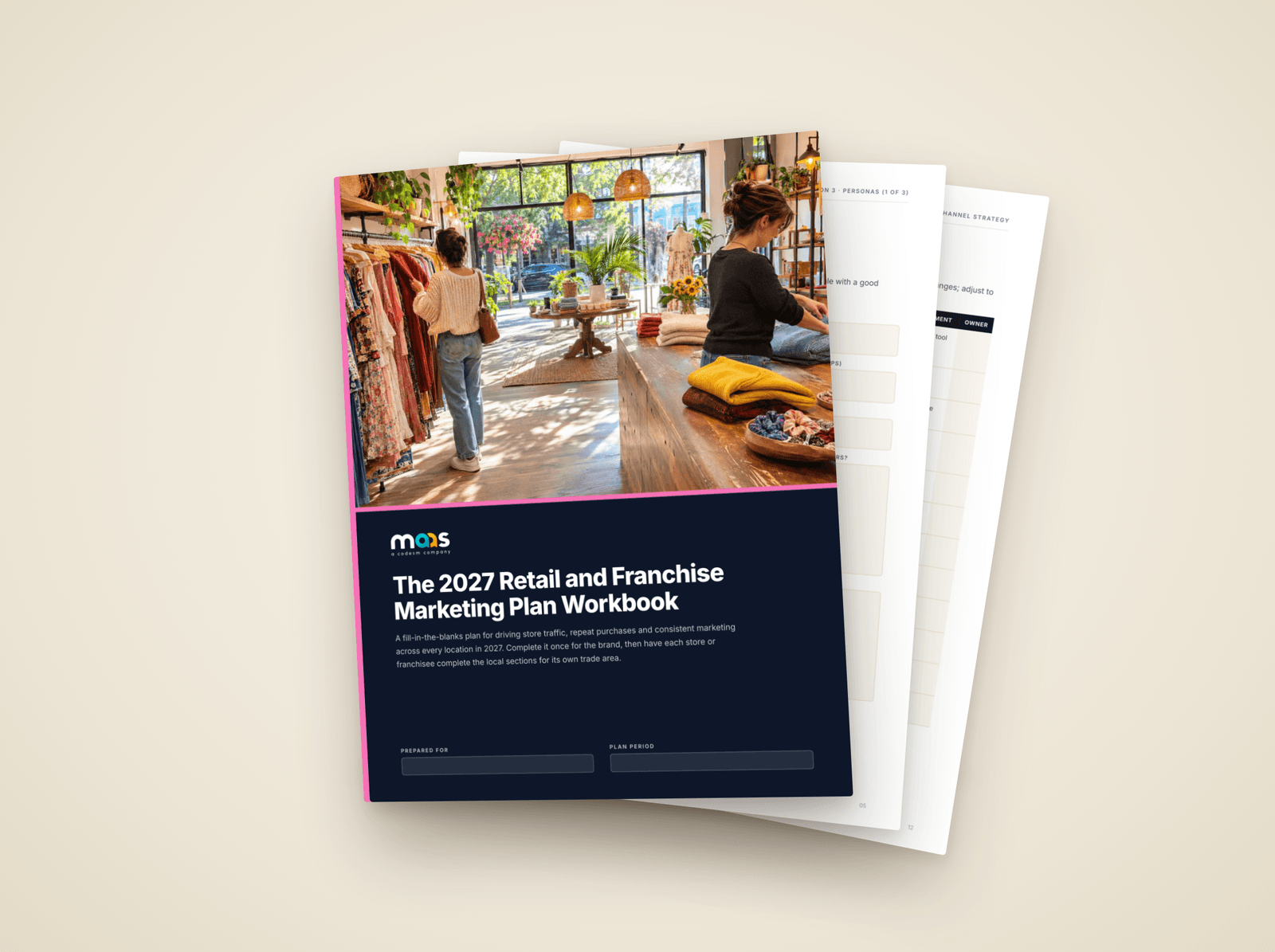
Click to download the free 2027 Retail & Franchise Marketing Plan workbook (PDF)
Why most retail and franchise marketing fails
The failures are predictable, and most of them come from structure, not creative:
- Brand fund and local marketing run as separate worlds. National campaigns build awareness, local efforts chase this week’s sales, and neither is planned against the other. Franchisees end up paying into a fund they don’t trust and improvising locally with off-brand creative.
- Location data is a mess. Duplicate Google listings, wrong holiday hours, a store that moved in 2024 still pinned at the old address. Every one of those errors leaks visits to whoever is listed correctly nearby.
- Promotions without margin math. The calendar becomes a string of discounts. Traffic goes up, margin goes down, and nobody checks whether the promotion brought new customers or just discounted the regulars.
- Online ads judged only on online sales. A shopper who sees a product ad, checks stock and buys in store looks like a wasted click in the ad platform. Brands then cut the ads that were driving store traffic.
- Reviews handled 40 different ways. One store offers a discount for 5-star reviews, another hides negative ones, a third never asks. The first two can violate the FTC’s review rule, and the third is losing to competitors with fresher reviews.
- Customer data stays at the register. The POS captures emails and phone numbers, but nobody sends anything, or every franchisee uses a different tool and corporate can’t see the list.
A written plan fixes these by deciding who owns what (brand versus location), what the calendar is, what every location must do the same way, and how you’ll measure store traffic, not just clicks.
The 2027 economics of retail and franchise marketing
Budget as a share of revenue. Gartner’s 2026 CMO Spend Survey put average marketing budgets at 7.8% of company revenue, mostly at large companies. For independent and multi-location retailers, a common planning range is 3–8% of sales depending on margin and growth stage, higher for new stores and new markets. Adjust to your margins.
How franchise budgets are built. Most franchise agreements fund marketing two ways: a brand (advertising) fund contribution and a local store marketing requirement, both usually a percentage of gross sales. A common planning range is 1–4% to the brand fund plus another 1–5% in required local spend, but your franchise agreement and FDD set the real numbers. Item 11 of the FDD must disclose who contributes, who administers the fund, and how it was spent in the last fiscal year by category, so franchisees can and should hold the plan to it.
What clicks and leads cost. LocaliQ’s 2026 search benchmarks put Shopping, Collectibles & Gifts at a $4.14 cost per click and 4.01% conversion rate, Apparel and Jewelry at $4.44, Furniture at $3.97, and Home & Home Improvement at $8.33, against a $5.42 all-industry average. Meta is cheaper per click: traffic campaigns averaged $0.59 for Shopping, Collectibles & Gifts and $0.71 for Apparel. Those are medians; seasonality moves them a lot, especially in Q4.
Owned channels pay back. In Omnisend’s 2026 report on 2025 data, automated emails were 2% of sends but drove 30% of email-attributed revenue. Welcome, browse, post-purchase and win-back flows should be built before you buy more traffic.
Reviews decide the shortlist. In the same BrightLocal survey, 74% of consumers only consider reviews from the last three months, 47% won’t use a business with fewer than 20 reviews, and 89% expect owners to respond. For a multi-location brand, every store needs its own steady flow, not a strong average across the chain.
Channel benchmarks for 2027:
| Channel | What it is good for | Benchmark or typical cost |
|---|---|---|
| Google Business Profile and Apple Business Connect (per location) | “Near me” searches, directions, calls, hours | Free; Google allows bulk verification for 10 or more locations |
| Google Shopping and Performance Max with local inventory | Product searches with in-store stock and pickup | Shopping & Gifts $4.14 CPC (LocaliQ); local inventory needs a feed and a Business Profile per store (Google) |
| Google Search (brand, category, location) | Capturing intent by store | All-industry $5.42 CPC (LocaliQ) |
| Meta (local awareness, catalog, retargeting) | Driving store visits around launches and events | Shopping & Gifts traffic CPC $0.59 (LocaliQ) |
| Email and SMS | Repeat purchases, launches, replenishment | Automated email: 2% of sends, 30% of email revenue (Omnisend) |
| Loyalty program | Frequency, data capture at the register | Planning range: 1–3% of member sales in rewards cost |
| Reviews program | Fresh reviews and responses per location | Planning range: $50–$150 per location per month for tools |
| Influencer and UGC | Local discovery and social proof | Planning range: $200–$2,500 per creator post, plus product |
| Local events, print and OOH | Openings, community presence | Varies by market |
Rules to know before you market
Retail and franchise marketing carries more regulation than most owners realize, especially around reviews and pricing. This is a practical summary, not legal advice.
- The FTC Consumer Reviews and Testimonials Rule. In effect since October 21, 2024, it bans fake reviews, incentives conditioned on positive (or negative) sentiment, undisclosed reviews by employees or their relatives, company-controlled “independent” review sites, suppressing negative reviews, and buying fake followers or views. In December 2025 the FTC sent its first warning letters under the rule and noted penalties of up to $53,088 per violation. Asking every customer for a review is fine. Paying for 5 stars is not, and Google’s own policies go further: no incentives of any kind for reviews and no selectively asking happy customers.
- The Endorsement Guides. The FTC’s updated Endorsement Guides (June 2023) cover influencers, gifted product, employee posts and reshared UGC. Material connections need clear disclosure, and a platform’s built-in paid-partnership label may not be enough on its own.
- Sale and comparison pricing. The FTC’s Guides Against Deceptive Pricing say a “was” price should be one the item was actually offered at, openly and in good faith, for a reasonable period. “Compare at” and permanent “sale” pricing draw state attorney general attention too.
- Email and SMS. Commercial email must follow CAN-SPAM (accurate sender, physical address, working unsubscribe). Marketing texts need prior express written consent under the TCPA, opt-outs made by any reasonable means must be honored within 10 business days, and some states add their own texting rules.
- Paid memberships and auto-renewals. The FTC’s click-to-cancel rule was vacated by the Eighth Circuit in July 2025, but ROSCA and state auto-renewal laws still require clear terms, consent and easy cancellation for paid loyalty tiers and subscriptions.
- Franchise sales marketing. If your marketing also recruits franchisees, earnings claims belong only in Item 19 of the FDD, and the Franchise Rule prohibits financial performance representations made outside it.
The 10-section retail and franchise marketing plan
The workbook has a fillable page for each section. Franchisors should complete it once for the brand, then have each location complete sections 1, 4 and 6 for its own market.
1. Business snapshot
Locations and formats (flagship, mall, strip center, kiosk), corporate versus franchised stores, trade area per store, top categories and price bands, average transaction value, sales split between store, pickup and shipping, POS and e-commerce platform, loyalty program, and current marketing spend split between brand fund and local. Then one sentence on why someone should shop here instead of the big box or the marketplace app.
2. SWOT analysis
Strengths: product you can touch, staff expertise, exclusive brands, same-day availability, community roots. Weaknesses: price versus online, inconsistent store experience, thin reviews at some locations, no customer data. Opportunities: local inventory ads in categories where competitors don’t show stock, an underused loyalty list, new trade areas, a weak competitor’s closures. Threats: marketplaces and big-box price matching, rising rents, shifting foot traffic, and compliance risk in how locations handle reviews and promotions.
3. Customer personas
Three personas cover most retail and franchise brands:
- The Near-Me Shopper. Needs it today. Searches “near me,” checks hours and stock, and goes to whichever store shows the item available and the best rating. Local inventory ads, accurate listings and fresh reviews win this persona.
- The Loyal Regular. Buys every few weeks, belongs to the loyalty program, opens your emails. Wants recognition, early access and convenience more than discounts. This is usually where most of your margin lives.
- The Occasion Planner. Shops for holidays, back-to-school, gifts, events or a home project. Researches online for days or weeks, compares across brands, and responds to the retail calendar. Content, Shopping ads and well-timed email move this persona.
For each, write down age and household, trade area, what they buy and spend, how they found you, the channel they respond to, and what would make them come back sooner.
4. Competitive analysis
Pick five competitors per trade area: usually a big-box chain, a marketplace or online pure play, one or two independents, and another franchise brand in your category. Compare them on Google rating and reviews per location, price position and promotion cadence, whether they show local inventory and pickup, loyalty program, email and SMS frequency, and social presence. Then write one line on where you can win.
5. Positioning statement
One sentence:
“For [target customer], [brand] is the [category] that [differentiator] because [reason to believe].”
Example: “For busy pet owners within ten minutes of a store, Brightside Pet Supply is the neighborhood pet shop that has your food in stock when the big box is out, because every store holds a 30-day buffer on the 200 items members buy most and shows live stock on Google.”
For a franchise, the brand writes the positioning once and every location uses it. Local marketing adapts the proof, not the promise.
6. Goals and KPIs
Three to five SMART goals that tie to store sales, not just clicks. Examples:
- Raise the average Google rating across 24 locations from 4.3 to 4.6, with at least 100 reviews per location, by December 2027
- Grow SMS and email reachable customers from 18,000 to 40,000 by year-end
- Lift loyalty-member share of sales from 35% to 45%
- Increase same-store sales 5% in Q4 2027 while holding promotional discount at or below 12% of sales
- Get 90% of franchisees running the quarterly local marketing kit on schedule
Each goal gets an owner (brand marketing, field marketing, store or franchise owner) and a weekly check-in.
7. Customer journey map
- Need. Something runs out, breaks, or an occasion is coming.
- Search. “Near me” searches, maps, AI assistants, marketplace apps.
- Compare. Reviews, stock, price, hours, pickup options.
- Plan the visit. Directions, call, reserve online or buy online for pickup.
- Store visit. Displays, staff, checkout speed. The store is still the brand.
- Purchase. In store, pickup, or ship from store.
- Capture. Loyalty sign-up or email and SMS opt-in at the register or on the receipt.
- Follow-up. Receipt email, review request, care tips, cross-sell.
- Repeat. Replenishment reminders, member offers, new arrivals.
- Advocacy. Reviews, UGC, referrals, gifting.
Most brands spend on stages 2 and 3 and leave stages 7 to 9 to chance. That is where repeat revenue comes from.
8. Channel strategy
| Channel | Role | Cadence | Typical investment |
|---|---|---|---|
| Google Business Profile (per location) | Local visibility, calls, directions | Weekly posts, monthly photos, hours checked before every holiday | Time plus listings tool |
| Apple Business Connect | Apple Maps and Siri visibility | Monthly updates | Free plus time |
| Location pages on your site | Local SEO and AI answers for each store | One page per store, refreshed quarterly | $150–$400 per page to build |
| Google Shopping and Performance Max with local inventory | Product discovery with in-store stock | Always on, daily feed | $1,500–$15,000/mo |
| Google Search | Brand, category and store-level intent | Always on | $1,000–$8,000/mo |
| Meta and short video | Local awareness, launches, retargeting | Always on plus event bursts | $1,000–$10,000/mo |
| Retention, launches, replenishment | Weekly campaigns plus automated flows | $100–$1,500/mo platform | |
| SMS | Time-sensitive offers, pickup alerts | 2–4 messages/month | $100–$1,000/mo platform |
| Loyalty program | Frequency and data capture | Always on | Rewards cost plus platform |
| Reviews program | Fresh reviews and responses | Daily requests, replies within 48 hours | $50–$150 per location/mo |
| Influencer and UGC | Local discovery | 1–3 creators per quarter per market | $200–$2,500 per post |
| Local events and print | Openings, community, seasonal | Monthly or seasonal | $250–$2,000 per event |
These are planning ranges for a 10–30 location brand; scale up or down. Store data has to be clean before the paid channels: local inventory ads only work when each store’s Business Profile and store code match the feed exactly.
9. Content strategy and calendar
A workable mix: about 50% short video (product in use, staff picks, store moments), 25% carousels and product photography, 15% UGC and reviews, and 10% community. Corporate produces the core assets each month; locations add local photos and events. Aim for 3–5 brand posts a week, 1–2 local posts per location a week, and a weekly email. Categories to rotate:
- New arrivals. First look at what just landed, with stock by store.
- Staff picks. A named employee and why they recommend something.
- How-to and product education. Short demos that answer the questions shoppers type into search and AI assistants.
- Bundles and gift guides. Built around the retail calendar.
- Customer content. Reshared UGC with permission and clear disclosure when anything was given in exchange.
- Store moments. Openings, remodels, events, behind the counter.
- Member perks. Early access and member-only events.
- Community. Local schools, causes and partner businesses near each store.
Plan the year on the retail calendar: New Year resets, Valentine’s Day, spring and Easter, Mother’s Day and Father’s Day, back-to-school (July to September), Halloween, and the November to December holiday stretch, plus any category-specific seasons. Many retailers plan on the NRF 4-5-4 calendar so year-over-year comparisons line up by week.
10. Budget allocation and measurement
A 12-location retailer or franchise group spending about $30,000 a month might split it like this:
- Google Shopping, Performance Max and Search: $8,400 (28%)
- Meta and short video ads: $6,000 (20%)
- Content and creative production (photo, video, UGC): $4,200 (14%)
- Email, SMS and loyalty: $3,600 (12%)
- Local SEO, Business Profiles and reviews: $3,000 (10%)
- Local events, print and community: $2,400 (8%)
- Testing reserve: $2,400 (8%)
In a franchise system, the brand fund typically covers creative, platforms, national or regional media and the local kit. Each location’s required local spend then runs on brand-approved templates: geo-targeted Meta and Google campaigns, events and print, with results reported by location.
Measurement: use one UTM convention and one set of store codes across every channel. Turn on store visit and local action reporting where your ad accounts qualify, connect loyalty and POS data so you can match ad audiences to store sales, and report every metric by location. The weekly dashboard: sales by location versus last year, transactions and average order value, loyalty-member share of sales, new email and SMS opt-ins per store, review count, rating and response time per location, Business Profile calls and direction requests, email and SMS revenue per send, and blended return on ad spend.
Common mistakes to avoid
- Planning the brand fund and local marketing separately. Put both on one calendar so local efforts amplify national campaigns instead of competing with them.
- Letting every location build its own listings and ads. Centralize Business Profile ownership, store data and ad templates, then give locations controlled access to add local content.
- Gating or rewarding positive reviews. Sentiment-based rewards violate the FTC rule, and both break Google’s review policies. Ask every customer the same way, and respond to negative reviews instead of burying them.
- Measuring online ads on online sales alone. Shopping and local ads drive store visits. Without store visit or POS match-back data, you’ll cut what’s working.
- Promotions without margin math. Set a discount budget for the year and measure each promotion on new customers and gross margin, not just traffic.
- Not capturing customers at the register. Every store should have an opt-in target per week, with staff who know why it matters.
- Influencer posts without disclosure. Gifted product counts. Put disclosure requirements in every creator agreement.
Where to start if you’re starting from scratch
Don’t try to finish all ten sections in one weekend. Use this order:
- Week 1. Sections 1, 3 and 5: snapshot, personas and positioning. Two to three hours.
- Week 2. Location data audit. Claim and verify every Google Business Profile (in bulk if you have 10 or more), fix duplicates, hours and categories, and set up Apple Business Connect. Four to six hours.
- Week 3. Write one review policy for every store that asks all customers the same way and offers no sentiment-based rewards. Set up review requests and response ownership. Three hours.
- Week 4. Turn on opt-in capture at the POS and on receipts, and build the welcome email flow. Four hours.
- Month 2. Launch Shopping and Performance Max with local inventory, plus one Meta campaign per region around your next calendar moment.
- Month 3. Lay out the 12-month retail calendar and the quarterly local marketing kit for stores or franchisees. Build the weekly dashboard by location.
- Quarter 2. Launch or relaunch loyalty, add automated replenishment and win-back flows, and run the first creator program.
- Year 1. Annual review by location. Reallocate the brand fund and local requirements based on what actually moved store sales.
Retail and franchise marketing plan FAQ
What are the 7 P’s of retail marketing? Product, price, place, promotion, people, process and physical evidence. For a store, the last three matter most: the staff, how easy it is to buy or pick up, and the store itself. The 5 P’s version usually drops process and physical evidence.
How much should a retail store spend on marketing? A common planning range is 3–8% of sales, with new stores and new markets at the higher end. Gartner’s 2026 survey puts the cross-industry average at 7.8% of revenue, mostly at large companies. Set the number from your margins and goals, then move it based on what drives store sales.
What should a franchise marketing plan include? The brand plan (positioning, national or regional campaigns, creative, platforms and how the brand fund is spent), the local store marketing plan (what each location must do, with templates and a minimum spend), shared rules for listings, reviews and promotions, and reporting by location so franchisees can see what their contributions bought.
Can you give an example of franchise marketing? A fitness franchise runs a national New Year campaign from the brand fund. Each location gets a kit with ad templates, geo-targeted Meta and Google campaigns, an email for its members, signage and a review request flow, and every location’s results show up on one dashboard.
Can a store offer an incentive for reviews? Not for Google reviews: Google’s policies prohibit incentives of any kind. Under the FTC’s 2024 rule, rewards tied to positive sentiment, suppressing negative reviews and undisclosed employee reviews are prohibited everywhere. The safe approach is to ask every customer, offer nothing in return, and respond to what they write.
Download the full template
The fillable PDF workbook is the companion to this guide. Inside:
- How to use the workbook
- Business snapshot
- SWOT analysis
- Three persona templates (Near-Me Shopper, Loyal Regular, Occasion Planner)
- Competitive analysis matrix (5 competitors)
- Brand positioning canvas with a worked example
- Goals and KPI tracker with a monthly check-in
- Customer journey map (10 stages)
- Channel strategy matrix
- Content framework and 30-day content calendar
- Budget allocation worksheet with an example split
- Tech stack checklist and weekly measurement dashboard
- 12-month action plan
- Common mistakes checklist and quick-start plan
Download the 2027 Retail & Franchise Marketing Plan workbook (PDF)
If you’d rather have a team run this for you, from location listings and reviews to local inventory ads, franchise kits and reporting by store, that’s what the retail and franchise marketing team at MaaS by CodeSM does, the same kind of work we’ve done for retailers like GILSA and the Farmacia Samaritana pharmacy chain. For more on the review side, see our guide to getting more good reviews. Get in touch and we’ll audit where you are and map the plan.
Share this article