


The freight market is turning, slowly. After 42 months of year-over-year declines, Cass freight shipments turned positive in August and rose 1.9% year over year in September 2026, while the Cass truckload linehaul index climbed 10.1%, its 21st straight month of growth. On the southern border, the US declined to renew USMCA at the July 1, 2026 joint review, so the agreement stays in force but now faces yearly reviews. And seats cost more to fill: driver cost per hire rose 41% year over year in the third quarter.
Most carriers, freight brokers and 3PLs grew on relationships. Marketing is a website, a trade show booth and whatever the owner posts on LinkedIn. That holds while the network is warm. It breaks when a key shipper consolidates providers, a top rep leaves, or a new procurement lead builds the RFP list from a web search. In 6sense’s 2025 survey of nearly 4,000 B2B buyers, buyers made first contact about 61% of the way through their journey, and the winning vendor was on the day-one shortlist 95% of the time. If you are not on the list before the bid, you are not in the bid.
This guide lays out the 2027 logistics marketing plan for trucking carriers, freight brokers, 3PLs and warehousing companies: why logistics marketing fails, the benchmarks that should set your budget, the rules that touch your ads and recruiting, and a 10-section framework that covers shipper personas, account-based marketing, RFP readiness and driver recruiting. At the end, you can download a free fillable PDF workbook to build your own plan.
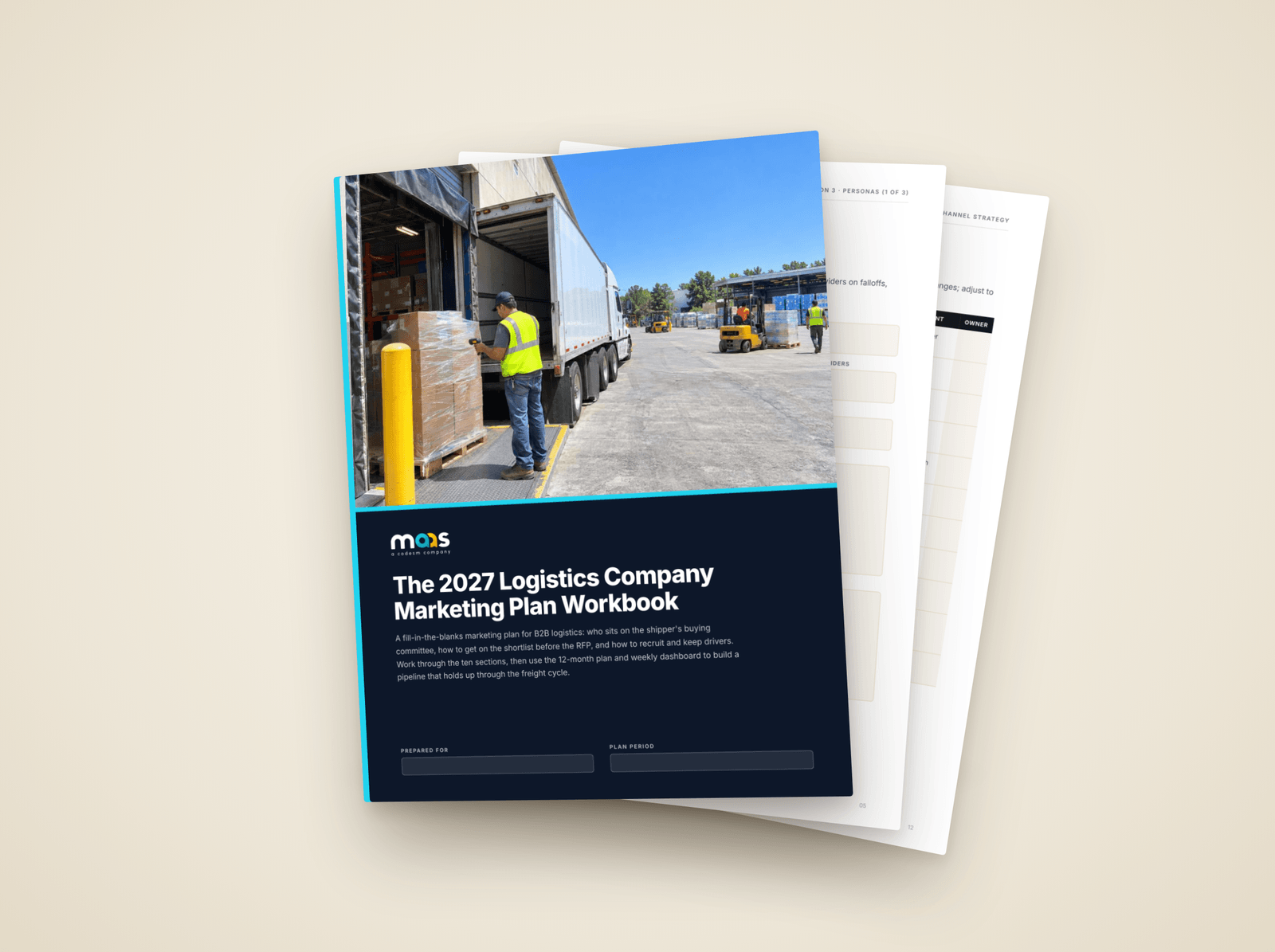
Click to download the free 2027 Logistics Marketing Plan workbook (PDF)
Why most logistics marketing fails
Six patterns explain most of it:
- Claims without numbers. “Reliable, on-time, safety-first” is on every carrier’s website. Shippers buy lanes, on-time percentages, claims ratios, tender acceptance and tracking. If your proof is not on the page, the adjectives do nothing.
- One audience called “shippers.” The shipping manager who tenders loads every day, the procurement lead who runs the bid and the operations VP who redesigns the network want different things. Marketing that talks to all of them at once lands with none.
- Marketing that follows the freight cycle. Budgets get cut when volumes fall, so when capacity tightens and shippers re-bid, there is no pipeline and no brand to lean on.
- The RFP scramble. Insurance certificates, safety data, lane metrics, case studies and references get rebuilt from scratch for every bid, usually the night before it is due.
- Recruiting and sales tell two stories. Driver ads promise one company and the sales deck describes another.
- Leads with nowhere to go. A rate request from the website sits in a shared inbox for two days. No CRM, no owner, no follow-up.
A plan fixes these by deciding in advance who you sell to, what proof you show and how every inquiry gets handled.
The 2027 economics of logistics marketing
The freight cycle. Rising contract rates send shippers back to bid, and falling volumes push them to consolidate providers. Either way, the shortlist gets built months before the RFP, and procurement already knows the companies that kept publishing proof through the downturn.
How shippers buy. Beyond 6sense’s shortlist finding, the same research found average B2B buying cycles of 10.1 months, and Dreamdata’s 2025 benchmark measured B2B customer journeys averaging 211 days. The job is staying visible to the right accounts for months.
Budget. Across industries, marketing budgets sit at 9.0% of company revenue in The CMO Survey’s 2026 report, but most of that sample are companies with more than $100 million in revenue, and transportation is only 3.3% of respondents. Asset-heavy, thin-margin logistics companies run far lower. A practical planning range is 1% to 3% of revenue for carriers and 3PLs, or 5% to 10% of net revenue for brokers, with driver recruiting budgeted separately and measured on cost per hire. Adjust to your growth goals.
Driver recruiting. Besides the 41% jump in cost per hire, 46% of carriers surveyed had raised driver pay in the past 90 days, and the ATA’s 2026 compensation study put median pay for irregular-route dry van employee drivers at $73,639 for 2025. Fully loaded costs are high: a TCA best-practice exercise with 43 carriers put total expense per hire at about $10,900 back in 2018, before the recent increases. And turnover at large truckload carriers averaged 92.7% from 1996 to 2023, according to ATA data cited in a National Academies study. Retention is a marketing number.
A niche example: cross-border US-Mexico. Freight between the US and Mexico reached $872.8 billion in 2025, up 3.9%, with trucks carrying 73.6% of it. Laredo alone handled $296.2 billion in truck freight, 46.1% of US-Mexico truck value. With USMCA under annual review, shippers want partners who can explain the rules, not just quote a rate. The same applies to any niche you own, from cold chain to final mile.
Channel benchmarks for 2027:
| Channel | What it is good for | Benchmark or typical cost |
|---|---|---|
| Website with service and lane pages | Proof, RFQ capture, being findable for your lanes | Planning range: $2,000 to $5,000 per month with SEO and new pages |
| Google Search Ads | Capturing active searches for capacity, 3PL and warehousing | Business services: $5.87 CPC, 4.85% conversion rate, $93.69 cost per lead. Industrial and commercial: $5.87 CPC, $75.19 cost per lead (LocaliQ 2026) |
| LinkedIn Ads (account-based) | Reaching buying committees at target accounts | Median $9.39 CPC, 0.67% CTR and $202 cost per lead across 138 B2B advertisers (Metadata); 113% ROAS in Dreamdata’s benchmark (PPC Land) |
| LinkedIn organic (company and leaders) | Visibility with procurement and operations leaders | Time: 2 to 4 hours per week across leaders |
| Account-based email and outbound | Direct conversations with target accounts | Planning range: $200 to $800 per month in data and tools |
| Case studies and RFP library | Getting shortlisted and winning bids | Production time; one strong case study per quarter |
| Trade shows and associations | Accelerating relationships with known accounts | Planning range: $5,000 to $50,000 per event |
| Load boards and freight platforms | Capacity and spot freight for carriers and brokers | Subscription pricing |
| Driver recruiting | Filling seats and holding them | Cost per hire up 41% year over year (Transport Topics) |
Rules to know before you market
This is a practical summary, not legal advice. Confirm your obligations with FMCSA, your attorney and your compliance team.
- Brokers must market as brokers. Under 49 CFR 371.7, a broker may not advertise under any name other than the one its registration is issued in, may not represent its operation as a carrier, and must show its broker status in advertising. If you broker freight, do not write “our trucks” or “our fleet.” Since January 16, 2026, FMCSA can suspend a broker’s authority when its required $75,000 bond or trust drops below that level and is not replenished, and shippers and carriers check, so keep your MC number and authority easy to verify.
- Fleet branding must carry your USDOT number. 49 CFR 390.21 requires the carrier’s legal name or a single trade name and its USDOT number on both sides of each power unit, in contrasting color, legible from 50 feet in daylight. A truck wrap is a billboard and a compliance item.
- Performance claims need data behind them. On-time percentages, savings and safety claims in ads and case studies should come from records you can produce. Get customer approval for every case study and testimonial; the FTC’s 2024 rule bans fake reviews and testimonials.
- B2B email is covered by CAN-SPAM. The law makes no exception for business-to-business email: use accurate headers and subject lines, include a physical postal address and a clear opt-out, and honor opt-outs within 10 business days. Penalties run up to $53,088 per violating email.
- Calls and texts follow the TCPA. Autodialed or prerecorded calls and texts to cell phones need prior consent, including to business contacts and drivers. Build consent into shipper forms and driver applications, and honor opt-outs within 10 business days (current FCC rules).
- Recruiting ads follow employment law. The EEOC says it is illegal to publish a job ad that shows a preference based on race, color, religion, sex, national origin, age (40 or older), disability or genetic information. Avoid phrases like “young drivers” or “recent grads.” Background checks require a standalone written disclosure and written authorization under the FCRA, plus notices before and after any adverse action. Advertise pay you can document.
The 10-section logistics marketing plan framework
The workbook has a fillable page for each section. Here is what goes in each one.
1. Business snapshot
One page: your business model (asset-based carrier, broker, 3PL and warehousing, or a hybrid), modes and equipment, top 10 lanes, facilities, authority (USDOT, MC, broker bond), safety record, service metrics (on-time, claims ratio, tender acceptance), share of revenue from your top five accounts, sales capacity, and for carriers, open driver seats. Finish with one sentence on why a shipper should choose you. If it could appear on any competitor’s website, rewrite it.
2. SWOT analysis
- Strengths: dense lanes, asset capacity, specialized equipment (reefer, flatbed, hazmat), cross-border capability, tracking and EDI or API integration, safety record.
- Weaknesses: customer concentration, no published case studies, no marketing owner, thin website, driver turnover.
- Opportunities: nearshoring and cross-border lanes, shippers re-bidding as contract rates rise, niche verticals (food and beverage, automotive, building materials), AI answers where competitors are invisible.
- Threats: the freight cycle, rate pressure, USMCA and tariff changes, fraud and double brokering that erode trust in the whole market, insurance and driver costs.
3. Customer personas
Most logistics companies sell to a buying committee. Three personas cover it:
- The Shipping Manager. Tenders loads every day and gets blamed for every missed appointment. Wants capacity that shows up, live tracking and a dispatcher who answers the phone. Judges you on falloffs and communication. Found through Google, sales outreach and peer referrals.
- The Procurement Lead. Runs the annual or quarterly RFP. Wants competitive rates, clean compliance documents (authority, insurance, W-9, safety data), scorecards and financial stability. Rewards providers who submit complete bids on time and penalizes those who do not.
- The Supply Chain VP. Owns network strategy: new distribution centers, cross-border expansion, risk and technology. Reads LinkedIn, trade press and peer conversations. Wants a partner with a point of view and the capacity to grow with them.
Carriers have a fourth audience, drivers, covered below. For each persona, write down role and company type, freight profile, the KPIs they are judged on, biggest frustration, where they research, and the proof that moves them.
4. Competitive analysis
Pick five competitors you meet in bids or on your best lanes. For each, record modes and lanes served, published proof (case studies with real numbers), authority and safety information shown, tracking and integrations, LinkedIn activity, and search visibility for your service and lane terms. Carriers should add the driver offer. Then write one line on where you can beat them. Often the gap is proof: most competitors publish none.
5. Brand positioning statement
“For [target shipper], [your company] is the [category] that [differentiator] because [reason to believe].”
Example for a fictional company: “For automotive and industrial shippers moving freight between Monterrey and the Midwest, Puente Norte Logistics is the cross-border truckload carrier that keeps every load visible through the border handoff, because we run our own drivers, our own Laredo transfer yard and one tracking portal from pickup to delivery.”
Name a shipper type, a lane or mode, and a reason to believe a competitor cannot copy overnight.
6. Marketing goals and KPIs
Three to five SMART goals, each with an owner and a weekly check-in:
- Add 12 new shipper accounts with at least $250,000 in annual freight each by December 31, 2027
- Receive 20 RFP or bid invitations in 2027, up from 8, and win at least 25% of lanes bid
- Engage 60 of 150 target accounts (two or more contacts active) by September 30, 2027
- Generate 25 qualified quote requests per month from the website by Q4 2027
- For carriers: cut driver cost per hire by 15% and lift 90-day retention from 60% to 75%
Ten engaged target accounts are worth more than a thousand generic clicks.
7. Customer journey map
- Trigger. A service failure with the current provider, a new lane or facility, the annual bid cycle, a tariff change.
- Research. Google, AI assistants, LinkedIn, peers and trade press.
- Shortlist. Website proof, lane pages, case studies, authority and safety checks.
- First contact. RFQ form, spot quote, intro call.
- Trial loads. A few loads or a pilot lane to test you.
- RFP or bid. Rates, compliance packet, references.
- Onboarding. Setup packet, EDI or API connection, insurance certificates, SOPs.
- Performance. Scorecards, quarterly business reviews, exceptions handled well.
- Expansion. More lanes, modes or warehousing.
- Advocacy. A case study, reference calls, a LinkedIn mention.
Most logistics companies only market at stage 4. Stages 2 and 3 decide the shortlist; stages 8 to 10 decide growth.
8. Channel strategy
The 2027 channel mix (investment figures are planning ranges for a regional carrier, broker or 3PL):
| Channel | Role | Cadence | Typical investment |
|---|---|---|---|
| Website + lane and service pages | Proof and RFQ capture | 2 to 4 new pages/month | $2,000 to $5,000/mo with SEO |
| LinkedIn organic | Leader and company visibility | 3 to 5 posts/week across leaders | Time |
| LinkedIn Ads (ABM) | Reach buying committees at target accounts | Always on to the account list | $2,000 to $8,000/mo |
| Google Search Ads | Capture active capacity and 3PL searches | Always on, tight lane and service terms | $1,500 to $5,000/mo |
| Account-based email + outbound | Conversations with target accounts | Weekly sequences | $200 to $800/mo tools |
| Case studies + RFP library | Shortlist and bid support | 1 case study/quarter, library updated quarterly | Production time |
| Market update newsletter | Stay on the shortlist between bids | Monthly | $100 to $400/mo tool |
| Trade shows + associations | Meet target accounts in person | 2 to 4 per year | $5,000 to $50,000 per event |
| Load boards + freight platforms | Capacity and spot freight | Daily | Subscription |
| Driver recruiting | Seat drivers and keep them | Always on | Budgeted on cost per hire |
Account-based marketing. Pick 100 to 200 accounts by lane fit, freight profile and vertical, and map three to six contacts per account across shipping, procurement and operations. Run LinkedIn ads, email, sales calls and content to the same list, and measure account engagement instead of clicks.
RFP readiness. Keep a bid library current every quarter: company overview, authority and insurance certificates, safety data, service metrics by lane, tracking and integration specs, case studies, references and rate templates. A complete, on-time bid is marketing.
Driver recruiting funnel. Ad, landing page with real pay, home time and equipment, short mobile application, recruiter call within minutes, full DOT application and background check, orientation, 90-day check-ins. Track cost per application, application-to-hire rate, cost per hire, time to hire and 90-day retention. A driver who leaves in 60 days costs the same to replace.
AI assistants now answer questions like “best cross-border carrier in Laredo” directly. Our AEO guide covers how to be named in those answers.
9. Content strategy and calendar
The mix: about 40% LinkedIn posts from leaders and the company page, 25% proof (case studies, metrics), 20% website guides (lane, service and compliance pages) and 15% video (yard, equipment, drivers). Cadence: three to five LinkedIn posts a week, one case study a quarter, two to four website pages a month and a monthly newsletter. Categories to rotate:
- Lane guides. “Laredo northbound: how a cross-border load moves, step by step.”
- Case studies with lanes and metrics. On-time before and after, on a named lane, with the customer’s approval.
- Market updates. A monthly read on rates, capacity and what it means for shippers.
- Compliance explainers. The USMCA review, broker rules, what changed this year.
- RFP resources. “What a complete carrier bid package includes.”
- Driver stories. Home time, equipment, long-tenured drivers.
- Facility and equipment tours. Warehouse walkthroughs, new trucks, the dispatch floor.
- Leadership point of view. The freight cycle, nearshoring, technology.
10. Budget allocation and measurement
An example split for a regional carrier or 3PL spending $15,000 a month on commercial marketing, with driver recruiting budgeted separately:
- LinkedIn ads and ABM: 25%
- Content, case studies and SEO: 25%
- Events and associations: 15%
- Google Search Ads: 12%
- Email, outbound data and tools: 8%
- CRM, analytics and website: 8%
- Contingency and tests: 7%
Set a floor for the downturn. A budget that only exists when freight is strong leaves the pipeline empty when the market turns.
Measurement: a CRM with account-level source tracking, UTM tags on every campaign, and pipeline tied to accounts, not just leads. Review a dashboard every Monday: qualified quote requests, target accounts engaged, meetings booked, pipeline added, RFP invitations and submissions, win rate by lane, new-account revenue over the trailing 90 days, and for carriers, driver cost per hire and 90-day retention. Our post on email metrics to track covers the newsletter side.
Common mistakes to avoid
- Cutting marketing at the bottom of the cycle. Keep proof, LinkedIn and ABM running so you are on the list when shippers re-bid.
- Claims without numbers. Replace “reliable” with on-time percentages, claims ratios and named lanes you can document.
- A brokerage that looks like a carrier. It violates 49 CFR 371.7 and destroys trust the moment a shipper checks your authority.
- Answering every RFP from scratch. Build the bid library once and update it quarterly.
- LinkedIn ads aimed at job titles instead of accounts. Target the accounts that fit your lanes, then the people inside them.
- Recruiting ads that overpromise. Promised home time that dispatch cannot deliver shows up in 90-day turnover.
- No lane-level pages. Shippers search by lane and mode. A single “services” page ranks for nothing.
Where to start if you’re starting from scratch
- Week 1. Sections 1, 3 and 5: snapshot, personas and positioning. List your top 10 lanes, top 20 accounts and three ideal account profiles. Three hours.
- Week 2. Proof and compliance audit: pull on-time, claims and safety data, outline three case studies, and check the website, ads and trucks for MC, USDOT and broker-status rules. Four hours.
- Week 3. Website basics: an RFQ form routed to the CRM with a 15-minute response target, and the first three lane or service pages. Six hours.
- Week 4. Build a target account list of 150 companies with buying committees mapped in the CRM. Six hours.
- Month 2. Start a LinkedIn posting cadence for two or three leaders, launch an ABM campaign to the account list, and add Google Search Ads on service and lane terms.
- Month 3. Assemble the RFP library and send the first monthly market update newsletter.
- Quarter 2. Plan events around target accounts, audit the driver recruiting funnel, and launch a niche content series such as cross-border.
- Year 1. Review pipeline by source against the freight cycle, keep what produced accounts, and set a minimum budget for down markets.
Frequently asked questions
How do logistics companies get new shippers?
By getting on the shortlist before the bid. Publish proof (lane pages, case studies, service metrics), run account-based LinkedIn and email campaigns to a defined list of target shippers, capture active searches with SEO and Google Ads, and answer quote requests fast.
How do freight brokers find clients?
Most combine targeted outbound to shippers that fit their lanes and verticals with content that proves expertise, LinkedIn activity from leaders, and referrals. Brokers must always market as brokers, with broker status shown.
What are the best marketing strategies for trucking companies?
Lead with proof on specific lanes, keep your website and fleet branding consistent, run LinkedIn and email to target accounts, build an RFP library, and treat driver recruiting as its own funnel with cost per hire and retention targets.
Does LinkedIn advertising work for logistics companies?
It can, when it targets a list of accounts rather than broad job titles. LinkedIn clicks are expensive, with a median of about $9.39 in one 2025 benchmark, so judge it on engaged accounts, meetings and pipeline, not on cost per click.
How much should a logistics company spend on marketing?
Cross-industry surveys put marketing near 9% of revenue, but asset-heavy logistics companies run much lower. A planning range is 1% to 3% of revenue for carriers and 3PLs, or 5% to 10% of net revenue for brokers, with driver recruiting budgeted separately.
How can carriers lower driver cost per hire?
Fix the funnel before raising ad spend: show real pay and home time, shorten the application, call applicants within minutes, and track 90-day retention. Driver referral programs help too.
Download the full template
The workbook is a fillable PDF companion to this guide. Inside:
- How to use the workbook
- Business snapshot
- SWOT analysis
- Three persona templates (Shipping Manager, Procurement Lead, Supply Chain VP)
- Competitive analysis matrix (5 competitors)
- Brand positioning canvas with a worked example
- Goals and KPI tracker with a monthly check-in
- Customer journey map (10 stages)
- Channel strategy matrix
- Content framework and 30-day content calendar
- Budget allocation worksheet with an example split
- Tech stack checklist and weekly measurement dashboard
- 12-month action plan
- Common mistakes checklist and quick-start plan
Download the 2027 Logistics Marketing Plan workbook (PDF)
If you would rather have a team run this for you, from lane pages and case studies to LinkedIn, account-based campaigns and recruiting creative, that is what the logistics marketing team at MaaS by CodeSM does, and we have worked with transportation companies such as Trancasa and Jimenez Logistics. Get in touch and we’ll review where you stand and map your 2027 plan.
Share this article