


Community banks and credit unions head into 2027 competing for the same deposits as online banks, fintech apps and national brands with ad budgets many times their size. Customers have moved where that competition happens: in the 2026 ABA and Morning Consult survey, 44% of consumers said they bank most often through a mobile app and 20% on a laptop or PC, while 10% named a branch visit. The branch still matters, but the search for a new bank often starts on a phone, before anyone at the bank knows the prospect exists.
Budgets have not caught up. Banks typically put 0.05% to 0.07% of assets into marketing, often split by habit: a CD special when deposits get tight, sponsorships the board likes, a website refresh every few years. Marketing sits between retail, lending and compliance, so nobody owns the path from first ad to funded, primary account.
This guide lays out a 2027 marketing plan built for community banks and credit unions: why most bank marketing underperforms, the benchmarks that should shape your spend, the compliance rules to build in from the start, and the 10 sections of the plan, with personas, positioning, KPIs and a sample budget. At the end you can download a free fillable PDF workbook to complete for your own institution.
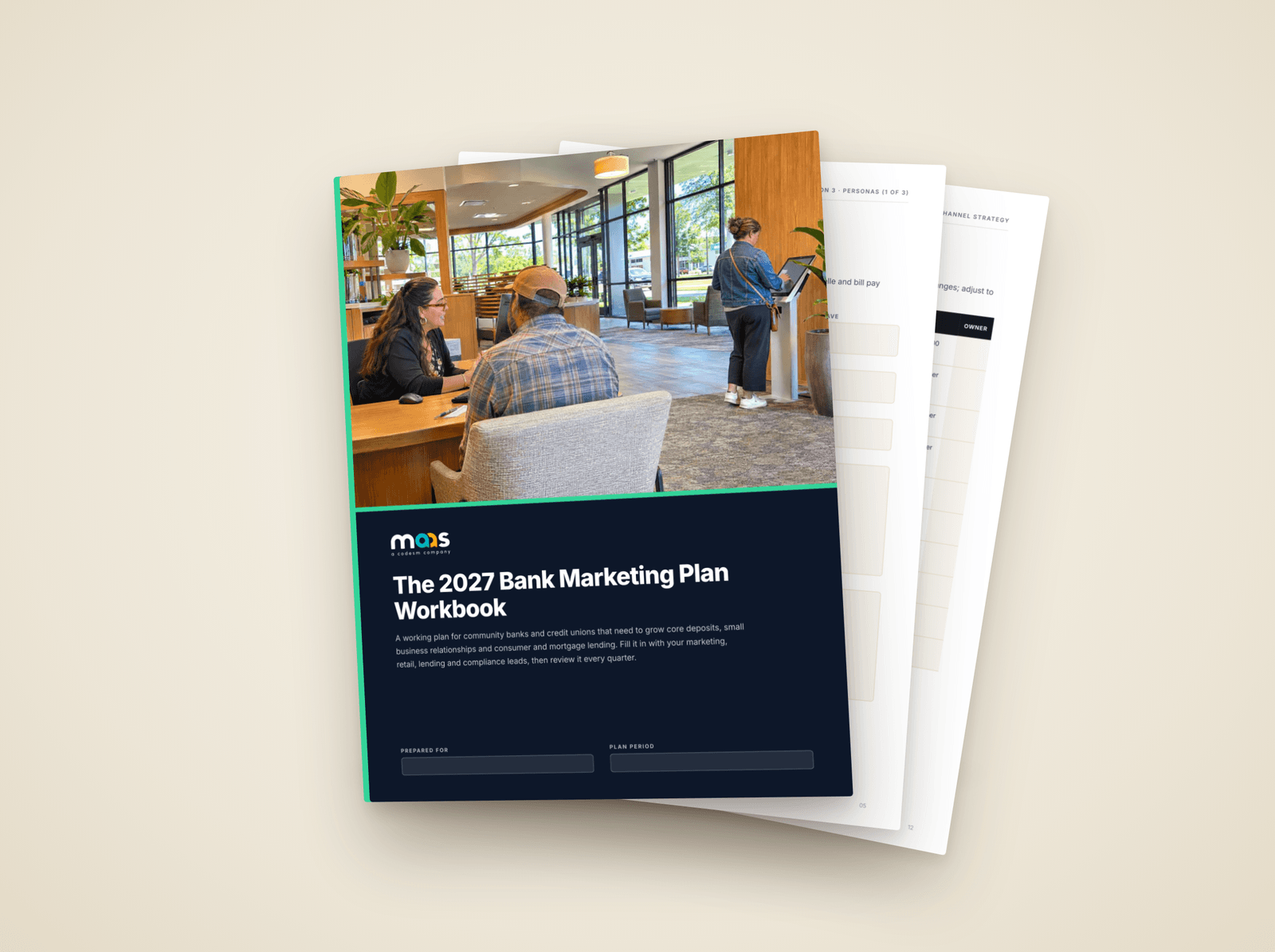
Click to download the free 2027 Bank Marketing Plan workbook (PDF)
Why most bank marketing fails
Bank marketing rarely fails for lack of effort. It fails in predictable ways:
- Rate is the only message. A promotional CD rate brings in balances, often from rate shoppers who leave at maturity. With no step after the rate ad, you rent deposits instead of earning relationships.
- Opened is treated as won. An account with $50 in it and no direct deposit is not a relationship. Most banks report new accounts; few report how many became primary within 90 days.
- The application leaks. Digital account opening reached 27% of checking openings in Cornerstone Advisors’ 2026 study, but 3.36 applications were abandoned for every one completed. Ads that send people into a slow or confusing flow pay for abandonment.
- Compliance comes last. When review happens after creative is finished, campaigns stall for weeks and rate offers expire before launch.
- Business banking gets a brochure. Treasury management, lines of credit and SBA lending are relationship sales, yet most bank websites give business owners a product list and a phone number.
- Everyone sounds the same. “Local decisions, personal service, community roots” appears on nearly every community bank and credit union site. Without proof, it reads as filler.
A written plan forces the decisions in advance: which products you are growing, for whom, what a good account looks like at day 90, and where compliance sits in the calendar.
The 2027 economics of bank marketing
Budget. At 0.05% to 0.07% of assets, a $750 million bank spends roughly $375,000 to $525,000 a year on marketing. Digital already makes up more than 60% of a typical bank’s media mix, and Capital Performance Group expects that to reach 65% to 70% in 2026.
Where the money goes. In the ABA’s 2026 budget survey of 121 institutions, budgets were allocated 30% to deposit growth, 23% to new customer acquisition and 20% to loan growth, with only 14% for deepening existing relationships and 12% for retention. Marketers rated digital advertising (3.78 out of 5) and search marketing (3.62) as their best-returning channels, and 85% planned to increase digital ad spend. Directories (1.52) and statement enclosures (1.63) scored lowest.
Search costs. In LocaliQ’s 2026 search benchmarks, Finance and Insurance averaged a $3.39 cost per click and a 2.64% conversion rate, against 8.18% across all industries, with an average cost per lead of $74.44. Clicks are not the hard part in banking. Converting them is, which is why the landing page and the account opening flow belong in the marketing plan.
Acquisition cost. There is no regulator-published benchmark. One bank consultancy estimates that acquiring a new checking account holder can cost upwards of $500 to $600. Treat that as a reference point and calculate your own: total campaign cost divided by funded accounts, then by accounts that are primary at 90 days. The second number is the one that matters.
Reviews and local search. In BrightLocal’s 2026 consumer survey, 97% of consumers read online reviews for local businesses, 47% won’t use a business with fewer than 20 reviews, and 89% expect owners to respond. Use of ChatGPT and other AI tools for local recommendations rose to 45%, and Apple Maps use for reviews rose to 27%. Every branch is its own listing, and every listing is a deposit channel.
Small business. The Federal Reserve’s 2026 Report on Employer Firms found that applicants at small banks were the most likely to be fully approved (57%), while 60% of online lender borrowers said their costs were higher than expected. Yet the share of applicants seeking online lenders rose from 17% in the 2020 survey to 29%. Community banks often have the better offer; online lenders have the better marketing.
| Channel | What it is good for | Benchmark or typical cost |
|---|---|---|
| Google Search (product terms) | Capturing people comparing checking, CDs, HELOCs, mortgages and business accounts | Finance and Insurance: $3.39 avg CPC, $74.44 avg CPL (LocaliQ 2026) |
| Google Business Profile + Apple Business Connect | ”Bank near me” searches, directions, calls, reviews per branch | Free; staff time per branch |
| Meta (Facebook, Instagram) | Awareness in your footprint, retargeting, community stories | Financial products special ad category limits targeting (Meta) |
| Email and SMS to customers | Onboarding, cross-sell, CD maturity, deepening | Rated 3.40 of 5 for return by bank marketers (ABA 2026) |
| SEO and content | Rate pages, calculators, branch pages, first-time buyer and business guides | Planning range: $1,500–$5,000/month in content and SEO support |
| Direct mail | Geographic prospecting, pre-screened offers, movers | Planning range: $0.60–$1.50 per piece, postage included |
| Business banking, treasury management, commercial lenders | Planning range: $1,000–$4,000/month in paid; organic is staff time | |
| Community events and sponsorships | Trust, local visibility, employer relationships | Varies; measure with event-specific offers |
Ranges without a source link are planning ranges, not published benchmarks. Adjust them to your market.
Rules to know before you market
Bank and credit union advertising is regulated more closely than almost any other industry. This is a practical summary, not legal advice: your compliance officer and counsel have the final word.
- UDAAP and UDAP. The Dodd-Frank Act prohibits unfair, deceptive or abusive acts or practices, and the FTC Act covers unfair or deceptive ones. The CFPB rescinded 67 guidance documents in May 2025 and spent 2026 in court over its funding (a federal court in Oregon ruled in September 2026 that the refusal to request funds was unlawful). The statute did not change, your prudential regulator still examines for it, and state attorneys general can bring their own cases. “No fees” that has fees is still deceptive.
- Regulation DD (Truth in Savings). Deposit ads cannot call an account “free” or “no cost” if a maintenance or activity fee may apply. A stated rate must be the annual percentage yield, and stating it triggers disclosures such as minimum balance, how long the rate is offered, and that fees could reduce earnings. Credit unions follow the NCUA’s parallel rule, Part 707.
- Regulation Z (Truth in Lending). In closed-end credit ads, terms like a down payment, number of payments, payment amount or finance charge trigger full disclosures, including the APR stated as “annual percentage rate.” HELOCs and other open-end credit have their own rules in section 1026.16.
- Regulation B and fair lending. Creditors may not use statements, “in advertising or otherwise,” that would discourage applicants on a prohibited basis, and that includes photographs and video. Dwelling-related loan ads need the Equal Housing Lender legend (12 CFR 338.3 for FDIC-supervised banks, 701.31 for federal credit unions). The ad platforms add their own limits: Meta’s financial products and services category fixes age at 18 to 65+, blocks gender and ZIP targeting and requires a 15-mile radius, and Google restricts age, gender, marital status and ZIP targeting for credit ads in the U.S. Map where you advertise against your assessment area.
- FDIC signs and digital signage (12 CFR 328). Ads need an official advertising statement such as “Member FDIC,” including social media ads. Under the 2026 amendments, the FDIC digital sign must appear on the homepage, the login page and the page where a consumer first starts opening a deposit account, and pages for non-deposit products need the “not FDIC insured; no bank guarantee; may lose value” disclosure. After several delays, the compliance date for the amended website, app and ATM rules is April 1, 2027, confirmed in the FDIC’s May 2026 updated Q&As.
- NCUA advertising rules (12 CFR 740). Credit union ads still need the official advertising statement, such as “Federally insured by NCUA.” The NCUA proposed eliminating that requirement in December 2025, but as of November 2026 its rulemaking page shows the proposal with its comment period closed and no final rule. The official sign requirement for offices and digital account opening locations is not part of that proposal.
Build a compliance workflow, not a compliance gate. Keep a pre-approved disclosure library for each product, a claims file that backs up every statement (“local decisions,” “fastest approvals”), a weekly review slot, and a rule that rate ads carry an end date and come down the day the rate changes. Archive every approved ad with its approval date. Marketing moves faster when compliance approves the building blocks once.
The 10-section bank marketing plan framework
The workbook has a fillable page for each of these sections.
1. Business snapshot
One page: charter type (state bank, national bank, federal or state credit union), asset size, branches and the counties they cover, deposit mix (core versus time deposits), loan-to-deposit ratio, the three products you most need to grow this year, whether you offer digital account opening for consumers and businesses, and your CRA assessment area or field of membership. End with a one-sentence differentiator you can prove. If it would fit on any bank’s website, keep writing.
2. SWOT analysis
Strengths usually include local decisions, lending in niches big banks avoid, and staff tenure. Weaknesses: the app rating, the account opening flow, a thin review profile. Opportunities: owners frustrated with online lenders, big-bank branch closures in your footprint, movers into your market. Threats: high-yield online savings, rate-driven outflows, and fintech apps that become a customer’s primary account.
3. Customer personas
Three personas cover most community bank and credit union growth plans:
- The Primary Switcher. 28 to 45, frustrated with fees, a closed branch or a call center, and ready to move direct deposit if switching is easy. Compares app ratings and Zelle or bill pay before rates. Often the next first-time mortgage or auto loan.
- The Main Street Owner. Runs a business with $1 million to $20 million in revenue, needs a line of credit, payroll and cash management, and wants a banker who answers. Decides on relationship and speed, and is often referred by a CPA or attorney.
- The Rate-Aware Saver. 55 and older, holds large balances in CDs or money market accounts, compares rates on comparison sites and is comfortable in a branch. Valuable deposits, but loyal only if you give them a reason beyond rate, such as a HELOC, trust services or a banker relationship.
For each, write the trigger that makes them shop, where they research, which product is the entry point, what would make them primary, and the objection you need to answer.
4. Competitive analysis
Compare five competitors: two local banks or credit unions, one national bank branch in your footprint, one online bank and one fintech your customers use. For each, record the top savings or CD APY, checking fees and minimums, time to open an account online (test it yourself), app store rating, Google rating and review count per branch, business banking offer, and dominant message. The gap is rarely rate. It’s speed to open, lending access, or a human you can reach.
5. Brand positioning statement
“For [target customer], [institution] is the [category] that [differentiator] because [reason to believe].”
Example: “For owner-operated businesses in the Tulsa metro that have outgrown a big bank’s call center, Prairie State Bank is the business bank where the lender who approves your line of credit is the one who answers your call, because every credit decision under $2 million is made in Tulsa within five business days.”
Notice the reason to believe is specific and checkable. Compliance can approve it once, and every ad can use it.
6. Goals and KPIs
Three to five SMART goals tied to the balance sheet, not to impressions. Examples:
- Add $40 million in core (non-CD) deposits by December 31, 2027
- Open 1,200 new checking households, with 60% receiving direct deposit within 90 days
- Cut digital application abandonment from 3 abandoned per completed application to 2 by Q3 2027
- Add 150 business checking relationships with $25 million in combined balances
- Hold marketing cost per funded primary account under $350
- Reach 50+ Google reviews and a 4.6+ rating at every branch
Each goal gets an owner, a monthly board-level view and a weekly working view.
7. Customer journey map
Banking journeys are short to open and long to deepen:
- Trigger. A move, a new job, a fee, a closed branch, a business milestone.
- Research. “Best checking account [city]” searches, rate sites, AI assistants, branch reviews.
- Comparison. Rate page, fee schedule, app ratings, the “switch to us” page.
- Application. Digital or in branch. The KPI is completion rate.
- Funding. Track funded separately from opened.
- Onboarding. The first 90 days: debit activation, app login, direct deposit.
- Primacy. Paycheck, bill pay and debit activity run through you.
- Cross-sell. HELOC, auto loan, savings, business account.
- Retention. CD maturity, rate changes, life events.
- Advocacy. Referrals and reviews.
Most institutions invest heavily in stages 1 to 4 and almost nothing in 5 to 7, which is where acquisition cost is won back.
8. Channel strategy
| Channel | Role | Cadence | Typical investment |
|---|---|---|---|
| Google Search | Product-level demand capture (checking, CDs, HELOC, business) | Always on, by product | $4,000–$12,000/mo |
| Branch listings (Google, Apple, Bing) | Local search, calls, directions, reviews | Weekly posts, monthly photos per branch | Free + 1 hr/branch/month |
| SEO and content | Product, rate, branch and calculator pages; education | 2–4 pieces/month | $1,500–$5,000/mo |
| Meta Ads | Footprint awareness, retargeting, community stories | Always on + product bursts | $2,000–$6,000/mo |
| Onboarding email and SMS | 90-day primacy journey for every new account | Triggered | $300–$1,500/mo platform |
| Customer email | Cross-sell, CD maturity, financial education | 2x/month | Included above |
| Direct mail | Movers, pre-screened offers, branch openings | Quarterly | $0.60–$1.50/piece |
| Business banking and commercial lender visibility | Weekly organic + quarterly paid | $1,000–$4,000/mo | |
| Organic social | Community, staff, fraud alerts, local business stories | 3–5 posts/week | Staff time |
| Community and events | Sponsorships, financial literacy, business workshops | Monthly | Varies |
These are planning ranges for a bank roughly $300 million to $2 billion in assets. Scale to your budget and your footprint.
9. Content strategy and calendar
A useful mix: about 40% short video (banker introductions, 30-second explainers, community moments), 30% carousels and graphics (fraud tips, rate updates with disclosures, how-tos), 20% long-form web content (guides, calculators, business articles) and 10% customer and community stories. Three to five social posts a week and two to four web pieces a month is enough if it is consistent.
Content categories to rotate:
- Fraud and scam alerts. Timely, useful and shareable. “The text message that looks like it’s from us.”
- Product explainers. HELOC versus cash-out refinance, how CDs ladder, what a line of credit costs.
- Switching help. A switch kit: moving direct deposit and autopays in 15 minutes.
- Meet your banker. Lenders and branch managers on camera, by name.
- Local business spotlights. Customers’ businesses, with written permission.
- First-time homebuyer education. Down payment programs, prequalification, closing costs.
- Community involvement. Volunteering, sponsorships, financial literacy classes.
- Business owner briefings. Cash flow, SBA basics, payments and treasury tools.
Anything that mentions a rate, fee or loan term goes through compliance. Education without rates moves faster, one more reason to publish it.
10. Budget allocation and measurement
A sample $30,000 monthly budget, roughly 0.06% of assets for a $600 million institution:
- Google Search (deposit, HELOC and business campaigns): $8,000
- Meta Ads (awareness and retargeting): $4,000
- SEO and content production: $4,500
- Onboarding and lifecycle email/SMS: $1,500
- Direct mail (movers and branch-area prospecting): $4,000
- Listings and review management: $1,000
- Creative and video production: $3,000
- Community sponsorships and events: $2,000
- Contingency for rate moves and opportunities: $2,000
Measurement: pass campaign source into your account opening platform and core (UTM parameters, promo codes, unique phone numbers), then report weekly on applications started and completed, funded accounts, cost per funded account, 90-day direct deposit rate, average balance at 90 days, branch listing calls and directions, and review volume. The workbook includes a dashboard template.
Common mistakes to avoid
- Measuring accounts opened instead of relationships built. Report funded accounts and 90-day primacy, or rate chasers will look like success.
- Sending paid traffic into a broken application. Apply for your own account on a phone every quarter, and fix the flow before raising the ad budget.
- Bringing compliance in at the end. Pre-approve disclosures and claims, then build creative from approved parts.
- One profile for the whole bank. Each branch needs its own claimed, reviewed and updated listing.
- Targeting that creates fair lending risk. Don’t exclude neighborhoods, ages or ZIP codes from credit campaigns, and review custom audiences built from customer lists before you use them.
- Ignoring business banking content. Owners search before they call. Give your commercial lenders pages, articles and LinkedIn profiles worth finding.
Where to start if you’re starting from scratch
- Week 1. Sections 1, 3 and 5: snapshot, personas, positioning. Pull 12 months of new accounts by source. Two to three hours.
- Week 2. Build the compliance workflow: disclosure library, claims file, weekly review slot. Audit website, app and ATM signage against the FDIC or NCUA rules and the April 1, 2027 digital compliance date.
- Week 3. Claim and update every branch on Google Business Profile and Apple Business Connect. Start a review request after account opening and loan closing.
- Week 4. Open an account through your own digital channel on a phone. Time it, note every drop point, and agree on fixes.
- Month 2. Launch the 90-day onboarding journey. Start Google Search for your two priority products.
- Month 3. Connect campaign source to funded accounts. Build the weekly dashboard and the monthly board summary.
- Quarter 2. Business banking content, lender pages and LinkedIn. Product and branch pages for search and AI answers.
- Year 1. Review results against goals, shift budget toward the channels with the lowest cost per primary account, and set 2028 targets.
FAQ
What is a marketing plan for banks? A written plan that connects growth goals (deposits, loans, households) to target customers, positioning, channels, budget, compliance review and measurement, usually for 12 months.
What are the 7 Ps of bank marketing? Product, price, place, promotion, people, process and physical evidence. For banks, people (bankers customers can reach) and process (how fast an account opens or a loan decision comes back) are often the real differentiators.
How much should a bank spend on marketing? ABA survey data puts typical bank marketing budgets at 0.05% to 0.07% of assets. Banks entering new markets or launching digital account opening often spend above that range for a period.
What are effective marketing ideas for community banks? Product-level Google Search, a managed listing for every branch, a 90-day onboarding journey, business banking content with named lenders, and fraud education.
How is credit union marketing different? Credit unions follow NCUA rules instead of FDIC rules, market within a field of membership, and can lean on member ownership. The deposit, lending and onboarding mechanics are largely the same.
Download the full template
The fillable PDF workbook is the working companion to this guide. Inside:
- How to use the workbook
- Business snapshot
- SWOT analysis
- Three persona templates (Primary Switcher, Main Street Owner, Rate-Aware Saver)
- Competitive analysis matrix (5 competitors)
- Brand positioning canvas with a worked example
- Goals and KPI tracker with a monthly check-in
- Customer journey map (10 stages)
- Channel strategy matrix
- Content framework and 30-day content calendar
- Budget allocation worksheet with an example split
- Tech stack checklist and weekly measurement dashboard
- 12-month action plan
- Common mistakes checklist and quick-start plan
Download the 2027 Bank Marketing Plan workbook (PDF)
If you’d rather have a team run this with you, from product campaigns and branch listings to onboarding journeys and compliance-ready creative, that is what the bank and credit union marketing team at MaaS by CodeSM does, for community banks like Elsa State Bank and Greater State Bank. For the AI side of local search, see our guide to answer engine optimization. Get in touch and we’ll review where you are and map the plan.
Share this article