


Most dealerships don’t have a marketing plan. They have an OEM co-op calendar, a stack of vendor contracts, a month-end push, and a weekly meeting where every vendor’s dashboard claims credit for the same sold units. When a month goes badly, the only lever anyone reaches for is more spend.
That gets expensive. The average franchised dealership spent $586,246 on advertising in 2025, or $739 per new vehicle sold, according to NADA, and the first half of 2026 came in at $791 per new vehicle sold. The buyer, meanwhile, has done most of the shopping before contacting you: in Cox Automotive’s 2025 Car Buyer Journey, 75% of buyers used third-party sites and 19% used AI tools or AI search overviews while shopping. And the FTC spent 2026 reminding dealer groups that the price in the ad has to be a price a buyer can actually pay.
This guide lays out a 2027 car dealership marketing plan for franchise and independent stores, covering sales and fixed ops: the spend benchmarks that should set your budget, the advertising rules to clear first, the 10 sections of the plan, and the order to build it in. At the end you can download a free fillable PDF workbook to complete for your own store.
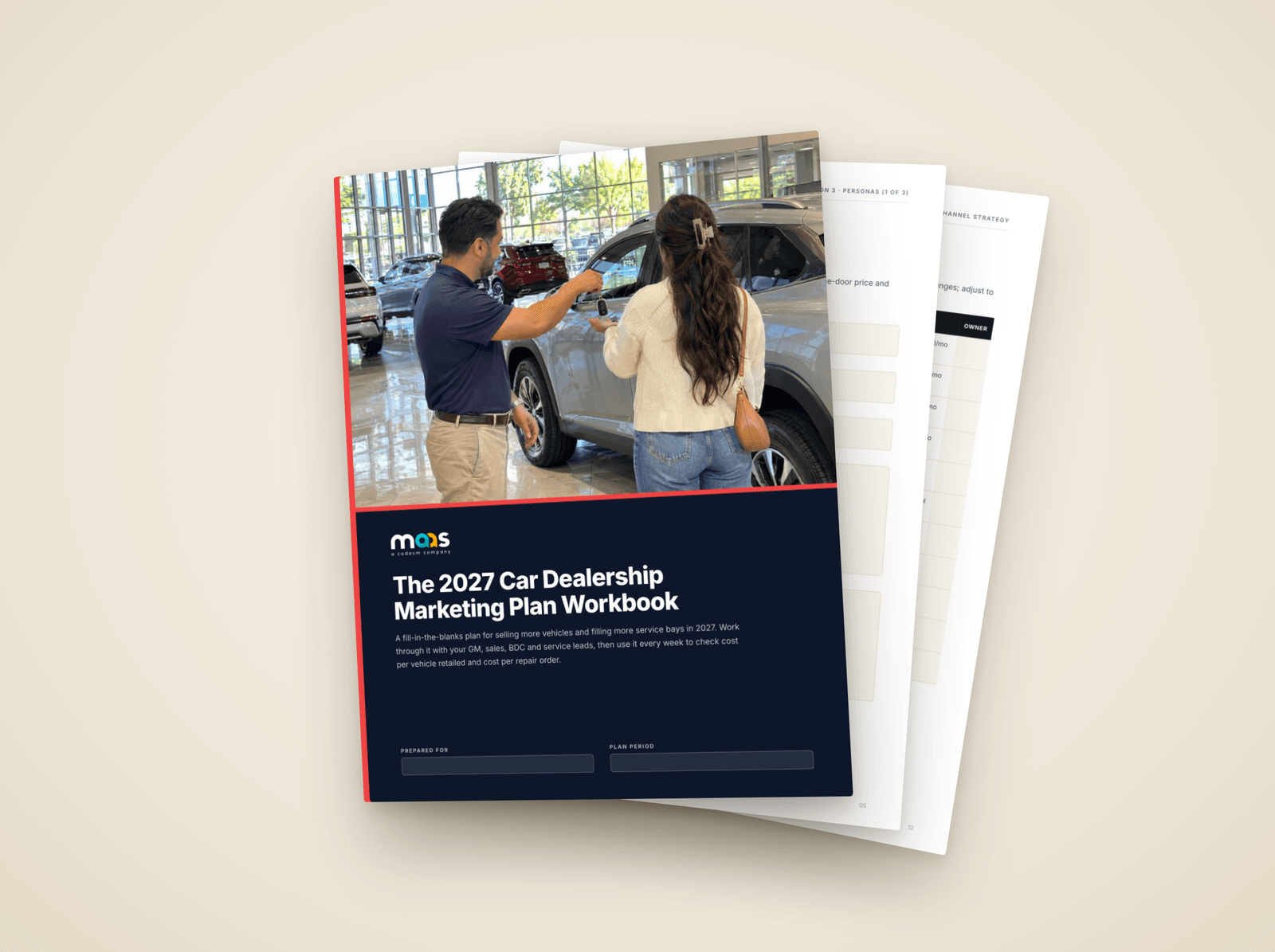
Click to download the free 2027 Car Dealership Marketing Plan workbook (PDF)
Why most car dealership marketing fails
Dealers rarely lack effort or budget. The failures are structural:
- The vendors write the plan. The website provider, the marketplace rep, the search agency and the OEM’s tier 3 program each report their own leads. Nobody owns the whole funnel, so the same buyer gets counted three times and nobody knows what a sold unit cost.
- Ads drift away from inventory. A unit that sold on Tuesday is still in a carousel on Friday, and the price in a Meta ad doesn’t match the vehicle page. That gap wastes clicks and is exactly what regulators look for.
- Leads die between the form and the BDC. In Pied Piper’s 2025 Internet Lead Effectiveness study, about 20% of website inquiries still got no personal response, and dealers used more than one contact path (email, phone and text) less than half the time.
- Fixed ops gets the leftovers. Service is the most predictable revenue in the building and the least marketed. Cox Automotive found dealerships now handle about 12% fewer service visits than they did in 2018, even though total service visits have grown.
- Co-op sets the message. When the OEM template becomes the whole calendar, every dealer in the region runs the same offer with a different logo.
A written plan fixes these by deciding who owns each stage of the funnel, what a sold unit and a repair order should cost to acquire, and how you’ll check it every week.
The 2027 economics of car dealership marketing
Start with NADA’s numbers, because your dealer principal already measures against them.
Where the average franchised store’s ad budget went in 2025 (NADA Data 2025):
| Medium | Average per dealership | Share |
|---|---|---|
| Search engine marketing | $123,698 | 21.1% |
| Third-party listing sites | $117,249 | 20.0% |
| SEO and website optimization | $114,318 | 19.5% |
| Social media advertising | $83,247 | 14.2% |
| TV | $61,556 | 10.5% |
| Radio | $40,451 | 6.9% |
| Direct mail | $32,830 | 5.6% |
| Newspaper | $12,311 | 2.1% |
| Total | $586,246 | 100% |
About three quarters of the average budget is now digital, and a fifth goes to marketplaces you don’t control.
Fixed ops is a business of its own. The average franchised dealership sold $9.69 million in service and parts in 2025, wrote 16,252 repair orders and averaged $494 per customer repair order. Service and parts were 13.3% of total dealership sales dollars, but they recur, and they feed the next sale: Cox puts the share of dealership service customers likely to buy their next car from the same store at 74%.
What clicks and leads cost. LocaliQ’s 2026 search benchmarks put general new-car dealers at a $2.48 average cost per click and $35.87 cost per lead, used-car dealers at $1.73 and $59.74, and auto service and repair at $6.42 and $42.10. On Meta, automotive lead campaigns averaged a $35.52 cost per lead. These are medians, and your brand and market will move them. Cost per sold unit matters more, and it depends on what happens after the lead arrives.
How buyers actually buy. In the same Cox study, only 7% of buyers bought entirely online and 53% completed every step at the dealership; 48% wanted to apply for credit online but only 33% did. The opportunity is letting buyers do the steps they want online, then making the visit short.
Reviews and AI answers. BrightLocal’s 2026 survey found 97% of consumers read reviews for local businesses, 74% only consider reviews from the last three months, and 45% now use ChatGPT or other AI tools for local recommendations. What AI assistants say about your store now affects showroom traffic; our AEO guide explains how they decide.
Channel benchmarks for 2027:
| Channel | What it is good for | Benchmark or typical cost |
|---|---|---|
| Google Search (brand, model, “near me”, service) | Buyers who already know what they want | New-car dealers $2.48 CPC and $35.87 CPL; service $6.42 CPC (LocaliQ) |
| Google Vehicle Ads (VLAs) | VIN-level ads with photo, price and mileage that click to your vehicle page | Pay per click from a Merchant Center vehicle feed, in Performance Max or Standard Shopping (Google) |
| Meta automotive inventory ads | Retargeting vehicle-page viewers, reaching in-market shoppers with live inventory | Auto lead campaigns $35.52 CPL (LocaliQ) |
| Third-party marketplaces | Used and CPO exposure, price-comparison shoppers | About $117,000 a year for the average franchised store (NADA) |
| SEO, Google Business Profile, vehicle pages | Model and service searches, map pack, AI answers | About $114,000 a year for the average store (NADA) |
| Service retention (email, SMS, reminders) | Customer-pay repair orders and the next sale | Planning range: $1,500–$6,000/mo per rooftop |
| TV, radio, streaming audio and CTV | Reach, events, brand recall | TV about $62,000 and radio about $40,000 a year for the average store (NADA) |
| Direct mail and equity mining | Lease-end, equity and conquest offers to known households | About $33,000 a year for the average store (NADA) |
Rules to know before you market
Dealership advertising is one of the most regulated forms of local marketing. This is a practical summary, not legal advice: have your compliance lead or dealer attorney review your ad templates.
- The CARS Rule is gone; pricing enforcement isn’t. The Fifth Circuit vacated the CARS Rule on January 27, 2025 on procedural grounds, before it ever took effect. The FTC kept enforcing Section 5 of the FTC Act instead. In March 2026 it warned 97 dealership groups that advertised prices must include all mandatory fees, and in September 2026 it published price transparency FAQs saying the advertised price must be one a consumer can actually pay, excluding only government charges. Leaving out required fees, rebates not everyone qualifies for, prices that require dealer financing and unavailable vehicles are among the practices it named.
- State law can go further. California’s CARS Act (SB 766) took effect on October 1, 2026. It requires the total price in any ad that references a specific vehicle or financing terms and in the first written communication with a buyer, add-ons disclosed as optional, a three-business-day cancellation right on used vehicles priced at $50,000 or less, and two years of records on ads and pricing communications.
- Finance ads have trigger terms. Under Regulation Z, stating a down payment, the number of payments, a payment amount or a finance charge requires also disclosing the down payment, the repayment terms and the APR.
- Lease ads have their own. Under Regulation M, stating a payment amount or an amount due at signing (or that nothing is due) requires stating that it’s a lease, the total due at signing, the number, amount and timing of payments, whether a security deposit is required, and that end-of-term charges may apply. “$299 a month” on a social graphic counts.
- Texts and calls need consent. Marketing texts and calls sent with an autodialer or prerecorded voice need prior express written consent under the TCPA. The FCC’s one-to-one consent rule was vacated by the Eleventh Circuit in January 2025, but opt-outs made by any reasonable means must still be honored within 10 business days, and the FCC narrowed its “revoke all” rule in September 2026. Put consent language on every lead form.
- Credit offers change targeting. Ads built around a financing offer can fall under Google’s consumer finance personalized ads policy (no targeting by age, gender, parental status, marital status or ZIP code in the US and Canada) and Meta’s Financial Products and Services special ad category, which restricts audiences in a similar way.
- OEM co-op has its own rulebook. Most programs require pre-approval, brand standards, specific disclaimers and claim deadlines. Build the calendar around its submission dates.
The 10-section car dealership marketing plan
The workbook has a fillable page for each of these sections.
1. Business snapshot
One page: rooftops and brands, new, used and CPO mix, average monthly retail units, service bays and technicians, monthly repair orders, primary market area (the ZIP codes your sales actually come from, pulled from the DMS), CRM and DMS, current advertising cost per vehicle retailed, and co-op funds available. Then one sentence on why someone should buy or service here instead of at the same-brand store 20 minutes away. If the honest answer is “price,” the plan has to build something else.
2. SWOT analysis
Strengths: inventory depth on a popular model, a long-tenured service team, a lead in reviews. Weaknesses: response time, thin used-car photos, a service drive booked two weeks out. Opportunities: a competitor’s slow BDC, an underserved Spanish-speaking market, lease maturities in your area. Threats: same-brand dealers advertising below you, independents winning out-of-warranty work, and compliance gaps in your ad templates.
3. Buyer personas
Three personas cover most stores:
- The Model Researcher. Knows the make, the model and probably the trim. Compares two or three dealers on out-the-door price, availability and reviews, using OEM sites, Google, marketplaces and, more and more, AI overviews. The store with the clearest vehicle page and the fastest real answer wins.
- The Payment Shopper. Shops a monthly payment more than a vehicle, often used or CPO, often with credit questions. Wants to know they’ll be approved before driving over. Online credit applications, trade-in estimates and payment examples with compliant disclosures move this buyer.
- The Service Customer. Owns a 3–10 year old vehicle and is choosing between you, an independent shop and a quick-lube chain. Price clarity, online scheduling, updates during the visit and transportation options matter more than the badge. This is also your best next-sale prospect.
For each, write down household, vehicle and price band, credit situation, research channels, decision criteria, and what wins or loses them.
4. Competitive analysis
Pick the five stores you actually lose deals and repair orders to (usually two same-brand dealers, a cross-brand competitor, a used-car superstore and an independent service shop). Compare them on Google rating and reviews from the last 90 days, inventory count and price position on marketplaces, vehicle page quality (photos, video, full price shown), lead response time from a mystery shop, service pricing and online scheduling, and paid presence (VLAs, Meta inventory ads, marketplace placement). Then write one line on where you can win.
5. Positioning statement
One sentence:
“For [target buyer], [dealership] is the [category] that [differentiator] because [reason to believe].”
Example: “For working families in Cedar County who need a reliable SUV without losing a Saturday, Ridgeway Toyota is the dealer that gets you from first message to keys in under two hours, because every vehicle page shows the full price, credit decisions come back online the same day, and one advisor stays with you through your first service.”
6. Goals and KPIs
Set three to five SMART goals tied to sold units and repair orders, not clicks. Examples:
- Cut advertising cost per new vehicle retailed from $810 to $720 by Q4 2027 while holding volume
- Respond personally to 95% of web leads within 15 minutes during open hours, by phone plus text or email, by March 2027
- Raise appointment show rate from 52% to 62% by Q3 2027
- Grow customer-pay repair orders 10% year over year
- Earn 40 new Google reviews per rooftop per month and hold a 4.6 or higher rating
- Book 35% of service appointments online by year-end
Each goal gets an owner and a weekly check-in.
7. Customer journey map
- Trigger. Lease maturity, a big repair estimate, a new job, a growing family.
- Research. Model reviews, YouTube, OEM sites, AI overviews, payment calculators.
- Shortlist. Marketplaces, VLAs, Google Maps, a review scan.
- Vehicle page. Photos, full price, history report, availability. This is the real showroom.
- First contact. Form, chat, call or text. Response time and a real answer decide what’s next.
- Appointment and test drive. Text confirmation, vehicle pulled up and ready.
- Deal and finance. Trade, credit and F&I, with the online steps already done.
- Delivery. Walkaround, tech setup, a photo with permission, a review request.
- First service. The handoff from sales to service, where retention is won or lost.
- Loyalty and next vehicle. Maintenance reminders, equity alerts, lease-end outreach, referrals.
Most dealers spend heavily on stages 2 to 5 and little on 8 to 10, which is where most service revenue and the next sale come from.
8. Channel strategy
| Channel | Role | Cadence | Typical investment |
|---|---|---|---|
| Google Search | Brand, model, “near me” and service intent | Always on, weekly search-term review | $6,000–$20,000/mo |
| Google Vehicle Ads | VIN-level shopping ads | Always on, feed syncs daily | $3,000–$12,000/mo |
| Meta inventory and video ads | Retargeting, in-market reach, events | Always on plus event bursts | $3,000–$10,000/mo |
| Third-party marketplaces | Used and CPO exposure | Monthly package review | $5,000–$15,000/mo |
| SEO and model pages | Organic model, comparison and service traffic | 4–8 pages/month | $2,500–$8,000/mo |
| Google Business Profile and Apple Business Connect | Map visibility for sales, service and parts | Weekly posts and photos | Time plus review tool |
| Reviews program | Volume, recency, responses | Daily requests, replies within 48 hours | $300–$1,000/mo |
| Service retention (email, SMS, reminders) | Customer-pay ROs, recall work | Weekly campaigns plus triggered reminders | $1,500–$6,000/mo |
| CRM equity mining and lease-end | Next vehicle from current customers | Monthly lists, triggered alerts | Tool plus BDC time |
| Radio, streaming audio, CTV | Reach and event support | Event flights | $3,000–$15,000/mo |
| Direct mail | Equity, conquest, service win-back | Monthly or quarterly drops | $0.60–$1.50 per piece |
These are planning ranges for one franchised rooftop; adjust to your volume and use co-op where it applies. Feed VLAs and Meta from the same inventory source so a sold unit disappears everywhere at once, and track calls with dynamic number insertion so phone leads get credited.
9. Content strategy and calendar
A workable mix: about 60% short video, 20% model and comparison pages for search, and 20% community and team content. Aim for 4–6 social posts a week and 2–4 new model or comparison pages a month. Categories to rotate:
- Walkaround videos. 30 to 60 seconds on a specific unit, shot by a real salesperson.
- Model comparisons. “Which three-row SUV fits a family of five,” answering what buyers ask AI assistants.
- Payment and lease explainers. Lease versus finance, what “due at signing” means, with disclosures whenever a number appears.
- Service tips. Tires before winter, AC before summer, recall checks.
- The team. Advisors, technicians and the BDC person who answers the text.
- Delivery moments. Keys-in-hand photos, shared with permission.
- New arrivals and launches. Timed to OEM launch windows.
- Community. Sponsorships, school partnerships, events at the store.
Anchor the calendar to tax refund season (February to April), Memorial Day, July 4, Labor Day, model-year changeover and year-end, then layer in OEM incentive windows and co-op deadlines.
10. Budget allocation and measurement
A franchised rooftop spending about $50,000 a month (close to NADA’s 2025 average) might split it like this:
- Google Search and Vehicle Ads: $13,500 (27%)
- Third-party marketplaces: $9,500 (19%)
- Meta inventory and video ads: $7,500 (15%)
- SEO, content, Business Profile and reviews: $6,500 (13%)
- Service retention: $4,500 (9%)
- Radio, CTV and direct mail: $5,500 (11%)
- Testing reserve: $3,000 (6%)
The testing reserve lets you move money to what’s working mid-event instead of next month.
Measurement: match sold units and repair orders back to lead source every month in the CRM and DMS, track calls with dynamic numbers, send vehicle page views and lead events to GA4, watch Merchant Center feed diagnostics, and record booking source in the service scheduler. The weekly dashboard: advertising cost per vehicle retailed (rolling 30 days), deduplicated leads by source, first response time, appointment set and show rates, close rate by source, days in stock, online service bookings and customer-pay ROs, and new reviews per rooftop.
Common mistakes to avoid
- Paying for leads instead of sold units. A $25 lead that never buys costs more than a $90 lead that does. Judge channels on cost per vehicle retailed after a monthly sales match-back.
- Advertising a price nobody can pay. Dealer fees, conditional rebates and “with dealer financing” prices are what the FTC letters named. Fix the template once and every ad inherits it.
- Payment numbers without disclosures. A monthly payment in a Reel triggers the same Regulation Z or M disclosures as a newspaper ad.
- Inventory ads on a stale feed. Sync daily and audit a sample of ads against vehicle pages each week.
- Treating the BDC as a call center. Response time, scripts and consent capture are marketing outcomes. Mystery-shop your own store monthly.
- Marketing service only when the bays are empty. Retention runs on maintenance intervals, recalls and seasons. Make it always on.
- Never checking what AI assistants say about you. Ask ChatGPT, Gemini and Google which dealer to buy your brand from in your city. If they name a competitor, the reasons usually trace back to reviews and listings you can fix.
Where to start if you’re starting from scratch
Don’t build all ten sections in one weekend:
- Week 1. Sections 1, 3 and 5: snapshot, personas and positioning. Pull 90 days of sold units and repair orders by source from the DMS. Three hours.
- Week 2. Clean up Google Business Profiles for sales, service and parts (where brand guidelines allow separate listings) and Apple Business Connect. Start daily review requests. Four hours.
- Week 3. Compare five live ads with their vehicle pages against the FTC FAQs, fix the templates, and add finance and lease disclosure blocks. Four hours.
- Week 4. Mystery-shop your BDC and two competitors. Set a response-time standard and add consent language to every form. Three hours.
- Month 2. Launch or clean up VLAs and Meta inventory ads from one feed. Restructure search by brand, model, used and service.
- Month 3. Build the weekly dashboard and the monthly sales match-back. Renegotiate or cut marketplace packages based on cost per sold unit.
- Quarter 2. Launch the service retention program, lease-end and equity outreach, and the first model comparison pages.
- Year 1. Annual review. Reallocate budget by cost per vehicle retailed and cost per repair order.
Car dealership marketing plan FAQ
How much should a car dealership spend on marketing? NADA’s benchmark is the place to start: the average franchised dealership spent $739 per new vehicle sold in 2025, about $586,000 for the year, and $791 per new vehicle in the first half of 2026. Most dealers budget per unit retailed by department and plan service marketing separately, then adjust based on cost per sold unit.
How do car dealers advertise? Mostly digitally. In NADA’s 2025 data, search marketing, third-party listing sites and SEO each took about a fifth of the average budget, social media about 14%, and TV, radio, direct mail and newspaper shared the rest.
What are some effective marketing ideas for a car dealership? Live-feed inventory ads on Google and Meta, walkaround videos of specific units, fast multi-channel lead response, a steady review program, model comparison pages, service reminders tied to maintenance intervals, and equity and lease-end outreach to existing customers.
What are the 5 P’s of a marketing plan for a dealership? Product (your inventory mix and service offer), price (transparent and compliant), place (your market area and which steps happen online), promotion (channels and offers) and people (the BDC, salespeople and service advisors who turn interest into deals).
What is the 70/20/10 rule for a marketing budget? Put about 70% into channels with a proven cost per sold unit, 20% into promising channels you are scaling (for example VLAs or CTV), and 10% into tests. Review the split each quarter.
Download the full template
The fillable PDF workbook is the companion to this guide. Inside:
- How to use the workbook
- Business snapshot
- SWOT analysis
- Three persona templates (Model Researcher, Payment Shopper, Service Customer)
- Competitive analysis matrix (5 competitors)
- Brand positioning canvas with a worked example
- Goals and KPI tracker with a monthly check-in
- Customer journey map (10 stages)
- Channel strategy matrix
- Content framework and 30-day content calendar
- Budget allocation worksheet with an example split
- Tech stack checklist and weekly measurement dashboard
- 12-month action plan
- Common mistakes checklist and quick-start plan
Download the 2027 Car Dealership Marketing Plan workbook (PDF)
If you’d rather have a team run this for you, from inventory ads and co-op campaigns to service retention, reviews and weekly reporting, that’s what the automotive marketing team at MaaS by CodeSM does, the same kind of work we’ve done for luxury franchise stores like Acura of RGV and Mercedes-Benz of San Juan. Get in touch and we’ll audit where you are and map the plan.
Share this article